Peru Country Facts At-a-Glance
Geography: Located in South America, Peru is bordered by the Pacific Ocean to the west, Ecuador to the north, Chile to the south, and Colombia, Brazil, and Bolivia to the east. Peru’s geography includes one of the driest deserts in the world, the rugged Andes Mountains, and the dense jungle of the Amazon Rainforest.
Capital City: Lima
Population: 33.7 million (2023 est.)
Languages: Spanish 82.6%, Quechua 13.9%, Aymara 1.7%, Ashaninka 0.3%, other native languages (includes a large number of minor Amazonian languages) 1.5%
Religions: Roman Catholic 60%, Evangelical 14.6%, other 3.3%, unspecified or none 22.1% (2020 est.)
Ethnic Groups: Amerindian 26%, mestizo (mixed Amerindian and white) 60%, white 6%, black, Japanese, Chinese, and other 8%
Life Expectancy: 77 years
Literacy Rate: 94.5% (2023 est.)
Government: Constitutional republic
Suffrage: 18 years of age; universal and compulsory until age 70
Current Head of State: President Dina Boluarte (since December 7, 2022). The President is elected by popular vote for a five-year term and is eligible for non-consecutive re-election.
Independence: July 28, 1821 (from Spain)
Currency: Peruvian sol (PEN)
GDP per Capita: $14,000 USD (2023 est.)
Unemployment Rate: 6.5% (2023 est.)
GDP – Composition by Sector:
- Agriculture 7.4% – coffee, cocoa, cotton, sugarcane, rice, potatoes, corn, plantains, a variety of fruits, medicinal plants, palm oil, wheat, poultry, beef, pork, dairy products, guinea pigs, fish
- Industry 34.1% – mining and refining of minerals, petroleum extraction and refining, fishing and fish processing, cement, glass, textiles, clothing, food processing
- Services 58.5% – information technology services, software, tourism, finance, telecommunications
Source: CIA World Factbook
Peru Country Basics
Peru is almost twice the size of the U.S. state of Texas with a population of nearly 34-million people. It’s bordered by the Pacific Ocean to the west, Ecuador to the north, Chile to the south, and Colombia, Brazil, and Bolivia to the east. Peru has many climates including desert, mountain and tropical, which enables the nation to have a high level of biodiversity.
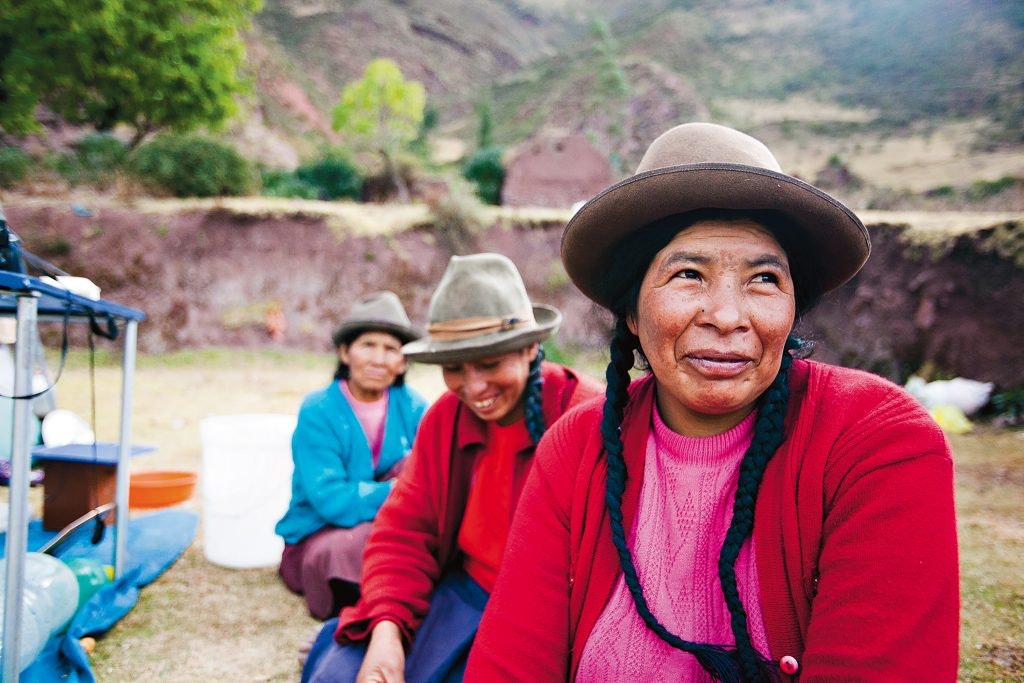
In addition, the country has a large number of indigenous people. Overall, about 45% of Peru’s population are members of groups like the Quechua.
Brief History of Peru
Peru is most famous for being home to the Incan Empire, the largest pre-Colombian civilization in the Americas. However, hundreds of Pre-Incan cultures populated Peru long before the Incan empire and contributed to their many world renowned achievements.
The Incan Empire prospered until 1532 when it was attacked by Francisco Pizarro and his army of Spanish conquistadores. Battles between the Incas and the Spanish lasted until the establishment of the Viceroyalty of Peru in the 1570s.
After decades of Spanish rule, Peru declared independence in 1821. Led by the famous liberator, Simon Bolivar, successfully defeated the Spanish forces by 1824. For over a century, Peru shifted between military dictatorships and democratically elected governments and suffered from severe inflation and economic stagnation.
In the early 1990s, economic collapse combined with growing social discontent fueled the emergence of insurgent movements for Marxist reform. Alberto Fujimori, the president of Peru, retaliated against these violent uprisings with a strong hand and was able to defeat the rebel groups before the end of the decade.
In June 2011, former military commander Ollanta Humala was elected president, defeating Keiko Fujimori, the daughter of Alberto Fujimori. Since his election, Humala has carried on the market-oriented economic policies of the three preceding administrations.
Language
Peru has three official languages. Spanish is the most widely used and is spoken by about 83% of the population. The native language of Quechua is spoken by nearly 14% and Aymara is spoken by less than 2%. In addition, there are dozens of other indigenous languages, particularly in the Amazon regions.
Before traveling to the country, it’s helpful to have some Spanish phrases ready to go. Here are a few words and phrases that may help:
Greetings:
- Hello / Hola
- How are you? / ¿Cómo estás?
- Good / Bien
- Good morning / Buenos días
- Good afternoon / Buenas tardes
- Good night / Buenas noches
- Welcome / Bienvenido
- Goodbye / Adiós
Etiquette:
- Please / Por favor
- Thank you / Gracias
- Excuse me / Perdón
- Sorry / Lo siento (perdón)
Pronouns:
- I / Yo
- You / Tú
- He/she / Él/ella
- We / Nosotros
- You (plural) / Ustedes
- They / Ellos/ellas
Conversational:
- What is your name? / ¿Cómo te llamas?
- My name is ___. / Me llamo ___.
- Where are you from? / ¿De dónde eres?
- I am from ___. / Yo soy de ___.
- How old are you? / ¿Cuántos años tienes?
- I am ___ years old. / Tengo ___ años.
- Do you speak English? / ¿Hablas inglés?
- I speak a little Spanish. / Hablo un poco de español.
- Could you repeat that please? / Repite por favor.
- How do you say ___ in Spanish? / ¿Cómo se dice ___ en español?
- I don’t understand. / No entiendo.
- I want to go to ___. / Yo quiero ir a ___.
- Where is ___? / ¿Dónde está ___?
- I would like ___. / Yo quisiera ___.
- How much is it? / ¿Cuánto vale ___?
Present Tense:
- To want / Querer
- I want / Yo quiero
- You want / Tú quieres
- He/she wants / Él/ella quiere
- You (plural) want / Ustedes quieren
- They want / Ellos/ellas quieren
- We want / Nosotros queremos
Feelings:
- I am ___. / Estoy ___.
- angry / Estoy enojado.
- happy / Estoy feliz.
- sad / Estoy triste.
- cold / Tengo frío.
- hot / Tengo calor.
- sleepy / Tengo sueño.
- hungry / Tengo hambre.
- thirsty / Tengo sed.
*Use the verb tener (to have) instead of estar (to be)
Quechua Phrases
Here are some Quechua phrases that may come in handy while interacting with local indigenous people.
- Good morning: Allin p’unchay
- Good afternoon: Allin sukha
- Good night: Allin tuta
- Goodbye: Tupananchiskama
- How are you? ¿Allillanchu?
- Thank you: Solpayki

Currency
The official currency of Peru is the nuevo sol (S/). It’s divided into 100 céntimos. One U.S. dollar will get you about 3.75 Peruvian nuevo soles. With that exchange rate, you may benefit from using an exchange calculator for quick calculations.
In the country, paper bills have denominations of 10, 20, 50, 100 or 200 soles, though it’s better to carry the smaller denominations. Coins come in values of 1, 2 and 5 soles, along with 10, 20 and 50 céntimos. Like a number of other countries in the Americas, U.S. dollars are accepted at a number of places.
Counterfeiting is a large problem in Peru. Therefore, you may need to study the currency appearance so you could possibly spot fake money. There also are scams such as short changing, which is one of the reasons you’ll want to use smaller denominations.
Haggling is also common in Peru. Prices for tourists can be inflated, so that is when negotiating can come into play. However, it’s also good not to take it too far and to respect artisans by giving them a fair price.
![]()


