


Safety at Rustic Pathways is one connected operating system: every operated program has a written risk plan, screened and trained Program Leaders supervise students, defined medical-review rules govern complex needs, and the crisis system assigns response functions and roles.
Below are the controls, who performs them, when they happen, and where parents can verify the detailed standard for Rustic Pathways’ Teen Travel Programs, Gap Year Programs, and School Group Travel Programs in 38 countries.
Is Rustic Pathways Safe?
Yes, Rustic Pathways is safe. In the completed 2025 season it recorded 8.9 escalated reports per 1,000 traveler records, about 1 in 112.
Across measured 2025 and 2026 Student Travel groups, the median was one staff member per 4.37 students, and no measured group exceeded 7 students per staff member.
Every Program Leader completes more than 80 hours of training, and a board-certified Medical Director has reviewed complex cases since 2015.
Every Program Leader also passes a Sterling background check and sex-offender registry review and holds CPR and First Aid certification. Rustic Pathways assumes duty of care at the first staff handoff and keeps it through end-location departure.
Enrolled families receive a 24/7 emergency number and WhatsApp access to the in-country Country Director.
Families can inspect the controls, denominators, and historical results below.
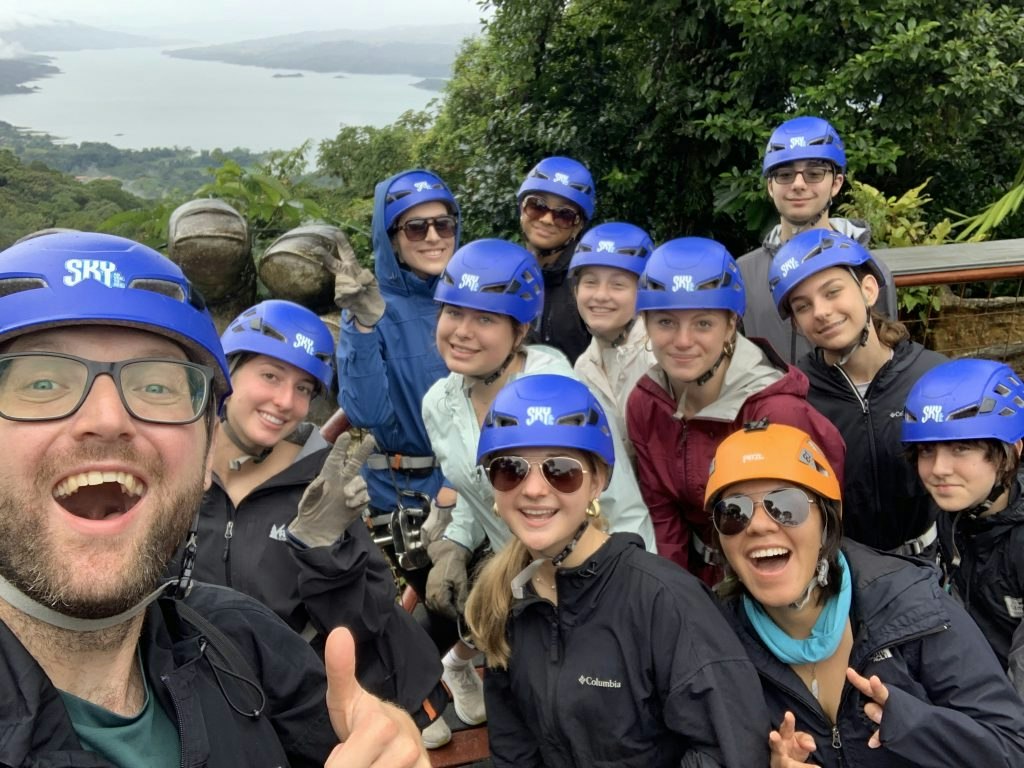
How Rustic Pathways’ Teen Travel Safety System Works
Rustic Pathways teen travel safety works by organizing around seven operating layers, from written program risk plans through supervision, medical review, crisis response, and incident reporting. The seven layers, in operating order:
- Program design: every program operated has a written Program Risk Management Plan that covers accommodation, transport, food and water, activities, environment, cultural and political conditions, and student interactions and behaviors.
- Partner control: third-party vendors are vetted through a three-tier, risk-based screening process, and high-risk vendors require an on-site Rustic Pathways inspection.
- Traveler accountability: direct, indirect, and remote supervision rules define staff presence, handoffs, headcounts, buddy groups, meeting points, and check-in times.
- Supervision: screened and trained Program Leaders remain responsible for students throughout the program.
- Whole-student care: disclosed health needs, Medical Director review rules, medication tracking, mental-health preparation, and safeguarding policies work together.
- Crisis response: The crisis system defines six response functions and 12 response roles, while every Program Leader carries emergency equipment and has authority to respond. Rustic Pathways conducts crisis simulations twice each year, and operating locations conduct safety drills monthly.
- Communication and learning: parents receive severity-based updates, and the classified incident record provides a consistent reporting structure.
Go deeper:
- Seven steps Rustic Pathways uses to keep students safe: the short version of these layers.
- Whether teen travel programs are safe: the answer for the category as a whole.
2026 Year-to-Date and Historical Incident Data
Current 13-year record: Rustic Pathways reports 4,139 incident reports across 57,079 traveler records from 2014 through 2026 year-to-date, with an August 26, 2026 cutoff. The record contains 3,619 GREEN, 500 YELLOW, 9 RED, and 11 BLACK reports.
The 520 reports above GREEN equal 9.11 escalated reports per 1,000 traveler records, or about 1 in 110.
2026: Rustic Pathways reports 62 incident reports across 1,479 traveler records.

Year-by-Year Record, 2014 to 2026
| Year | GREEN | YELLOW | RED | BLACK |
|---|---|---|---|---|
| 2014 | 269 | 7 | 0 | 0 |
| 2015 | 406 | 86 | 1 | 1 |
| 2016 | 389 | 63 | 0 | 1 |
| 2017 | 519 | 63 | 3 | 0 |
| 2018 | 608 | 68 | 1 | 0 |
| 2019 | 682 | 107 | 0 | 2 |
| 2020 | 16 | 9 | 0 | 0 |
| 2021 | 93 | 23 | 1 | 1 |
| 2022 | 154 | 17 | 0 | 0 |
| 2023 | 173 | 18 | 0 | 2 |
| 2024 | 122 | 8 | 1 | 1 |
| 2025 | 142 | 18 | 1 | 1 |
| 2026 year to date | 46 | 13 | 1 | 2 |
| Total | 3,619 | 500 | 9 | 11 |
2026 Year-to-Date Breakdown
| Level | Count | Share of reports |
|---|---|---|
| GREEN | 46 | 74.2% |
| YELLOW | 13 | 21.0% |
| RED | 1 | 1.6% |
| BLACK | 2 | 3.2% |
| Total | 62 | 41.9 reports per 1,000 traveler records |
Sixteen 2026 reports are above GREEN. Using 1,479 traveler records as the supplied denominator, that is 10.8 escalated reports per 1,000 traveler records, or approximately 1 in 92.
Two BLACK reports, external events affecting a program, were logged in 2026 year to date, against 9 across the 12 completed years from 2014 through 2025.
Completed 2025 Incident Breakdown
| Level | Count | Share of reports | Definition |
|---|---|---|---|
| GREEN | 142 | 87.7% | Minor; group remains intact; first aid, rest, or over-the-counter treatment |
| YELLOW | 18 | 11.1% | Significant; may separate from the group; medical facility and parent notification |
| RED | 1 | 0.6% | Life-threatening or emergent; emergency response and possible evacuation |
| BLACK | 1 | 0.6% | External event affecting a program |
| Total | 162 | 100% | 72.1 reports per 1,000 traveler records |
Escalation Math
Under the escalation definition, any report above GREEN, 2025 had 18 YELLOW, 1 RED, and 1 BLACK reports, or 20 escalated reports.
With 2,247 traveler records as the denominator, that is 8.9 escalated reports per 1,000 traveler records, or approximately 1 in 112.
How to Read the Record
Traveler records are student-program participations, not unique people. A separate traveler record is created for each participation.
If a student participates in multiple programs, the same individual is counted as a unique participant on each program session.
Severity percentages use incident reports as the denominator; historical rates per 1,000 use student-program participations as the denominator.
Every incident is classified under written definitions, and parent notification is recorded on the incident record itself, including the date of notification.
The complete safety FAQ answers the most common parent questions about the record.

Which Safety Claims Can Families Verify?
Families can check an A+ BBB rating, WYSE membership, Viristar training completion, and a 2024 Magellan safety award.
| Evidence | Current status | What it supports |
|---|---|---|
| Better Business Bureau | A+ BBB business rating, and a BBB Accredited Business since January 14, 2026; independently checkable on the current BBB profile. | A current, externally checkable business rating. |
| WYSE Travel Confederation | Full member, listing verified August 26, 2026; independently checkable on WYSE. | Participation in an international youth and student travel association. |
| Viristar risk-management training | Twenty-three Rustic Pathways program-leadership staff completed Viristar’s month-long Risk Management for Outdoor Programs certification course, reported by Viristar on February 18, 2026. | Twenty-three program-leadership staff completed an external risk-management course. |
| ISO 31030:2021 | Rustic Pathways describes its travel-risk work as moving toward alignment. | The standard provides a recognized reference point for travel risk management. |
| Published incident record | Rustic Pathways publishes its own incident classifications and historical counts. | Families can inspect frequency, severity, definitions, and denominators. |
| Corporate liability insurance | For the May 24, 2026 through May 24, 2027 policy term, Rustic Pathways carries $5 million in General Liability and Products Liability coverage per occurrence and in the policy aggregate. | Documents current corporate liability coverage. |
| Travel Weekly Magellan Awards | 2024 Magellan Gold Award for Outstanding Health & Safety Innovations. | Provides independently checkable recognition of a Rustic Pathways safety initiative. |
When any provider cites an audit, ask for the auditor, standard, scope, fieldwork date, findings, and remediation status.
Go deeper:
- Accreditation, membership, and external training evidence: the current list.
What Gets Checked Before a Trip Runs?
Before a trip runs, every operated program has a written Program Risk Management Plan, and any hazard scoring above 5 is not accepted into it. The plan records hazards, likelihood, potential outcomes, preventive controls, and the planned response.
A score of 6 requires reassessed controls or cancellation of the activity, and applicable activity standards are copied into the plan in full.
Rustic Pathways monitors U.S. State Department advisories, CDC and WHO health notices, and disaster alerts for every country on its program roster, answers advisory changes through a four-level response ladder, and publishes dated position statements when destination risk changes.
| Area | Before students arrive | During the program | Failure response |
|---|---|---|---|
| Itineraries and activities | The written plan covers seven hazard categories and maps risks across meals, activities, transport, and accommodation. | Direct, indirect, and remote supervision rules define the required staff presence, boundaries, meeting points, buddy groups, and emergency contact procedures. | A score of 6 requires reassessed controls or cancellation. Families can also review the published prohibited activity list. |
| Vendors and activity operators | Rustic Pathways classifies vendors along three risk tiers. High-risk vendors require an on-site Rustic Pathways inspection. Every activity vendor completes a formal safety assessment before use and is re-assessed every one to two years. | A re-assessment is triggered early by 50 percent staff turnover, a change of business ownership, or any incident requiring emergency medical care. The vendor guideline sets preferred general liability minimums of $500,000 per incident for low-risk activities and $1 million per incident for medium- and high-risk activities, with deviations reviewed by the Director of Operations. | Vendors are suspended for refusing the vetting process, failing assessment requirements, failing to maintain assessed safety standards, repeated negative performance feedback, or an incident involving significant injury, equipment damage, or loss of insurance or license. The Director of Operations is alerted whenever a vendor has an incident or fails safety criteria. |
| Vehicles and drivers | Rustic Pathways requires seat belts on all ground transportation and life vests on all water vessels. Staff who drive students hold a valid in-country driver’s license and pass a motor vehicle background check. | Night driving is prohibited outside approved urban routes. A documented pre-trip vehicle inspection is required every day students are transported. | Any staff member may stop any vehicle judged unsafe and remove students immediately. United States drivers of vehicles over 10,000 pounds follow DOT hours of service: a 10-hour drive limit, a 15-hour on-duty limit, and 70 hours in 8 days. |
| Accommodation and homestays | Homestays complete a 26-point assessment across Property, Security, Safety Systems, Sanitation, and Policy Compliance. | Every student receives an individual bed, and gender-separated student rooms generally sleep two to five students. | Exact accommodation details remain itinerary-specific. |
Go deeper:
- Vendor, transportation, and accommodation standard: the three risk tiers and the suspension criteria.
- Subcontractor risk-management standard: the same vetting for activity operators.
- Homestay vetting guide: the 26-point homestay assessment.

How Are Medical, Mental-Health, and Inclusion Needs Handled?
A board-certified emergency physician has served as Rustic Pathways Medical Director since 2015, reviewing complex conditions, refrigerated medication, and recent acute mental-health concerns before travel. The published system combines Medical Director review rules, traveler-specific planning, trained field staff, medication tracking, and defined escalation.
Dr. William R. Smith is a board-certified emergency physician and a United States Army colonel. Smith is the Rustic Pathways Medical Director.
| Need | Before travel | On program | Escalation |
|---|---|---|---|
| Medical conditions and allergies | A diagnosis alone does not disqualify a student. Complex or unstable conditions, refrigerated medication, and recent acute mental-health concerns require Medical Director review. | Rustic Pathways can accommodate disclosed asthma, diabetes, ADHD, anxiety, and allergies, and trained staff carry emergency epinephrine. | Conditions outside the documented plan route to the Medical Director and the applicable incident-response process. |
| Medication | Medication needs are disclosed before departure, and refrigerated medication requires Medical Director review because refrigeration is itinerary-dependent. | Students self-carry and self-manage daily medication with Program Leader tracking. | Complex or unstable medication needs route to the Medical Director. |
| Mental and emotional health | Families can disclose anxiety and other support needs. Recent acute mental-health concerns require Medical Director review. | Program Leaders receive Youth Mental Health First Aid training, and each student receives an individual one-to-one check-in within 24 hours of arrival. | Concerns that exceed the field plan route to the Medical Director and the applicable incident-response process. |
| Bullying, discrimination, and inclusion | Rustic Pathways develops annual DEIA, cultural-sensitivity, and LGBTQ+ competency training in consultation with Gender Spectrum. | Rustic Pathways uses Two-Deep Leadership so a single staff member is not alone with students. The staff-side Zero-Tolerance Child Safeguarding Policy was established in February 2019 and is updated annually. | Graduated coaching, documentation, family communication, and support apply, while serious zero-tolerance violations can cause immediate dismissal. |
The child protection policy is maintained in dated editions; the January 2020 and February 2023 editions are on file.
Go deeper:
- Health and wellness operating standard: the Medical Director review rules.
- Inclusion, accommodation, and anti-bullying policy: the graduated-response ladder.
- Travel with medical conditions: condition-specific guidance.
- How programs handle homesickness
- Food-allergy guide: food planning.
- Teens with dietary restrictions
- Student travel vaccination guide: destination health preparation.
What Happens If a Teen Has a Medical Emergency?
The nearest Program Leader responds immediately with issued emergency equipment, and the Medical Director advises on complex cases.
- Immediate response: the nearest Program Leader uses the issued emergency equipment and acts in accordance with the Every-Leader Response Standard.
- Incident classification: the event is logged and classified as either GREEN, YELLOW, RED, or BLACK severity.
- Medical consultation: complex or unstable conditions and escalated health questions are routed to the Medical Director.
- Evacuation when required: a RED incident may require emergency response or evacuation.
- Family updates: parents receive updates as information becomes available until the situation is resolved.
Rustic Pathways requires every participant to carry medical insurance with coverage in the destination country. Travel insurance is separate, is not included in Program Tuition, and is strongly recommended rather than required.
Go deeper:
- Medical and emergency escalation process: the GREEN-to-BLACK classification and Medical Director routing.
- Student travel insurance guide: the required medical coverage.

Who Is Accountable for a Teen During Flights and Daily Travel?
Rustic Pathways assumes duty of care at the first staff handoff, or gateway-to-gateway on a chaperoned group flight, and keeps it through end-location departure. Families choose one of three flight models, and the handoff point changes with that choice.
| Flight model | In-transit responsibility | Arrival and handoff | If travel is disrupted |
|---|---|---|---|
| Chaperoned group flight | Rustic Pathways provides gateway-to-gateway custody on the chaperoned group flight. | After the flight, in-country supervision follows the applicable program operating standard through the end-location departure. | The live flight policy and enrollment terms govern disruption support and the chaperoned group flight fee. |
| Independent flight with support | The family, student, and airline retain responsibility until the first Rustic Pathways staff handoff. | Rustic Pathways assumes duty of care at the first staff handoff and keeps it through the end-location departure. | The live flight policy and enrollment terms govern Flight Support services and fees. |
| Self-managed flight | The family, student, and airline retain responsibility until the first Rustic Pathways staff handoff. | Rustic Pathways assumes duty of care at the first staff handoff and keeps it through the end-location departure. | The live flight policy and enrollment terms govern self-managed travel and out-of-window arrangements. |
A Safe Arrival email goes out within 12 hours.
Enrolled families also receive flight itineraries, arrival and departure windows, and a Wheels Up packet with arrival instructions, gateway details, contacts, and the program emergency number.
Go deeper:
- Flight, custody, and disruption guide: the Wheels Up packet, gateway details, and program emergency number.
- Whether to send a teenager abroad alone: deciding if a teen is ready.
- What solo travel means for teens: flying without a parent versus being unsupervised on program.
- Traveling with a group a teen does not know: social readiness.
- Whether parents should worry about international teen travel: broader concerns.
How Rustic Pathways Defines Supervision
Rustic Pathways’ operating manual distinguishes direct, indirect and remote supervision. The level of supervision determines staff presence, boundaries and the arrangements students must follow.
Remote supervision requires approval and planned safeguards. Families should receive the supervision arrangements that apply to their itinerary and the point at which Rustic Pathways assumes responsibility during travel.
The individual student check-in within 24 hours of arrival is separate from the Safe Arrival email sent to families.
How Students Are Accounted For on Program
Rustic Pathways uses Scout and Sweep: one Program Leader leads, another follows, and leaders use headcounts so no student is lost or left behind.
- At transition points: leaders count students before and after movements and establish meeting locations and times.
- During activities: remote supervision still requires a bounded area, buddy groups, staff presence, a meeting point, timekeeping, and emergency contact procedures.
- After arrival: each student receives an individual one-to-one check-in within 24 hours of arrival.
- At the end of the day: programs use nightly wellbeing debriefs and reflection circles.
Every student receives an emergency card at Day One Orientation naming their in-country staff contacts and local emergency numbers, with a help request translated into the local language.
How families stay in touch: Rustic Pathways uses staff accountability and direct communication instead of a live student GPS map. Enrolled families receive WhatsApp access to the in-country Country Director and a 24/7 emergency number for use during programs and travel days.
The student safety rules explain the buddy, check-in, and reporting requirements, set a substance-free standard, and define the graduated response that follows a breach.
Go deeper:
- MyRustic communication guide: the available channels.
How Are Program Leaders Selected, Prepared, and Overseen?
Every Program Leader passes a Sterling background check and sex-offender registry review, completes more than 80 hours of training, and holds CPR and First Aid certification. Program Leaders supervise students during activities, transportation, meals, accommodations, and structured free time.
Regional teams and local partners support them, but Program Leaders retain direct responsibility for student safety. Rustic Pathways runs a four-month new-Program-Leader selection process that begins each December and includes vetting, training, evaluation, and candidate winnowing.
Every Rustic Pathways program includes at least one leader with three or more years of field experience.
| Control | Published practice | Why it matters in the field |
|---|---|---|
| Screening | As of August 26, 2026, 100% of active Program Leaders had completed the required Sterling background check, National Sex Offender Registry review, and FBI fingerprinting, where required, with rechecks every 2 years. | Screening occurs before an adult receives responsibility for students. |
| Core preparation | Each Program Leader completes more than 80 hours of training, including more than 40 hours of in-person training. | The 80 hours apply to each Program Leader completing the current predeployment training cycle; the 40 in-person hours are the in-person component of that same cycle. |
| First-response credentials | As of August 26, 2026, all active Program Leaders in the 2026 field season held current CPR and First Aid certification. WFR certification is required on any program that is more than one hour from definitive medical care. A WFR is also required on any program with a Type 1 diabetic student in the group. About 40% of Program Leaders held WFR certification during the 2026 field season. | The universal requirement is CPR and First Aid; the two WFR staffing triggers are distance from definitive care and a Type 1 diabetic student in the group. |
| Local knowledge | Rustic Pathways reports that 92% of its seasonal staff are local to the countries where its programs operate. This does not mean every staff member is local or employed year-round. | The figure applies to the measured seasonal staff population, not to every staff member or every group. |
| Field redundancy | Every Program Leader carries emergency equipment and a location-specific emergency card with the nearest clinic or hospital, coordinates, and local emergency numbers. | A split group or occupied safety lead does not become a single point of failure. |
Evidence basis: These figures were verified against the active Program Leader roster on August 26, 2026. Screening was checked against Sterling, National Sex Offender Registry, and fingerprint records where required; CPR and First Aid were checked against credential expiry records; training hours were checked against the current curriculum and completion records.
Personnel records remain private.
Student Travel Supervision Levels
| Measure | Reported value | How to interpret it |
|---|---|---|
| Staffing pair | Median students per staff member: 4.37:1 · Maximum students per staff member: 7:1 | The median is calculated from measured group-level ratios, and no measured Student Travel group exceeded the maximum. |
Across measured 2025 and 2026 Student Travel groups, the median was one staff member per 4.37 students, and no measured group exceeded 7 students per staff member.
Go deeper:
- Program Leader screening, preparation, ratios, and role standard: the screening vendor, recheck cadence, and ratio method.
- Program Leader training guide: the 80-hour curriculum.
- Which background checks staff undergo
- Wilderness First Responder training: how it is used on remote programs.
- Student-to-staff ratio methodology
- Whether adults supervise teen tours
What Happens When a Group Splits?
The Every-Leader Response Standard keeps a trained adult, emergency equipment, local response information, and decision authority with each subgroup, the model described as distributed safety and the kit-per-leader standard.
How Crisis Response and Parent Communication Work
Above GREEN, the nearest Program Leader responds immediately and the crisis team activates. Parent communication follows the severity-based windows below.
Rustic Pathways’ crisis system defines six response functions and 12 response roles. One staff member can hold several of these roles at once.
What Activates an Escalated Response?
Rustic Pathways defines an escalation as any report above GREEN involving parent notification, medical consultation, or itinerary modification. Every Program Leader carries emergency equipment and is authorized to respond independently.
Communication by Severity
| Severity | Communication window | Policy note |
|---|---|---|
| Critical | Under 1 hour | Updates continue as information becomes available. |
| Serious | Under 4 hours | Updates continue as information becomes available. |
| Moderate | Under 24 hours | Updates continue as information becomes available. |
| Minor | Post-program summary | Included in the post-program summary. |
These windows are the stated policy.
Each update goes out once information is confirmed. Updates go out by phone and email.
Go deeper:
- How Rustic Pathways handles emergencies: the operating sequence.
- Parent safety guide: contact expectations.
- Search-and-rescue guide: the response context for remote locations.
- How a search-and-rescue doctor works in remote environments: the Medical Director’s field experience.
How Can Families Compare Teen Travel Providers on Safety?
Families can compare the safest teen summer programs on six evidence areas: program fit, staff assurance, prevention, response, safety record, and external assurance.
A defensible comparison cannot rely on a provider calling itself the safest. Academic residential programs, adventure camps, community service programs, and domestic or international travel programs should be compared within their actual operating model and risk exposure.
Named competitors are not ranked here, because their public incident definitions, denominators, and assurance scopes are not directly comparable.
| Comparison area | Evidence to request | Weak substitute |
|---|---|---|
| Program fit | Program type, ages, destinations, activity exposure, housing model, transportation, and supervision boundaries. | A general claim that every program uses one safety model. |
| Staff assurance | Hiring qualifications, background and reference checks, first-aid credentials, training completion, field oversight, and measured ratios. | Training-hour claims without completion records or a defined staff denominator. |
| Prevention | Itinerary risk assessments, activity standards, vendor and subcontractor review, housing controls, vehicle checks, and prohibited activities. | A broad statement that partners are trusted or experienced. |
| Response | Named on-site, regional, medical, and global roles; 24/7 contact; evacuation procedure; parent communication rules; and tested escalation paths. | An emergency phone number without response ownership or performance evidence. |
| Safety record | Historical incidents with definitions, severity, counted unit, denominator, period, and consistent reporting rules. | An incident-free percentage that does not identify what was counted. |
| External assurance | Current accreditation or audit evidence naming the issuing body, scope, standard, fieldwork date, findings, and remediation. | Membership, awards, ratings, reviews, training, or standards alignment presented as an operational audit. |
How Reviews Fit Into a Safety Decision
Parent and student reviews can reveal patterns in communication, supervision, and how problems felt to families, but reviews do not establish an incident rate or replace an operational audit.
Use the reviews and ratings hub for the independently hosted sources. Then inspect the separate Rustic Pathways self-audit for its methods and limitations.
Questions to Ask Any Teen Travel Provider
Before booking, ask for specific answers that can be checked.
- Who supervises students, and what actual ratio did the provider maintain in its most recent completed season?
- Who gives medical guidance, and what happens from first assessment through evacuation?
- What event activates the crisis team, and how is response time measured?
- Which incidents are counted, how are severity levels defined, and what denominator is used?
- When are parents notified at each severity level, and who makes the call?
- How are staff, activities, transportation providers, accommodations, and homestays vetted?
- Who is accountable for a traveler at every flight handoff, and what confirmation does the family receive?
- How are allergy, medication, mental-health, bullying, and inclusion needs planned and escalated?
- Which activities are prohibited regardless of local availability?
- Which credentials are true operational audits, and can the provider link directly to the auditor’s scope and findings?
The 23-question parent checklist extends these ten with the remaining questions to bring to any provider.
Have a safety-specific question? Contact the Rustic Pathways safety team at safety@rusticpathways.com.
Rustic Pathways Safety in Numbers
- 13 years of published incident data, from 2014 through 2026.
- 8.9 escalated reports per 1,000 traveler records in the completed 2025 season.
- 4.37:1 median students per staff member across measured 2025 and 2026 Student Travel groups, and no measured group above 7:1.
- 80+ hours of training for every Program Leader.
- Since 2015, a board-certified Medical Director has reviewed complex cases.
- 12 hours: the window for the Safe Arrival email.
Why you can trust this page: Kayla Anzalone, Director of Parent Experience & Portugal Operations, wrote it, and Patrick Ziemnik, Leader of Global Operations, verified it. Every figure comes from Rustic Pathways’ own incident and staffing records, with its period and denominator stated.
