School Trips to Puerto Rico

School trips to Puerto Rico are educational group tours that run from Old San Juan and Loíza to the mountains around Adjuntas, El Yunque, and the bioluminescent bays.
In 2026, Rustic Pathways programs to Puerto Rico priced between $3,520 and $4,340 per student, excluding airfare, on itineraries of 7 to 8 days.
No commitment, and no sales call unless you ask for one.
4.9on Trustpilot and Google
- $3,520–$4,340
- prices per student, excluding airfare
- 7–8 days
- three itineraries
- Custom school trips
- built around your dates, curriculum, and budget
- 1 free teacher spot
- for every 8 paying students
- 321 schools
- have partnered since 2012, each counted once

Puerto Rico School Travel Itineraries
Choose seven days in the mountains or on the eastern coast, or eight days with three nights on Vieques. Prices are per student, excluding airfare.
Compare the three itineraries side by side
| Itinerary | Mountain Food, Forests and Community Energy | San Juan, Living Culture and Eastern Ecology | Vieques: Island Ecology and Bioluminescence |
|---|---|---|---|
| Length | 7 days | 7 days | 8 days |
| Price | $3,520; excluding airfare | $3,925; excluding airfare | $4,340; excluding airfare |
| Learning focus | Agriculture · Environmental Science · Renewable Energy · History | History · Culture · Environmental Science · Marine Ecology | Environmental Science · Marine Ecology · Island Studies · History |
| Route | San Juan · Ponce · Adjuntas · Caguana | San Juan · Loíza · El Yunque National Forest · Río Grande · Icacos Island | San Juan · Vieques · Río Grande |
| Overnight bases | San Juan (2) · Adjuntas (3) · San Juan (1) | San Juan (3) · Río Grande (3) | San Juan (2) · Vieques (3) · Río Grande (2) |
| Physical profile | low: 2 days · moderate: 5 days | low: 2 days · moderate: 5 days | low: 4 days · moderate: 4 days |
| On-program flights | None on program: the group arrives and departs San Juan (SJU) | None on program: the group arrives and departs San Juan (SJU) | None on program: the group arrives and departs San Juan (SJU). The Vieques crossing is by passenger ferry. |
| Program focus | A working forest school and Casa Pueblo's own solar project in Adjuntas | A Bomba workshop in Loíza with a local provider | A three-night stay on Vieques with a guided Mosquito Bay kayak crossing |
| Best for | Best for environmental science and social studies departments. | Best for history and environmental science departments. | Best for environmental science departments that want a real multi-night stay on Vieques. |

Mountain Food, Forests and Community Energy
Students cook in Old San Juan, study coffee growing near Adjuntas, walk a public forest school, and examine Casa Pueblo, the community organization behind the town's solar-energy projects.
Choose this program- San Juan2 nights
- Adjuntas3 nights
- San Juan1 night
Your seven-day itinerary
-
Day 1
Land in San Juan
Arrive in San Juan, meet the Program Leaders, and settle into the hotel. Dinner and a short welcome are the only group activities after the flight.
MorningTouchdown at the San Juan airport, where the Program Leaders are waiting.AfternoonThe transfer to the hotel, check-in, and a quiet afternoon.EveningDinner together and a short welcome talk.- Route
- Luis Muñoz Marín International Airport (SJU), in Carolina, to the San Juan hotel.
- Travel
- Private coach, direct to the hotel.
- Overnight
- San Juan hotel, shared rooms.
- Meals
- Dinner; earlier meals follow the arrival time.
- Physical demand
- Low effort; a rest day after travel.
- Learning outcome
- Students set one question they want the week in the mountains to answer.
- Customization
- A later flight pushes the welcome talk to breakfast the next morning.
-
Day 2
History in the old city, then a cooking class
Explore El Morro and prepare Puerto Rican food, tracing how people, goods, and ingredients passed through San Juan's port.
MorningA guided visit to Castillo San Felipe del Morro, followed by a short Old San Juan walk to Plaza de Armas.AfternoonLunch and a paid cooking workshop tracing local ingredients through the island's food trade. Mofongo is a possible recipe, subject to the confirmed menu and dietary needs.EveningDinner and free time before an early night.- Route
- Old San Juan on foot, then a nearby cooking venue.
- Travel
- On foot inside the old city.
- Overnight
- San Juan hotel, shared rooms.
- Meals
- All three meals.
- Physical demand
- Moderate effort, several kilometers on cobblestones.
- Learning outcome
- Students trace one ingredient from an Old San Juan market stall to the dish it ends up in.
- Customization
- School-group fort visits at San Juan National Historic Site need reservations at least three weeks ahead and at least one adult per ten K–12 students. A ranger program requires its own available slot; this itinerary uses the group guide. The cooking venue and school-group capacity are confirmed separately.
-
Day 3
West through Ponce to the mountains
Walk Ponce's historic center before climbing into the mountains to Adjuntas. Compare the coastal city's street grid with the mountain town.
MorningDrive to Ponce for a short walk through Plaza Las Delicias and an exterior view of the striped Parque de Bombas.AfternoonLunch in Ponce, then the climb to Adjuntas and check-in.EveningDinner; a quiet evening after a long day on the road.- Route
- San Juan to Ponce, then into the Cordillera Central to Adjuntas. Allow roughly four hours of driving in total, plus the Ponce stop and lunch.
- Travel
- Coach, the day's longest single drive.
- Overnight
- Adjuntas hotel, shared rooms.
- Meals
- All three meals.
- Physical demand
- Easy to moderate effort; a short downtown walk in Ponce.
- Learning outcome
- Students compare Ponce's coastal grid with the mountain town they arrive in that evening.
- Customization
- Road and weather conditions can change the mountain transfer. Ponce museum and hacienda visits need the added days below.
-
Day 4
A forest school and a solar community
Walk the forest-school trail and visit Casa Pueblo to connect watershed protection with the town's community solar projects.
MorningA naturalist-led walk at Bosque Escuela Ariel Massol Deyá, also known as La Olimpia, within its public visiting hours.AfternoonLunch, then Casa Pueblo's public visitor spaces and its solar project.EveningDinner in Adjuntas, then an early night before the farm rotations.- Route
- The Bosque Escuela La Olimpia forest trail, then Casa Pueblo in Adjuntas.
- Travel
- Short coach legs between the forest, the town, and the hotel.
- Overnight
- Adjuntas hotel, shared rooms.
- Meals
- All three meals.
- Physical demand
- Moderate effort; uneven forest trails.
- Learning outcome
- Students connect forest protection upstream with the energy choices Casa Pueblo made downstream.
- Customization
- The forest school publishes Friday–Sunday visits, 9 a.m.–2 p.m. A Wednesday arrival places this day on Saturday; other start dates require a workable rearrangement and confirmed group access.
-
Day 5
Coffee, from the tree to the cup
See how coffee grows and is processed, then explore how farming and energy projects shape daily life in Adjuntas.
MorningA working coffee-farm visit covering cultivation and processing. Sandra Farms is the coffee-and-chocolate stop, subject to school-group capacity.AfternoonLunch, then a town walk comparing coffee economics with Adjuntas's solar initiatives.EveningDinner and open recreation time; nothing is scheduled after it.- Route
- A coffee farm near Adjuntas, then the town itself.
- Travel
- A short coach leg each way.
- Overnight
- Adjuntas hotel, shared rooms.
- Meals
- All three meals.
- Physical demand
- Easy to moderate effort; walking on farm paths.
- Learning outcome
- Students trace a coffee bean from the tree on the farm to the price on a bag.
- Customization
- Confirm timed farm rotations and walking needs before booking. A different farm or added transport requires an updated quote.
-
Day 6
Taíno heritage on the way back to the coast
Visit Centro Ceremonial Indígena de Caguana, an archaeological park in Utuado. Study its stone plazas and petroglyphs alongside the Spanish colonial history encountered in San Juan.
MorningThe drive to Caguana for a guided visit to the ceremonial site.AfternoonLunch, then the return drive to San Juan.EveningA farewell dinner in San Juan.- Route
- Adjuntas to Caguana, then back across the island to San Juan.
- Travel
- Coach, most of the day on the road.
- Overnight
- San Juan hotel, shared rooms.
- Meals
- All three meals.
- Physical demand
- Moderate effort; a long day, most of it seated.
- Learning outcome
- Students place Puerto Rico's Indigenous history alongside the colonial history they saw earlier in the week.
- Customization
- Confirm Caguana group access in advance. If it closes, use a teacher-led comparison of its stone plazas and petroglyphs with the colonial record; a museum replacement requires a separate booking.
-
Day 7
Fly out of San Juan
Share a closing reflection over breakfast, then transfer to the airport at the time required by the group's flight.
MorningBreakfast, packing, and the closing circle before the coach comes.AfternoonThe transfer to the San Juan airport.EveningThe flight out of San Juan.- Route
- The San Juan hotel to the airport.
- Travel
- Private coach transfer, then the flight home.
- Overnight
- No program night; the group flies home.
- Meals
- Breakfast; later meals follow the flight.
- Physical demand
- Low effort, mostly seated.
- Learning outcome
- Students say which mountain community left the strongest impression, and why.

San Juan, Living Culture and Eastern Ecology
Students explore Old San Juan and learn Bomba in the coastal town of Loíza, then study El Yunque rainforest, kayak Laguna Grande, and compare marine habitats near Icacos Island.
Choose this program- San Juan3 nights
- Río Grande3 nights
Your seven-day itinerary
-
Day 1
Arrive in San Juan
Arrive in San Juan, check in, and rest. A short evening orientation introduces Puerto Rico's history and present relationship with the United States.
MorningArrival at the San Juan airport, then the transfer into the city.AfternoonCheck-in, lunch, and rest; a short walk if the group is up to it.EveningWelcome dinner and a short orientation on Puerto Rico's history, including the change from Spanish to U.S. rule in 1898.- Route
- Luis Muñoz Marín International Airport (SJU), in Carolina, to the San Juan hotel.
- Travel
- Private coach transfer, direct to the hotel.
- Overnight
- San Juan hotel, shared rooms.
- Meals
- Dinner; earlier meals follow the arrival time.
- Physical demand
- Low effort; a settling-in day.
- Learning outcome
- Students name what they already assume about Puerto Rico and where each assumption came from.
- Customization
- A group landing on an evening flight moves the orientation talk to the next morning.
-
Day 2
Old San Juan and a cooking session
Walk El Morro and Old San Juan, then prepare a Puerto Rican recipe while discussing the ingredients and trade routes behind it.
MorningA guided walk through Castillo San Felipe del Morro and the colonial streets, with shade and water breaks.AfternoonLunch, then a paid cooking session on local ingredients, with mofongo as a possible confirmed recipe. Students compare Spanish food terms with the menu they prepare.EveningDinner, then free time.- Route
- El Morro and the streets of Old San Juan, then a cooking venue nearby.
- Travel
- Coach to the fort, the rest of the day on foot.
- Overnight
- San Juan hotel, shared rooms.
- Meals
- All three meals.
- Physical demand
- Moderate effort; several kilometers on cobblestone streets.
- Learning outcome
- Students compare the fort's military history with the everyday life of the streets around it.
- Customization
- School-group fort visits at San Juan National Historic Site need reservations at least three weeks ahead and at least one adult per ten K–12 students. A ranger program requires its own available slot; this itinerary uses the group guide. Castillo San Cristóbal is a separate reservation, not an automatic replacement.
-
Day 3
Loíza: Bomba and Afro-Puerto Rican heritage
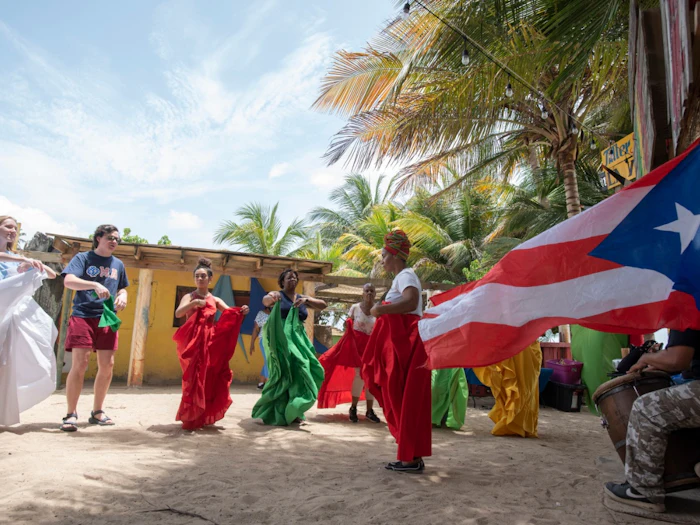
Learn Bomba dance and drumming with a local facilitator, then examine Loíza's Afro-Puerto Rican heritage through its art and coastal community.
MorningA paid Bomba dance and drumming workshop in supervised groups. A short listening comparison distinguishes Bomba from Plena.AfternoonLunch, an artisan-led discussion of Loíza's coconut vejigante masks, then a short Piñones coast stop. Mask making requires a separately agreed workshop.EveningDinner and free time after a day on sand and pavement.- Route
- San Juan to Loíza and the Piñones coast, then back to San Juan.
- Travel
- Coach, along the coast road.
- Overnight
- San Juan hotel, shared rooms.
- Meals
- All three meals.
- Physical demand
- Easy to moderate effort; short walks on sand and pavement.
- Learning outcome
- Students connect Bomba's rhythm and movement to the history of Loíza's Afro-Puerto Rican community.
- Customization
- Confirm the facilitator, workshop duration, student ages, and group rotations before booking. The price includes a cultural workshop.
-
Day 4
El Yunque at a manageable pace
Explore an open lower forest trail with a naturalist and study El Yunque's water cycle. The pace allows for heat, humidity, and observation stops.
MorningEl Portal de El Yunque Visitor Center, when open, and an approved forest trail with a naturalist. Interpret coquí habitat and Puerto Rican Parrot conservation without expecting wildlife sightings.AfternoonLunch and a watershed comparison of the La Mina and Mameyes rivers using maps and field observations. If road access allows, view La Coca Falls and Yokahú Tower before checking in at Río Grande.EveningDinner at the hotel, and an early night before the kayak day.- Route
- San Juan to El Portal and the forest trail, then Río Grande.
- Travel
- Coach, one leg into the rainforest.
- Overnight
- Río Grande hotel, shared rooms.
- Meals
- All three meals.
- Physical demand
- Moderate effort, humid conditions, on a forest trail.
- Learning outcome
- Students explain how the forest's water cycle recovers after a storm.
- Customization
- El Portal is closed September 8–20, 2026. During that closure, use teacher-led maps and conservation materials at the hotel before any approved open-trail visit. Check dated Forest Service notices; La Mina and Big Tree trails remain closed, and no river swimming is included.
-
Day 5
Daylight on the coast, night on the water
Observe the Luquillo coast, rest at the hotel, then travel to Fajardo for an evening kayak on Laguna Grande.
MorningA later start, shoreline observation at Luquillo Beach and lunch at the Luquillo Kiosks, using Spanish menus to discuss ingredients and food traditions.AfternoonRest and an early dinner before the excursion.EveningA guided night kayak on Laguna Grande in Fajardo, subject to operator approval of the school group, then return to Río Grande.- Route
- Río Grande to Luquillo and back for rest; later, Fajardo for Laguna Grande and return.
- Travel
- Coach to the launch point, then kayak.
- Overnight
- Río Grande hotel, shared rooms.
- Meals
- All three meals.
- Physical demand
- Moderate effort; paddling after dark.
- Learning outcome
- Students explain how dinoflagellates, including Pyrodinium bahamense, produce bioluminescence and why water conditions affect the glow.
- Customization
- Confirm ages, adult kayak pairings, weight limits, and school capacity. No swimming in Laguna Grande. A day swap requires both operators to accept the revised bookings; glow is not guaranteed.
-
Day 6
Snorkeling and marine ecology near Icacos
Travel by shared catamaran to Icacos Island and compare its marine habitats with El Yunque's forest watershed. The evening stays free after the boat excursion.
MorningCoach to Puerto del Rey Marina on the Ceiba–Fajardo coast, arriving 30–45 minutes before the shared catamaran departs for Icacos Island.AfternoonLunch on board, snorkeling, and marine interpretation, then the return.EveningA farewell dinner; no second excursion tonight.- Route
- Río Grande to Puerto del Rey Marina, then to Icacos Island and back on a six-hour shared sailing.
- Travel
- Coach to the marina, then shared catamaran; about 50 minutes sailing each way within the excursion.
- Overnight
- Río Grande hotel, shared rooms.
- Meals
- All three meals; lunch on board.
- Physical demand
- Moderate effort; swimming is optional and a non-swimming option stays on deck.
- Learning outcome
- Students compare the reef habitat around Icacos with the forest watershed at El Yunque.
- Customization
- Confirm school-group seats, supervision, and nonalcoholic arrangements on the shared boat before booking. Sea conditions can cancel sailing; any land replacement must be agreed separately.
-
Day 7
Depart from San Juan
Share breakfast and a closing reflection before the transfer to San Juan's airport.
MorningBreakfast at Río Grande, then the coach to the San Juan airport.AfternoonAirport check-in and the flight home.EveningOnward travel.- Route
- Río Grande hotel to the San Juan airport.
- Travel
- Private coach transfer, then the flight home.
- Overnight
- No program night; the group flies home.
- Meals
- Breakfast; later meals follow the flight.
- Physical demand
- Low effort, mostly seated.
- Learning outcome
- Students name one idea about Puerto Rico that changed during the week.

Vieques: Island Ecology and Bioluminescence
Students cross by passenger ferry to Vieques for three nights of coastal ecology, island history, and a guided kayak on Mosquito Bay, a bioluminescent lagoon. They return through Río Grande for a final forest day in El Yunque.
Choose this program- San Juan2 nights
- Vieques3 nights
- Río Grande2 nights
Your eight-day itinerary
-
Day 1
First night in San Juan
Two nights in San Juan precede the Vieques crossing. Tonight is for arrival, dinner, and rest.
MorningArrival at the San Juan airport and a meeting with the Program Leaders.AfternoonThe transfer into San Juan, lunch, and rest.EveningA welcome dinner and an outline of the crossing ahead.- Route
- Luis Muñoz Marín International Airport (SJU), in Carolina, to the San Juan hotel.
- Travel
- Private coach, direct to the hotel.
- Overnight
- San Juan hotel, shared rooms.
- Meals
- Dinner; earlier meals follow the arrival time.
- Physical demand
- Low effort; a settling-in evening.
- Learning outcome
- Students locate Vieques relative to the main island before they cross to it.
- Customization
- A late flight moves the crossing briefing to breakfast the next day.
-
Day 2
San Juan before the crossing
Explore Old San Juan's fort and waterfront before returning to the hotel to pack a compact bag for tomorrow's ferry.
MorningA guided walk through El Morro and the streets of Old San Juan.AfternoonLunch, then the historic city walls, San Juan Gate, and Paseo de la Princesa. Return to the hotel to pack a compact ferry bag.EveningDinner and free time, with bags repacked for the ferry.- Route
- El Morro and the Old San Juan waterfront.
- Travel
- On foot in the old city.
- Overnight
- San Juan hotel, shared rooms.
- Meals
- All three meals.
- Physical demand
- Moderate effort, several kilometers on foot.
- Learning outcome
- Students relate San Juan's port history to the island crossing they make the next day.
- Customization
- School-group fort visits at San Juan National Historic Site need reservations at least three weeks ahead and at least one adult per ten K–12 students. A ranger program requires its own available slot; this itinerary uses the group guide. In high heat, shorten the waterfront walk.
-
Day 3
Cross the channel to Vieques
Travel by coach to Ceiba, cross to Vieques by passenger ferry, and settle into the island hotel. The evening is for dinner and orientation.
MorningCoach to Ceiba ferry terminal, arriving at least one hour before the confirmed departure.AfternoonThe passenger crossing, then a minibus transfer and check-in on Vieques.EveningDinner and a short orientation to the island.- Route
- San Juan to Ceiba, a passenger ferry to Vieques, then the island hotel. Allow roughly five to six hours door to door, including check-in and island transfers.
- Travel
- Coach to the terminal, then a booked passenger ferry.
- Overnight
- Vieques hotel, shared rooms.
- Meals
- All three meals.
- Physical demand
- Low effort; a transfer day.
- Learning outcome
- Students explain the practical limits island access places on daily life.
- Customization
- Confirm whole-group ferry seats, island rooms, and a disruption plan before selling this route. Do not rely on a past timetable or a same-day evening excursion.
-
Day 4
Coastal habitat by day, the bay by night
Observe Vieques's coastal habitats by day, then kayak Mosquito Bay after dark to study the conditions that support bioluminescence.
MorningA naturalist-led walk through Vieques's public coastal habitats.AfternoonLunch, rest, and an early dinner before the excursion.EveningA licensed guided kayak trip on Mosquito Bay, then the return.- Route
- Vieques's coastal habitats, then the Mosquito Bay launch point.
- Travel
- Short coach legs, then kayak.
- Overnight
- Vieques hotel, shared rooms.
- Meals
- All three meals.
- Physical demand
- Moderate effort; paddling after dark.
- Learning outcome
- Students explain how bioluminescence depends on the bay's water conditions.
- Customization
- The current operator publishes a three-night full-moon closure: the night before, the full moon, and the night after. Choose dates outside it. A weather cancellation may move to day 5 only if the operator approves and has space; the glow can vary.
-
Day 5
A full look at Vieques
Walk Esperanza with a local guide to learn about island history and how tourism shapes daily life beyond the beaches.
MorningA local-guide walk through Esperanza, on the island's history beyond its beaches.AfternoonSupervised beach or shoreline recreation, with a non-swimming option.EveningDinner, with a rescheduled Mosquito Bay trip only if the operator confirms space after a weather cancellation.- Route
- Esperanza and the Vieques shoreline near the hotel.
- Travel
- On foot.
- Overnight
- Vieques hotel, shared rooms.
- Meals
- All three meals.
- Physical demand
- Easy to moderate effort; walking and optional swimming.
- Learning outcome
- Students assess how tourism shapes daily life on a small island.
- Customization
- If the bay excursion moves here, the afternoon rest period is kept and no second paid tour is added.
-
Day 6
Back across the channel
Return by ferry to Ceiba, then continue to Río Grande for lunch and rest after the transfer.
MorningCheck in at least one hour before the confirmed Vieques-to-Ceiba ferry departure.AfternoonCoach to Río Grande, lunch, and rest after the crossing.EveningDinner at Río Grande after a long transfer day.- Route
- Vieques to Ceiba ferry terminal, then Río Grande. Allow roughly four to five hours door to door; the crossing itself is about one hour.
- Travel
- A booked passenger ferry, then coach.
- Overnight
- Río Grande hotel, shared rooms.
- Meals
- All three meals.
- Physical demand
- Low effort; a transfer day.
- Learning outcome
- Students compare how convenient the crossing felt for visitors against how island residents experience it.
- Customization
- Two mainland nights provide a buffer before the flight home. Extended ferry disruption can still affect departure plans; confirm the response with the group before booking.
-
Day 7
El Yunque on the way home
Compare El Yunque's forest watershed with the coastal habitats studied on Vieques, using an open trail and conservation interpretation.
MorningEl Portal and a gentler open section of forest trail with a naturalist.AfternoonLunch, rest, and a short discussion linking the island coast to the mainland forest.EveningA farewell dinner in Río Grande.- Route
- Río Grande to El Portal and an open forest trail.
- Travel
- A short coach leg into the rainforest.
- Overnight
- Río Grande hotel, shared rooms.
- Meals
- All three meals.
- Physical demand
- Moderate effort; a forest trail in humid conditions.
- Learning outcome
- Students compare pressure on Vieques's marine habitat with pressure on El Yunque's forest habitat.
- Customization
- El Portal is closed September 8–20, 2026; use teacher-led forest and parrot-conservation materials at the hotel during the closure, with an open-trail visit only if conditions allow. Check current Forest Service notices; La Mina and Big Tree trails remain closed.
-
Day 8
Fly home from San Juan
Transfer from Río Grande to San Juan's airport for the flight home.
MorningBreakfast at Río Grande, then the coach to the San Juan airport.AfternoonAirport check-in and the flight home.EveningOnward travel.- Route
- Río Grande hotel to the San Juan airport.
- Travel
- Private coach transfer, then the flight home.
- Overnight
- No program night; the group flies home.
- Meals
- Breakfast; later meals follow the flight.
- Physical demand
- Low effort, mostly seated.
- Learning outcome
- Students say what surprised them most about the difference between the main island and Vieques.
Rooming
- Students
- Individual beds in shared, gender-separated rooms.
- Teachers
- Private rooms.
How much does a school trip to Puerto Rico cost?
Budget $3,520 to $4,340 per student for the three programs of 7 to 8 days. Prices exclude airfare, travel insurance, and medical insurance.
Program Tuition covers lodging, program meals, ground transport, scheduled activities, guides, and entrance fees, with one complimentary teacher place per eight paying students. Arrival and departure meals follow the flight schedule.
Added days, regional extensions, or substituted activities require a revised quote for your group and dates.
From $3,520
price per student, excluding airfare.
7 to 8 days
program length across three itineraries.
Group quote
every school receives its own, built on dates, group size, and route.
| Included | What it covers |
|---|---|
| Travel | Every program night's lodging, program meals and drinking water, airport transfers, ground transport, scheduled activities, guides, and entrance fees. Ferry travel is included on the Vieques route. |
| Staff and support | At least two trained Program Leaders, including both a male and a female leader, pre-departure planning, and school documentation. |
| Community donations | If an optional service project is confirmed, required donations are included in that project's revised quote, not collected from students. |
| Chaperones | One complimentary Program Tuition place per eight paying students. Chaperone airfare, travel insurance and medical insurance are separate. |
Not included: Airfare and home-to-airport travel, travel insurance, medical insurance, and personal spending.
| Effect | Factor |
|---|---|
| raises | Peak school-trip weeks and holiday dates |
| raises | Named-experience bookings and paid facilitation |
| raises | Upgraded lodging |
| raises | Extra chaperones beyond the complimentary place |
| lowers | More students in the group means fixed costs split more ways. |
| raises | Shorter trips cost more per day, since fixed costs spread across fewer days. |
Payment and cancellation
The school can pay as a group, or families can enroll directly. Group Travel monthly installments require enrollment more than 90 days before departure and a deposit at enrollment. Cancellation charges increase nearer departure; deposits and ticketed airfare can be nonrefundable under the Group Travel enrollment terms.
What do students learn on a Puerto Rico school trip?
Students read a tropical island as one system, from the rainforest to the reef, and meet Afro-Puerto Rican culture from the people who carry it.
Ecosystems and Earth science
Compare El Yunque watersheds, coastal habitats, and bioluminescence. An added north-coast route examines limestone caves; any water sampling needs site permission.
History, language, and culture
Read Taíno archaeology alongside Spanish colonialism, slavery, and migration. Use Spanish in food activities and study Afro-Puerto Rican Bomba, Plena, and visual art as distinct traditions.
Food, energy, and community
Follow coffee from farm to cup, compare food crops and trade, and examine how Casa Pueblo connects forest protection with community solar power.

What makes Rustic Pathways educational trips different?
A Rustic Pathways school trip is one private group on your school's own dates, one bed per student, and an itinerary built to your curriculum.
- 01No mixed groups. Just your school
- 02One student, one bed
- 03Your school picks the dates
- 04Monthly plans for eligible early enrollments
- 05No tipping; quoted activities include required admission fees
- 06Aligned to your curriculum
How is safety managed on a school trip to Puerto Rico?
Program Leaders manage local operations and safety procedures alongside school chaperones. Across 13 years of published incident data through August 26, 2026, 87% of reports from Rustic Pathways programs worldwide were GREEN, the minor tier where the group stays intact.
What the team plans for
Rainforest and coast days
Heat, humidity, and uneven paths require hydration, shade, and an advance review of walking needs
Emotionally demanding sites
Quiet time protected after each one, with no required public disclosure
Hurricane season
June–November brings storm risk; weather and official closures can change, suspend, or cancel outdoor activities and transfers
Water and coast
Water activities require operator-approved conditions, flotation, and swimming eligibility; arrange supervision for students who stay ashore or on board
Night water activity
Night paddling needs a local operator briefing, flotation, lights, and approved adult pairings; ages, health, and weight limits are checked before booking
Island transfers
Mountain roads, ferry check-in, and possible sailing disruption shape transfer days and departure buffers
Controls built into every trip
Written risk plan. A score above 5 requires new controls, reassessment, or cancellation.
Two-Deep Leadership. A single staff member is never alone with students, and at least two trained Program Leaders, including both a male and a female leader, support each School Group Travel trip.
Assessed activity vendors. Every named vendor is reviewed before use, every one to two years, and on site when high risk.
Medical readiness. Dr. William R. Smith has reviewed complex medical needs as Medical Director since 2015.
Is Rustic Pathways the right partner for your school trip to Puerto Rico?
Rustic Pathways runs private school trips to Puerto Rico on your dates, built around your curriculum. Your students travel only with their own teachers and classmates, never with another school's group.
Individual students can join teen travel programs instead.
A strong fit
- You want one private group with your dates and your teachers.
- You can travel for 7–8 days, with more time for regional extensions.
- You have 10 or more students.
- You want to read the day-by-day before you commit.
Talk with us first
- A student has significant mobility, medical, sensory, mental-health, dietary, or religious support needs.
- You have fewer than 10 students.
- Your dates fall in June–November, or ferry, night-paddling, or mountain-road conditions affect your group. Review timing and support early.
- You want a service day. The host, student eligibility, and dated project must be accepted before it can enter the itinerary.
Probably not a fit
- You are an individual student or parent looking for open enrollment teen travel programs in the United States.
- You want your group merged with another school.
- You want a beach week. The coast days are field science, with observation and recording on each one.
Questions about school trips to Puerto Rico
How much is a school trip to Puerto Rico?
A school trip to Puerto Rico starts at $3,520 per student for the seven-day mountain route; the seven-day eastern route is $3,925, and eight-day Vieques is $4,340 with ferries included. Airfare is extra, and added nights, regional extensions, or substituted activities need a revised quote.
When is the best time for a school trip to Puerto Rico?
The best time for a school trip to Puerto Rico is December–March, which usually brings drier weather. June 1–November 30 is Atlantic hurricane season, so planning must allow for storm disruption. For Vieques, confirm ferries and a bay date outside the operator’s full-moon closure before booking.

Have a question before you ask for a proposal?
Patrick Ziemnik answers Puerto Rico school-trip questions with the school travel team.
Send your group size, dates, trip length, and what you want students to learn. I’ll reply within 1 business day and send you options within 48 hours, and no sales call unless you ask for one.
Request your school's Puerto Rico trip proposal
Start your Puerto Rico trip proposal with your travel dates, group size, and learning goals. Receive a reply within 1 business day and customized trip options within 48 hours.
Or reach a person directly: +1 440-975-9691 or groups@rusticpathways.com
Need approval or funding first?
Certificate of insurance, risk management plans, and fundraising templates for families, on request.



Destinations related to Puerto Rico
United StatesBrowse all school trip destinations- Rustic Pathways has operated student travel since 1983. Recent industry recognition:
- 2026 GoAbroad Innovation AwardsInnovation in Adventure-Based Programming · Global Adventure Learning Model
- 2025 International Travel AwardsBest Group Tour Operator
- 2024 Skift IDEA AwardsIndustry Innovators – Tour Operators
- 4x WYSETC Best Youth Tour Operator2015, 2017, 2018, 2019
- BBB A+ RatingBetter Business Bureau profile
- NESA Affiliate OrganizationNear East South Asia Council of Overseas Schools
- 2025 World Travel AwardsUnited States’ Leading Tour Operator