School Trips to ItalyRome, Venice & Florence

Rustic Pathways school trips to Italy are 8–12 day educational travel programs. Trips visit Rome, Florence, Venice, Milan, Pisa, Naples and Pompeii, and Trento in the Italian Alps.
Three sample itineraries cover northern, central, and southern Italy. Programs cost $3,590–$5,295 per student, excluding international airfare.
No commitment, and no sales call unless you ask for one.
4.9on Trustpilot and Google
- per student across the three sample itineraries
- $3,590–$5,295
- three sample itineraries
- 8–12 days
- built around your dates, curriculum and budget
- Custom school trips
- for every 8 paying students
- 1 free teacher spot
- Rustic Pathways has operated student travel programs
- Since 1983

Choose an Italy school group travel program.
The three Italy school travel itineraries are History, Art, and Cuisine, Science Meets Art, and Alpine Magic. History, Art, and Cuisine starts at $5,295 for 12 days, Science Meets Art starts at $3,590 for 8 days, and Alpine Magic starts at $3,590 for 8 days.
Compare the three itineraries side by side
| Itinerary | Italy and Spain: History, Art, and Cuisine | Science Meets Art | Alpine Magic |
|---|---|---|---|
| Length | 12 days | 8 days | 8 days |
| Starting price | From $5,295 | From $3,590 | From $3,590 |
| Learning focus | History · Art and Design | Science and Engineering · Art and Design | Environmental Science · Physical Education |
| Route | Venice · Florence · Rome · Pompeii · Naples · Barcelona | Milan · Florence · Pisa · Venice · Burano | Venice · Trento · Bolzano · Verona · Monte Bondone · Dolomites |
| Overnight bases | In transit (1) · Venice (1) · Florence (3) · Rome (2) · Naples or Rome (1) · Barcelona (3) · In transit (1) | Milan (2) · Florence (3) · Venice (2) · In transit (1) | Trento (6) · Venice (1) · In transit (1) |
| Physical profile | 3 low · 7 moderate · 2 high | 3 low · 3 moderate · 2 high | 4 low · 3 moderate · 1 high |
| On-program flights | One in-program flight, to Barcelona on day 9 | None | None |
| One base or a chain of cities | Five cities, train and one flight | Three cities by train, Pisa and back in a day | One base in Trento, day trips out |
| Best for | Best for a history or humanities department that wants the classical and Renaissance sequence in order, from Venice down to Pompeii, and can spend four days in Barcelona at the end to see what the same ideas became somewhere else. | Best for a school running art and science together, where the argument is that a Renaissance workshop did both, and for a group that wants to climb the things it studies rather than look up at them. | Best for a school that wants one hotel for six nights instead of a suitcase every second morning, and a winter week where the science is done outdoors and most of the group has never skied. |
 Venice · Florence · Rome · Pompeii · Barcelona
12 days · From $5,295
Venice · Florence · Rome · Pompeii · Barcelona
12 days · From $5,295
Italy and Spain: History, Art, and Cuisine
Students work down Italy from Venice through Florence to Rome and Pompeii, then fly to Barcelona for four days on Gaudi, Picasso and the Catalan Modernista city.
Choose this programThe route connects Venice, Florence, Rome, Pompeii, Naples, and Barcelona.
- Outbound flight1 night
- Venice1 night
- Florence3 nights
- Rome2 nights
- Naples or Rome1 night
- Barcelona3 nights
- Flight home1 night
Your twelve-day itinerary
-
Day 1
Depart home airport
The group meets at its home airport, checks in together and flies to Italy. This is counted as a full day because the scheduled travel time runs beyond twelve hours from most departure cities.
MorningStudents meet the group at a pre-arranged point in the home airport and check bags together.AfternoonThe group clears security as a unit and waits at the gate.EveningThe transatlantic flight departs. Arrival is the following day.- Route
- Students travel from their home airport to Italy.
- Travel
- International flights. The exact routing and departure hour depend on the flight schedule confirmed for your group.
- Overnight
- Students are in transit overnight.
- Meals
- Meals on this day are whatever the airline serves. Program meals begin on arrival.
- Physical demand
- Low effort. The day is airport time and a long seated flight.
- Customization
- Your school books the flights or asks Rustic Pathways to arrange them, so the departure city and routing are set by the school.
-
Day 2
Arrive in Venice
The group lands at Marco Polo airport, meets the Program Leaders who stay with it all week, and starts on St Mark's Square, the Basilica, the Campanile and the Doge's Palace before a gondola ride and the Rialto.
MorningThe flight arrives at Venice Marco Polo. Students collect bags and meet their Program Leaders.AfternoonThe group walks St Mark's Square, sees the Basilica and the Campanile, and tours the Doge's Palace and its chambers.EveningA gondola ride through the canals, the Rialto Bridge and market, sunset from the Riva degli Schiavoni promenade, then dinner as a group and orientation.- Route
- Students arrive at Venice Marco Polo airport and transfer into Venice for St Mark's Square, the Doge's Palace and the Rialto.
- Travel
- International arrival, then a water or road transfer into the city. How much of the walking program runs today depends on the confirmed arrival hour.
- Overnight
- Students stay in Venice.
- Meals
- Program meals begin on arrival. Dinner is together as a group.
- Physical demand
- Moderate effort on a jet-lagged first day, and Venice is walked rather than driven, with bridge steps between most points.
- Learning outcome
- Students read Venice as a trading republic before they see what its money bought, which is the thread the Florence days pick up.
- Customization
- The order of the first afternoon flexes with the arrival time, and a late landing moves the Doge's Palace rather than dropping it.
-
Day 3
Venetian art and craftsmanship, then the train south
A morning of modern art at the Peggy Guggenheim Collection and the Dorsoduro galleries, a vaporetto out to the Murano glass furnaces, then the train from Venice to Florence.
MorningThe Peggy Guggenheim Collection in the patron's former home, with Picasso and Pollock, then a walk through the Dorsoduro gallery district.AfternoonA vaporetto across to Murano to watch glassblowing at a working furnace.EveningThe group takes the train from Venice to Florence and checks in.- Route
- Students spend the day in Dorsoduro and on Murano, then travel by rail from Venice to Florence.
- Travel
- Vaporetto to Murano and back, then a booked rail leg from Venice to Florence. The departure is fixed once the seats are reserved.
- Overnight
- Students stay in Florence.
- Meals
- Breakfast, lunch, and dinner are included.
- Physical demand
- Moderate effort. Standing in galleries, walking Dorsoduro, and moving luggage onto a train.
- Learning outcome
- Murano shows a craft that has been made in one place for seven hundred years, against a collection of twentieth-century work three canals away.
- Customization
- The rail departure sets the end of the day, so an afternoon addition in Venice has to fit before it.
-
Day 4
Florence: art and history
Florence Cathedral inside and out with the Baptistery and Campanile, the Accademia for Michelangelo's David, the sculpture under the Loggia dei Lanzi, Palazzo Vecchio, and the tombs at Santa Croce.
MorningThe Florence Cathedral interior, the Baptistery and the Campanile.AfternoonThe Accademia Gallery for David, then the Loggia dei Lanzi in Piazza della Signoria and the state rooms of Palazzo Vecchio.EveningThe Basilica of Santa Croce and the tombs it holds, then dinner.- Route
- Students walk the Florence historic center between the Cathedral, the Accademia, Piazza della Signoria, Palazzo Vecchio and Santa Croce.
- Travel
- No transfers. Everything on this day is within walking distance in the center.
- Overnight
- Students stay in Florence.
- Meals
- Breakfast, lunch, and dinner are included.
- Physical demand
- Moderate effort. A long day standing and walking on stone, with queues at timed entries.
- Learning outcome
- Students see civic, religious and private patronage in one afternoon and can ask who paid for which building and why.
- Customization
- Entry times at the Accademia and the Cathedral are booked ahead, so the day is ordered around them rather than the other way about.
-
Day 5
Florence: the Uffizi and the view
A morning in the Uffizi, the Ponte Vecchio and the story of the Vasari Corridor above it, the Pitti Palace and its gardens across the river, and Piazzale Michelangelo at the end of the day.
MorningThe Uffizi Gallery.AfternoonThe Ponte Vecchio and the goldsmiths' shops, the passage the Medici built above it, then across the Arno to the Pitti Palace and its collections and gardens.EveningUp to Piazzale Michelangelo for the view back over the city.- Route
- Students cross Florence from the Uffizi over the Ponte Vecchio to the Pitti Palace, then up to Piazzale Michelangelo.
- Travel
- No transfers. The climb to Piazzale Michelangelo is on foot.
- Overnight
- Students stay in Florence.
- Meals
- Breakfast, lunch, and dinner are included.
- Physical demand
- Moderate effort, with a sustained uphill walk to the viewpoint at the end of a long museum day.
- Learning outcome
- The Vasari Corridor is a ruling family's private route across a public city, which is a usable way into how Medici power actually worked.
- Customization
- The Uffizi entry is a booked time slot. The Piazzale Michelangelo climb is the part of the day that can be dropped or driven.
-
Day 6
Arrive in Rome
The group moves to Rome, settles in, and spends the rest of the day on the Trevi District: a picnic lunch of Italian delicacies, the Trevi Fountain, the Spanish Steps up to Trinita dei Monti, and the Pantheon.
MorningTravel from Florence to Rome and check in.AfternoonA picnic lunch gathered from local shops, then the Trevi Fountain and the three-coin custom.EveningUp the Spanish Steps from Piazza di Spagna to the French church of Trinita dei Monti, then the Pantheon.- Route
- Students travel from Florence to Rome, then walk the Trevi District, the Spanish Steps and the Pantheon.
- Travel
- A booked transfer from Florence to Rome. Departure is confirmed in the final proposal.
- Overnight
- Students stay in Rome.
- Meals
- Breakfast, lunch, and dinner are included. Lunch is a picnic assembled from local shops.
- Physical demand
- Moderate effort, with luggage in the morning and a walking evening on stone.
- Customization
- The evening walk is the flexible half of this day, and how much of it runs depends on when the group reaches Rome.
-
Day 7
The Vatican, the Colosseum and a Roman cooking class
The biggest day of the itinerary: a morning at the Vatican for St Peter's Basilica and the Sistine Chapel, then the Colosseum, the Palatine Hill and the Roman Forum, and a cooking class in the evening.
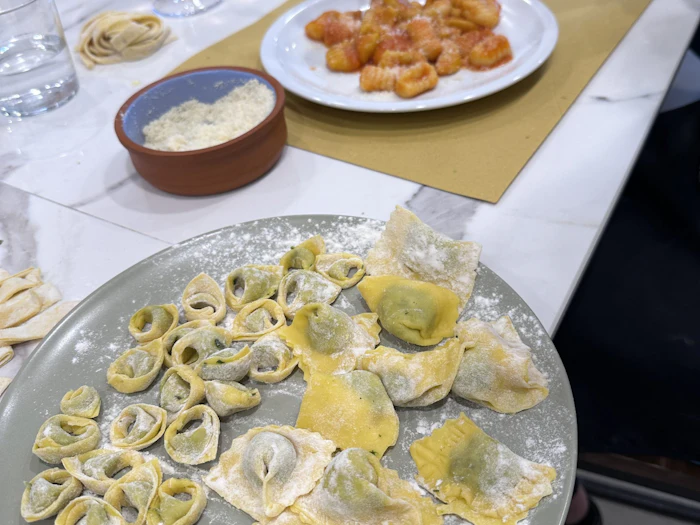
MorningA tour of the Vatican, St Peter's Basilica and the Sistine Chapel.AfternoonThe Colosseum on a timed entry, then the Palatine Hill and the Roman Forum next to it, reading the city from a million people down to about thirty thousand by the Middle Ages.EveningA cooking class in Roman traditions, and the group eats what it makes.- Route
- Students cross Rome from the Vatican to the Colosseum, the Palatine Hill and the Roman Forum, then to a cooking class.
- Travel
- Local transfers between the Vatican and the Colosseum, walking either side.
- Overnight
- Students stay in Rome.
- Meals
- Breakfast, lunch, and dinner are included. Dinner is what the group cooks.
- Physical demand
- High effort. This is the longest day on the itinerary, on uneven ancient stone with very little shade across the Forum.
- Learning outcome
- Students hold the scale of imperial Rome against its decline in one afternoon, standing on the ground both happened on.
- Customization
- Both the Vatican and the Colosseum are timed entries booked well ahead, so this day is fixed. The cooking class is the movable part.
-
Day 8
Pompeii
South towards Naples for a guided day in Pompeii, the Roman town buried by Vesuvius in 79 CE, about fourteen miles from Naples in Campania. Where the group sleeps depends on the next morning's flight to Barcelona.
MorningThe group packs and travels south from Rome towards Naples.AfternoonA guided tour of Pompeii covering the town before the eruption, the volcanic debris and the pyroclastic surge that followed.EveningThe group stays in Naples or returns to Rome, depending on the flight to Barcelona the next day.- Route
- Students travel from Rome south into Campania for Pompeii, about fourteen miles from Naples.
- Travel
- A long road or rail leg each way, or one way if the group stays in Naples.
- Overnight
- Students stay in Naples or back in Rome. Which one is set by the confirmed Barcelona flight.
- Meals
- Breakfast, lunch, and dinner are included.
- Physical demand
- High effort. Pompeii is a full site walked end to end on original paving, exposed and hot in summer.
- Learning outcome
- Pompeii preserves an ordinary town rather than a monument, which is a different kind of evidence from anything else on this itinerary.
- Customization
- The overnight city is genuinely undecided until flights are confirmed, and the proposal names which one applies to your dates.
-
Day 9
Barcelona and the Sagrada Familia
A flight to Barcelona in the morning, then Park Guell, the Sagrada Familia, and the Recinte Modernista de Sant Pau, three Catalan Modernista sites in one afternoon.
MorningThe group flies to Barcelona and reaches the city.AfternoonA walk through Park Guell, built between 1900 and 1914, opened as a public park in 1926 and now a UNESCO World Heritage Site.EveningThe Sagrada Familia, begun in 1882 and still unfinished, then the Recinte Modernista de Sant Pau, built as a hospital complex and now also a World Heritage Site.- Route
- Students fly to Barcelona and visit Park Guell, the Sagrada Familia and the Recinte Modernista de Sant Pau.
- Travel
- A short international flight. The departure hour depends on the schedule confirmed for your group.
- Overnight
- Students stay in Barcelona.
- Meals
- Breakfast, lunch, and dinner are included.
- Physical demand
- Moderate effort, with an airport morning and a walking afternoon over the slopes of Park Guell.
- Learning outcome
- Three buildings by two architects, one of them still under construction after more than a century, set against the finished Renaissance the group has just walked through.
- Customization
- The flight sets the start of the afternoon, so a late slot moves the Sagrada Familia entry rather than dropping it.
-
Day 10
Gaudi and Picasso
Casa Batllo on Passeig de Gracia in the morning, a tapas lunch, the Picasso Museum in the afternoon, and a Spanish dinner with a flamenco performance in the evening.
MorningCasa Batllo, designed about 120 years ago and now one of the city's signature buildings.AfternoonA tapas lunch and a rest through the middle of the day, then the Picasso Museum, covering his work as painter, sculptor, printmaker, ceramicist and stage designer.EveningA traditional Spanish dinner and a flamenco performance, an art form from southern Spain associated with the Andalusian Roma.- Route
- Students go from Casa Batllo on Passeig de Gracia to the Picasso Museum in the old city.
- Travel
- Short local legs on foot and by metro.
- Overnight
- Students stay in Barcelona.
- Meals
- Breakfast, lunch, and dinner are included. Lunch is tapas and dinner is a traditional Spanish meal.
- Physical demand
- Moderate effort, with a deliberate rest through the middle of the day.
- Learning outcome
- One artist's whole range in one museum, next to a building that treats a house as a narrative, gives students two different arguments about what art is for.
- Customization
- The midday break is built in and is the obvious place to add or remove something.
-
Day 11
Meander through Barcelona
Las Ramblas, the food stalls of La Boqueria, the narrow streets of the Gothic Quarter, and the afternoon at Barceloneta Beach on the Mediterranean.
MorningDown Las Ramblas with its street performers, then into La Boqueria market for produce and local specialities.AfternoonThe Gothic Quarter's narrow streets and alleyways.EveningBarceloneta Beach and the harbour, and a last dinner as a group.- Route
- Students walk Las Ramblas, La Boqueria, the Gothic Quarter and down to Barceloneta Beach.
- Travel
- No transfers. The whole day is walkable from the old city to the shore.
- Overnight
- Students stay in Barcelona.
- Meals
- Breakfast, lunch, and dinner are included.
- Physical demand
- Low effort. Flat walking with a long stop at the beach.
- Customization
- This is the loosest day on the itinerary and the easiest one to reshape around a department's own priority.
-
Day 12
Departure from Barcelona
The group checks out, transfers to the airport and flies home, with time to look back over Venice, Florence, Rome, Pompeii and Barcelona.
MorningCheck out, final packing and a group debrief on the twelve days.AfternoonTransfer to Barcelona airport and check in as a group.EveningThe flight home departs.- Route
- Students transfer from central Barcelona to the airport and fly home.
- Travel
- A road transfer to Barcelona airport, then international flights. Timing follows the confirmed schedule.
- Overnight
- Students travel overnight or arrive home the same day, depending on routing.
- Meals
- Breakfast is included. Later meals depend on the flight.
- Physical demand
- Low effort. Packing, a transfer and airport time.
- Customization
- An early departure moves the debrief to the evening before.
 Milan · Florence · Pisa · Venice
8 days · From $3,590
Milan · Florence · Pisa · Venice
8 days · From $3,590
Science Meets Art
Students trace the Renaissance as engineering as well as art, from Leonardo in Milan through Brunelleschi's dome and the Accademia in Florence to Pisa's leaning campanile and three days in Venice.
Choose this programThe route connects Milan, Florence, Pisa, Venice, and Burano.
- Milan2 nights
- Florence3 nights
- Venice2 nights
- Flight home1 night
Your eight-day itinerary
-
Day 1
Arrive in Milan
The group lands at Milan Malpensa, takes the train into the city center and checks in, then walks to the Sforzesco Castle before the first gelato of the week.
MorningArrival at Milan Malpensa and bag collection.AfternoonThe train from the airport into the city center, then check in and settle.EveningA walk to the Sforzesco Castle and its courtyards, then gelato.- Route
- Students arrive at Milan Malpensa, travel into central Milan and visit the Sforzesco Castle.
- Travel
- An airport rail transfer into the center. Arrival time follows the confirmed flight schedule.
- Overnight
- Students stay in Milan.
- Meals
- Program meals begin on arrival.
- Physical demand
- Low effort. A short walk after a long flight, with the day built around arrival.
- Customization
- How much of the castle the group sees depends on when the flight lands.
-
Day 2
Milan and the Last Supper
Up onto the roof of the Duomo among the spires, past Teatro alla Scala and along Via della Spiga, then the booked entry to see Leonardo's Last Supper on the refectory wall at Santa Maria delle Grazie.
MorningThe Duomo climb, out onto the roof terraces among the statues and flying buttresses.AfternoonTeatro alla Scala and the streets around it, then Via della Spiga.EveningThe timed entry at Santa Maria delle Grazie to see The Last Supper in the refectory it was painted for.- Route
- Students walk central Milan from the Duomo to Teatro alla Scala and Via della Spiga, then to Santa Maria delle Grazie.
- Travel
- On foot with short tram legs. No intercity travel today.
- Overnight
- Students stay in Milan.
- Meals
- Breakfast, lunch, and dinner are included.
- Physical demand
- Moderate effort. The Duomo roof is reached by a long stair climb, and the rest of the day is city walking.
- Learning outcome
- Seeing The Last Supper on the wall it was painted onto, rather than as a picture, is the day's argument about what a Renaissance commission actually was.
- Customization
- The Last Supper is the hardest ticket in Italy and the entry slot is booked months ahead, so the rest of the day is arranged around it and cannot move it.
-
Day 3
To Florence, and up the dome
The train to Florence in about an hour and a half, check in, then the climb inside Brunelleschi's dome at the Cathedral of Santa Maria del Fiore, Piazza della Signoria and the Ponte Vecchio.
MorningThe train from Milan to Florence, about an hour and a half, then check in.AfternoonThe Cathedral of Santa Maria del Fiore and the climb up between the inner and outer shells of Brunelleschi's dome.EveningPiazza della Signoria and the Ponte Vecchio at the end of the day.- Route
- Students travel from Milan to Florence, then walk from the Cathedral to Piazza della Signoria and the Ponte Vecchio.
- Travel
- A booked rail leg of about an hour and a half. The departure is fixed once the seats are reserved.
- Overnight
- Students stay in Florence.
- Meals
- Breakfast, lunch, and dinner are included.
- Physical demand
- High effort. The dome climb is a long ascent on narrow stone stairs between the two shells, with no lift and no way to turn back partway.
- Learning outcome
- Students climb inside the structure while being told how it was raised without centering, which is the case study the whole itinerary is built on.
- Customization
- The dome climb is a booked time slot and it is also the one activity a student may need an alternative to. Tell us early and we plan the alternative into the day rather than around it.
-
Day 4
Florence: David, Leonardo and the view
The Accademia Gallery for Michelangelo's David, the Leonardo da Vinci Museum and its working models, lunch at the Mercato Centrale, the panorama from Piazzale Michelangelo, and free time.
MorningThe Accademia Gallery, with the unfinished Prisoners on the way to David.AfternoonThe Leonardo da Vinci Museum and its interactive models, then lunch at the Mercato Centrale.EveningUp to Piazzale Michelangelo for the panorama, then free time in the center.- Route
- Students move on foot between the Accademia, the Leonardo da Vinci Museum, the Mercato Centrale and Piazzale Michelangelo.
- Travel
- No transfers. The climb to the viewpoint is on foot.
- Overnight
- Students stay in Florence.
- Meals
- Breakfast, lunch, and dinner are included. Lunch is at the Mercato Centrale.
- Physical demand
- Moderate effort, with a sustained uphill walk to the viewpoint late in the day.
- Learning outcome
- Leonardo's models put invention and observational drawing beside the painting seen in Milan, so students can trace one method across three kinds of work.
- Customization
- The Accademia is a booked entry. The free time and the Piazzale Michelangelo climb are the movable parts.
-
Day 5
Pisa and back
Ninety minutes by train to Pisa for the Leaning Tower climb and the Piazza dei Miracoli, then the Piazza delle Vettovaglie market before the train back to Florence.
MorningThe train from Florence to Pisa, about ninety minutes.AfternoonThe Leaning Tower climb and the rest of the Piazza dei Miracoli, cathedral and baptistery.EveningThe market at Piazza delle Vettovaglie, then the train back to Florence.- Route
- Students travel from Florence to Pisa for the Piazza dei Miracoli and the market, then return to Florence.
- Travel
- Booked rail legs of about ninety minutes each way. Both departures are fixed once reserved.
- Overnight
- Students return to Florence and stay there. Bags do not move.
- Meals
- Breakfast, lunch, and dinner are included.
- Physical demand
- High effort. The tower climb is a spiral stair on a leaning axis, which is disorienting as well as steep, and entry is capped and timed.
- Learning outcome
- A campanile that started tilting during construction and was finished anyway is a structural problem students can see rather than be told about.
- Customization
- Tower entry is capped, timed and booked ahead. Pisa is also the day a school can swap out entirely if it would rather have a second day in Florence.
-
Day 6
To Venice by rail
Two and a half hours by train to Venice, check in, then Vaporetto Line 1 the length of the Grand Canal as an introduction to the city from the water.
MorningThe train from Florence to Venice, about two and a half hours.AfternoonArrival in Venice and check in.EveningVaporetto Line 1 along the Grand Canal, reading the palace fronts from the water.- Route
- Students travel from Florence to Venice and take the Grand Canal by water bus.
- Travel
- A booked rail leg of about two and a half hours, then water transport inside the city.
- Overnight
- Students stay in Venice.
- Meals
- Breakfast, lunch, and dinner are included.
- Physical demand
- Low effort. A seated travel morning and a seated canal route, with luggage over bridges at either end.
- Learning outcome
- Approaching the palaces from the canal shows what they were built to be seen from, which is not the street.
- Customization
- The rail departure sets the shape of the day, and a later train shortens the canal route rather than removing it.
-
Day 7
Venice: the Doge's Palace and Row Venice
The Secret Itineraries tour through the working rooms and prisons behind the Doge's Palace, up St Mark's Campanile, then a standing rowboat lesson with Row Venice, and free time.
MorningThe Doge's Palace on the Secret Itineraries route, through the chancery, the interrogation rooms and the attic prisons.AfternoonUp St Mark's Campanile for the view across the lagoon.EveningA Row Venice lesson in standing Venetian rowing, then free time.- Route
- Students go from the Doge's Palace to St Mark's Campanile and then out onto the water with Row Venice.
- Travel
- On foot with short water-bus legs. No intercity travel today.
- Overnight
- Students stay in Venice.
- Meals
- Breakfast, lunch, and dinner are included.
- Physical demand
- Moderate effort. The campanile has a lift, the Secret Itineraries route does not and includes narrow stairs and low doorways, and the rowing lesson is standing work on an unstable platform.
- Learning outcome
- The Secret Itineraries route shows the administration behind the state rooms, so students see the republic as a bureaucracy as well as a spectacle.
- Customization
- The Secret Itineraries tour runs in small numbers and is booked well ahead, so a large group is split across slots. Row Venice is the part a school can trade for more free time.
-
Day 8
Burano, then departure
A ferry out to Burano for the painted houses and the lace tradition, back to Venice, then a water taxi to the airport for the flight home.
MorningThe ferry across the lagoon to Burano, its painted houses and its lace workshops.AfternoonThe return to Venice and final packing.EveningA water taxi to the airport and the flight home.- Route
- Students travel from Venice to Burano and back, then to the airport by water.
- Travel
- A public ferry to Burano and back, then a water taxi to Venice Marco Polo. Both are timed against the confirmed departure.
- Overnight
- Students travel overnight or arrive home the same day, depending on routing.
- Meals
- Breakfast is included. Later meals depend on the flight.
- Physical demand
- Low effort, with luggage and boat boarding at either end.
- Customization
- An early flight removes Burano rather than shortening it, and the proposal says which applies to your dates.
 Trento · Bolzano · Verona · Dolomites · Venice
8 days · From $3,590
Trento · Bolzano · Verona · Dolomites · Venice
8 days · From $3,590
Alpine Magic
Students base in Trento for six nights and go out each day to Bolzano, Verona, Monte Bondone and the Dolomites, then finish with a day in Venice.
Choose this programThe route connects Venice, Trento, Bolzano, Verona, Monte Bondone, and Dolomites.
- Trento6 nights
- Venice1 night
- Flight home1 night
Your eight-day itinerary
-
Day 1
Arrive in Venice, coach to Trento
The group lands at Venice Airport and coaches about two hours north to Trento, checks into the hotel that is home for the next six nights, and has a welcome dinner.
MorningArrival at Venice Airport and bag collection.AfternoonThe coach north to Trento, about two hours, and check in.EveningA welcome dinner and orientation on how the week works out of one base.- Route
- Students arrive at Venice Airport and travel by coach to Trento.
- Travel
- A private coach transfer of about two hours. The departure follows the confirmed arrival.
- Overnight
- Students stay in Trento, and stay there for six nights.
- Meals
- Program meals begin on arrival. Dinner is together as a group.
- Physical demand
- Low effort. Arrival and a seated road transfer.
- Customization
- A late arrival shortens the evening rather than moving the transfer, because the coach is booked to the flight.
-
Day 2
Trento: history, science and culture
A day in Trento itself: the Castello del Buonconsiglio and its frescoed cycles, the MUSE Science Museum, and the old town on foot.
MorningThe Castello del Buonconsiglio, the seat of the prince-bishops, and its painted rooms.AfternoonThe MUSE Science Museum, built around the alpine environment the rest of the week goes into.EveningThe old town on foot and dinner.- Route
- Students stay in Trento for the Castello del Buonconsiglio, the MUSE Science Museum and the old town.
- Travel
- No transfers. Everything today is walkable from the base.
- Overnight
- Students stay in Trento.
- Meals
- Breakfast, lunch, and dinner are included.
- Physical demand
- Low effort. Town walking and two indoor sites, on the first full day after the flight.
- Learning outcome
- MUSE sets up the alpine ecology and geology that the Dolomites day puts students out in.
- Customization
- This is the lightest day of the week by design and is the easiest one to add to.
-
Day 3
Bolzano: archaeology and mountain life
A train of about forty-five to fifty minutes up to Bolzano for Otzi the Iceman, the 5,300-year-old body recovered from a glacier, and the winter markets in the German-speaking South Tyrol.
MorningThe train from Trento to Bolzano, about forty-five to fifty minutes.AfternoonThe Otzi the Iceman exhibit and what the ice preserved with him.EveningThe winter markets and the old center, then the train back to Trento.- Route
- Students travel from Trento to Bolzano for the Otzi exhibit and the winter markets, and return the same evening.
- Travel
- Booked regional rail of about forty-five to fifty minutes each way.
- Overnight
- Students return to Trento. Bags do not move.
- Meals
- Breakfast, lunch, and dinner are included.
- Physical demand
- Low effort. A short rail leg and a walking afternoon, cold outdoors in winter.
- Learning outcome
- Otzi is the day's argument about preservation: the same ice that killed him is why we have him, and students meet the evidence before the ecology day explains the environment.
- Customization
- Bolzano is also where a language department gets its bilingual day, because South Tyrol is German-speaking an hour from Trento.
-
Day 4
Verona: Roman and Renaissance Italy
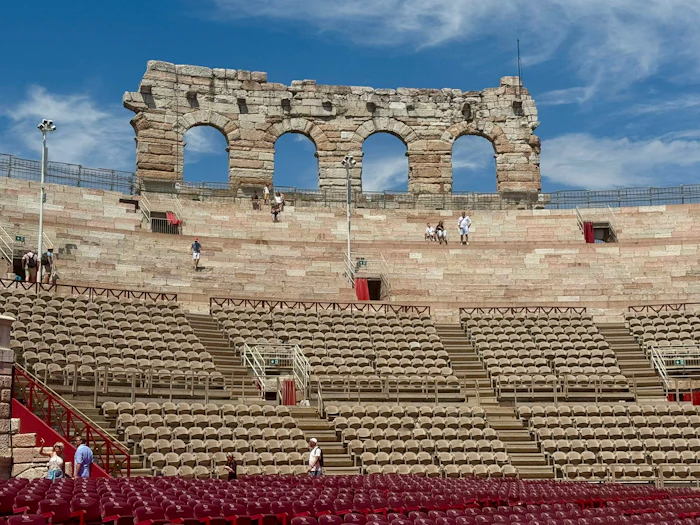
About an hour and a half by coach south to Verona for the Roman arena, Juliet's balcony, Piazza Bra and the market square at Piazza delle Erbe.
MorningThe coach from Trento to Verona, about an hour and a half.AfternoonThe Verona Arena, the Roman amphitheater still in use, and Piazza Bra around it.EveningJuliet's balcony and Piazza delle Erbe, the old market square, then the coach back.- Route
- Students travel from Trento to Verona for the Arena, Piazza Bra, Juliet's balcony and Piazza delle Erbe, and return the same evening.
- Travel
- A private coach of about an hour and a half each way.
- Overnight
- Students return to Trento. Bags do not move.
- Meals
- Breakfast, lunch, and dinner are included.
- Physical demand
- Moderate effort. Three hours on a coach and a full walking afternoon on stone.
- Learning outcome
- Verona and Bolzano sit on the same alpine trade route in different directions, which is a usable way into why either town is where it is.
- Customization
- This is the longest road day of the week and the one a school would drop first if it wanted a second day in the mountains.
-
Day 5
Ski day at Monte Bondone
Up to Monte Bondone above Trento for a full day on the snow, with gear rental and beginner lessons built for a group where most students have never skied, and snow play for anyone who would rather not.
MorningTransfer up to Monte Bondone, full gear rental and fitting.AfternoonBeginner ski lessons with instructors, in groups by ability.EveningSnow play, then back down to Trento.- Route
- Students travel from Trento up to Monte Bondone for the day and return in the evening.
- Travel
- A short road transfer up to the ski area and back.
- Overnight
- Students return to Trento. Bags do not move.
- Meals
- Breakfast, lunch, and dinner are included.
- Physical demand
- High effort. A full day on snow, and skiing is tiring in a way that catches out students who are fit but new to it. Snow play is the alternative for anyone not skiing.
- Learning outcome
- Beginner lessons put a whole group at the same starting point, which is the point of running it as a class rather than as free skiing.
- Customization
- Gear rental and lessons are included and sized to the group, and this is a weather-dependent day. Tell us early about any student who should not ski so the alternative is planned rather than improvised.
-
Day 6
Dolomites: winter ecology
Out to the Dolomites for a walk around the lake at Molveno, alpine ecology and geology in the field, and lunch in a mountain rifugio.
MorningThe transfer out to Molveno and the Brenta Dolomites.AfternoonThe lake walk with alpine ecology and geology taught outdoors.EveningLunch in a rifugio, then the return to Trento.- Route
- Students travel from Trento into the Dolomites for the Molveno lake walk and return the same day.
- Travel
- A road transfer on mountain roads each way.
- Overnight
- Students return to Trento. Bags do not move.
- Meals
- Breakfast, lunch, and dinner are included. Lunch is in a mountain rifugio.
- Physical demand
- Moderate effort. A walk at an easy grade, but in winter conditions and cold for a sustained stretch outdoors.
- Learning outcome
- The geology and the ecology are taught on the ground that shows them, and it is the same alpine environment MUSE introduced indoors on day 2.
- Customization
- This is a weather-dependent day. The route is shortened rather than cancelled when conditions close part of it.
-
Day 7
Venice finale
Out of the mountains and back to Venice: a vaporetto down the Grand Canal, St Mark's Square, and the Doge's Palace on the last full day.
MorningCheck out of the Trento base and transfer to Venice.AfternoonA vaporetto along the Grand Canal into the center.EveningSt Mark's Square and the Doge's Palace, then a final dinner.- Route
- Students travel from Trento back to Venice for the Grand Canal, St Mark's Square and the Doge's Palace.
- Travel
- A road transfer of about two hours, then water transport inside Venice.
- Overnight
- Students stay in Venice, the only night of the week away from the Trento base.
- Meals
- Breakfast, lunch, and dinner are included.
- Physical demand
- Moderate effort, with luggage over bridges and a walking evening.
- Learning outcome
- Venice at the end rather than the start lets students read it against the alpine towns they have just spent a week in, which were on the same trade routes.
- Customization
- The Doge's Palace is a booked entry, so the transfer time from Trento is set by it.
-
Day 8
Departure
The group transfers to Venice Airport, checks in with Program Leader support and flies home.
MorningCheck out and final packing in Venice.AfternoonThe transfer to Venice Airport and group check-in with Program Leader support.EveningThe flight home departs.- Route
- Students transfer from Venice to Venice Airport and fly home.
- Travel
- A water or road transfer to the airport, then international flights on the confirmed schedule.
- Overnight
- Students travel overnight or arrive home the same day, depending on routing.
- Meals
- Breakfast is included. Later meals depend on the flight.
- Physical demand
- Low effort. Packing, a transfer and airport time.
- Customization
- An early departure moves the group debrief to the evening before.
What applies across every itinerary
- Group and adults
- Programs start at 10 students, and one adult place is complimentary for every eight paying students.
- Rooming
- Students use shared, gender-separated rooms, and every student has an individual bed. Teachers get their own room.
- Excluded
- Flights to and from the program, travel insurance, medical insurance, and personal spending are not included in the Program Tuition.
- Flights and documents
- Your school books international flights or asks Rustic Pathways to arrange them. Families arrange passports and visas, with Rustic Pathways guidance.
- Supervision
- Program Leaders operate the itinerary during scheduled activities and are housed on site and available overnight. The final approved itinerary identifies any free time or supervision exception on the relevant day.
- Effort
- A low-effort day involves limited walking, a moderate-effort day involves sustained walking on varied surfaces, and a high-effort day involves strenuous or technical activity. Most Italy days are moderate, and stone stairs with no lift are what make a climb strenuous rather than distance.
- Flexibility
- Fixed days cannot move independently, linked days move only with connected rail seats or timed site entry that is already booked, and adjustable days can change without restructuring the entire program.
How much does a school trip to Italy cost?
A school trip to Italy costs $3,590 to $5,295 per student for program tuition, or approximately $441 to $449 per day. Tuition covers lodging, meals, airport transfers, in-country transport, scheduled activities, guides, and entrance fees.
Schools receive one complimentary program tuition place for every eight paying students. International airfare, travel insurance, and medical insurance are not included.
Final pricing depends on travel dates, group size, itinerary, and lodging. Each trip is quoted for your school group, and all prices are in USD per student.
$3,590 to $5,295
per student across the sample itineraries, excluding international airfare.
8 to 12 days
program length of the three itineraries on this page.
Group quote
every school receives its own, built on dates, group size and route.
What changes the price of a school trip to Italy?
Six variables change the price of a school trip to Italy: season, trip length, group size, chaperones, accommodations, and rail and timed admissions.
- SeasonSpring and autumn are the best windows and Italian summers are hot. Peak and holiday weeks cost more than shoulder-season dates, and the alpine itinerary runs in winter, which is its own season.
- Trip lengthShorter trips can cost more per day because fixed costs spread across fewer days. Italy itineraries run 8 to 12 days, and beyond that what the itinerary includes matters more than length alone.
- Group sizeLarger groups lower the per-student price. Programs start at 10 students with no upper cap, and the school sets the final size.
- ChaperonesOne teacher place is free for every eight paying students, so a group of 16 students earns two free places, 24 earns three, and 40 earns five. Additional chaperone seats are shared across the group and change the per-student price.
- AccommodationsLodging tier moves the price directly. A city-center hotel in Rome, Florence or Venice costs more than a standard three-star option further out, and Rustic Pathways can arrange either.
- Rail and timed admissionsTwo of these itineraries move between cities by booked rail, and the sites they visit sell entry in time slots bought ahead. Both are inside Program Tuition, and both are priced against the dates your school chooses.
What every Italy school trip includes
- Accommodation for every program night
- Breakfast, lunch, dinner and drinking water
- Airport transfers and in-country transport
- Scheduled activities, guides and entrance fees
- At least two trained Program Leaders, including both a male and a female leader
- Community donations required by a service project, paid by Rustic Pathways and never collected from students
- Enrolled families receive a 24/7 emergency number for use during programs and travel days.
- Pre-departure planning and school documentation
- One teacher travels free for every eight paying students
Not included: international airfare, travel insurance, medical insurance, personal spending money, passport or visa fees, and vaccinations.
Payment and cancellation
Installment plans are available. Review the current enrollment terms.
What do students learn on Italy student trips?
Students on Italy school trips learn science and engineering, history, and environmental science through Renaissance architecture, Roman sites, Pompeii, and the Dolomites.
Science and Engineering
Study Brunelleschi’s dome as a structural problem, then trace Leonardo’s methods from The Last Supper to invention models and observational drawings at the Leonardo da Vinci Museum.
How do you build something nobody has built before, without the mathematics to prove it will stand?
Science Meets Art
History
Walk the Roman Forum, Palatine Hill and Colosseum, then examine Pompeii and Mount Vesuvius as evidence of Roman life before and during the 79 CE eruption.
What does a city leave behind, and what can it not tell us?
Italy and Spain: History, Art, and Cuisine
Environmental Science
Study alpine ecology and geology in the Dolomites, winter conditions at Lake Molveno, and preserved ice at the Ötzi the Iceman exhibit in Bolzano.
What does a mountain environment preserve, and what does it destroy?
Alpine Magic

What makes Rustic Pathways educational tours different?
Rustic Pathways educational tours are private programs run for one school on its own dates, with one bed per student and an itinerary built around its curriculum.
- 01No mixed groups. Just your school
- 02One student, one bed
- 03Your school picks the dates
- 04Monthly payment plans available
- 05No tipping; Rustic Pathways Program Tuition includes community donations
- 06Aligned to your curriculum
Who supervises and manages the trip to Italy?
School chaperones and Rustic Pathways Program Leaders supervise and manage the school trip to Italy together.
Rustic Pathways manages the itinerary, accommodation, ground transport, activities and emergency procedures; your school manages its own student conduct and communication policies.
Your school can book international flights directly or ask Rustic Pathways to arrange them. Families receive trip logistics and itinerary information through the MyRustic web app.
How is safety managed on a school trip to Italy?
Program Leaders manage local operations and safety procedures alongside school chaperones. Across 13 years of published incident data from every Rustic Pathways program worldwide, 87% of reports were GREEN, the minor tier where the group stays intact.
What the team plans for
Trento, Monte Bondone and the Dolomites
A full day of beginner ski lessons and gear rental at Monte Bondone, and an alpine lake walk in winter conditions in the Dolomites, both on mountain roads above Trento.
Venice, Florence, Rome and Pompeii
Long stair climbs with no lift inside Florence's cathedral dome, and full days of walking on uneven ancient stone at the Roman Forum and on Pompeii's original paving, exposed and hot in summer. In Venice, students cross open water by vaporetto, gondola and water taxi, and climb narrow stairs with no lift on the Doge's Palace's Secret Itineraries route.
Barcelona
Crowded pedestrian streets and market stalls on Las Ramblas and in La Boqueria, short metro legs across the city, and open beach time at Barceloneta on the Mediterranean.
Controls built into every trip
Written risk plan. A score above 5 requires new controls, reassessment or cancellation.
Two-Deep Leadership. A single staff member is never alone with students, and at least two trained Program Leaders, including both a male and a female leader, support each School Group Travel trip.
Assessed activity vendors. Ski instruction, gear rental, rowing lesson and cooking class vendors are reviewed before use, every one to two years, and on site when high risk.
Medical readiness. WFR coverage for remote programs and Dr. William R. Smith, dedicated Medical Director since 2015.
Is Rustic Pathways the right Italy partner for your school?
Yes, Rustic Pathways is the right partner for private, curriculum-focused educational tours in Italy. Your school chooses the travel dates, and Rustic Pathways builds the itinerary around your curriculum.
Students travel only with their teachers and classmates and never join another school's group. Individual students can join open enrollment teen travel programs to Italy instead.
A strong fit if
- Your school wants one group, on your own dates, with your own teachers.
- You can travel for 8 to 12 days.
- You want to see the day-by-day before you commit rather than a brochure summary.
Worth a conversation first if
- A student has significant mobility, medical or mental-health support needs, or a specialized dietary or religious accommodation
- You have fewer than 10 students, the minimum for a school group trip
Probably not the right fit if
- You are an individual student or parent looking for open enrollment teen travel programs to Italy.
- You want packaged educational tours, where multiple schools travel on one publicly scheduled date.
- You need a trip shorter than 8 days.
Questions about school trips to Italy
The questions schools ask most before requesting an Italy proposal, answered from the itineraries and prices on this page.
What is the average cost of a trip to Italy?
A Rustic Pathways school trip to Italy costs $3,590 to $5,295 per student for 8 to 12 days, excluding international airfare. Dates, group size, trip length and lodging all move the price.
The program covers accommodation, meals, in-country transportation and scheduled activities. Groups start at 10 students, and one teacher place is free for every eight paying students.
When is the best time to travel to Italy?
Spring and autumn are the best windows for a school trip to Italy. Summers are hot, which matters most on the itineraries built around walking city centers in Rome, Florence and Venice.
The alpine itinerary is the exception and runs in winter, for the ski day and the winter markets. Rustic Pathways plans programs around your school's available travel dates and builds the route to suit them.

Have a question before you ask for a proposal?
Matija Paunovski answers Italy school-trip questions with the school travel team.
Send your group size, dates, trip length, and what you want students to learn. I’ll reply within 1 business day and send you options within 48 hours, and no sales call unless you ask for one.
Start with your travel window
Start your Italy trip proposal with your travel dates, group size, and learning goals. Receive a reply within 1 business day and customized trip options within 48 hours.
Or reach a person directly: +1 440-975-9691 or groups@rusticpathways.com
Have a school expeditions or tour operator quote?
Send it over. Rustic Pathways will show you what’s possible for the same budget.
Need approval or funding first?
Certificate of insurance, risk management plans, and fundraising templates for families, on request.
Need help fundraising?
Rustic Pathways provides parent-letter and sponsor-letter templates, plus a fundraising ideas sheet, to help families cover the cost.
Destinations related to Italy
Browse all school trip destinations- Rustic Pathways has operated student travel since 1983. Recent industry recognition:
- 2026 GoAbroad Innovation AwardsInnovation in Adventure-Based Programming · Global Adventure Learning Model
- 2025 International Travel AwardsBest Group Tour Operator
- 2024 Skift IDEA AwardsIndustry Innovators – Tour Operators
- 4x WYSETC Best Youth Tour Operator2015, 2017, 2018, 2019
- BBB A+ RatingBetter Business Bureau profile
- NESA Affiliate OrganizationNear East South Asia Council of Overseas Schools
- 2025 World Travel AwardsUnited States’ Leading Tour Operator