

Families weighing options can compare every Rustic Pathways community service program by country and length.
| Project type | Destinations | Duration | Ages | Price band | 2025 community output |
|---|---|---|---|---|---|
| 1. Environmental conservation | Dominican Republic, Costa Rica, Hawaii, Fiji | 8 to 16 days | 14 to 18 | $1,995 to $5,595 | 4,200 trees planted, 21 km of coastline cleared |
| 2. Animal conservation | Costa Rica, Greece, Italy, Thailand, Australia | 8 to 16 days | 14 to 18 | $2,895 to $6,890 | Sea turtle nest monitoring across 3 countries |
| 3. Infrastructure and clean water | Peru, Fiji, Thailand, Costa Rica | 7 to 23 days | 14 to 18 | $3,295 to $6,995 | 6 houses built, 55 houses repaired |
| 4. Agriculture and food security | Hawaii, Fiji | 12 to 16 days | 14 to 18 | $3,995 to $5,995 | Food bank sorting and farm work with 2 long-term partners |
| 5. Education exchange | South Korea, Japan | 8 to 15 days | 12 to 18 | $2,995 to $5,990 | Classroom and language support in 2 countries |
Prices are 2027 published rates and exclude airfare. Ranges are taken from the 18 service programs currently open for enrollment.
Age floor matters more than most families expect
Rustic Pathways sets the floor at 14 across the main service programs and runs dedicated middle school tracks from age 12. Several large international volunteer placement operators set the floor at 16 or 18, which removes freshman and sophomore year from the planning window.
What is a service learning project?
A service learning project is community work tied to a defined learning outcome and a structured reflection cycle. The labor and the academic component are assessed as one unit, which is what separates service learning from unstructured volunteering.
3 elements have to be present. A community partner defines the need, students perform the work, and students then process the experience through journaling, facilitated discussion, or a presentation.
Remove the reflection and the activity is volunteering. Remove the community partner and it is a field trip.
Rustic Pathways holds partnerships in each host community for a minimum of 3 years before students arrive, which is the standard applied to every service trip built for students aged 14 to 18 and the baseline for the ranking below.

Rustic Pathways students on a Costa Rica service project. Costa Rica carries the highest enrollment of any Rustic Pathways destination.
How Rustic Pathways ranked these 5 project types
The ranking applies 4 criteria to 2025 program data.
- Measured community output. Trees planted, houses built, kilometers of coastline cleared, and service hours logged, taken from the annual impact record rather than from participant surveys.
- Partnership tenure. Projects running with the same community partner for 3 years or longer rank above shorter placements.
- Student learning outcome growth. Rustic Pathways measures 10 student learning outcomes before a program, immediately after, and 6 months later. 9 of the 10 show pre-to-post growth and 8 of the 10 hold at 6 months.
- Availability. Project types offered in 3 or more countries rank above single-destination projects, because a student can then match the project to a region.
Enrollment popularity was excluded on purpose. The most-booked category is not the category producing the most community output, and the 5 entries below are ordered by output.
The 5 best service learning project types abroad
The 5 best service learning project types abroad are environmental conservation, animal conservation, infrastructure and clean water, agriculture and food security, and education exchange.
1. Environmental conservation
Environmental conservation projects restore damaged ecosystems through planting, removal, and cleanup work. Mangrove restoration, native species planting, invasive species removal, and coastline debris clearing account for most student hours in this category.
Rustic Pathways students planted 4,200 trees and cleared 21 km of coastline in 2025. Totals since 2013 stand at more than 100,000 trees and 360 km of coastline.
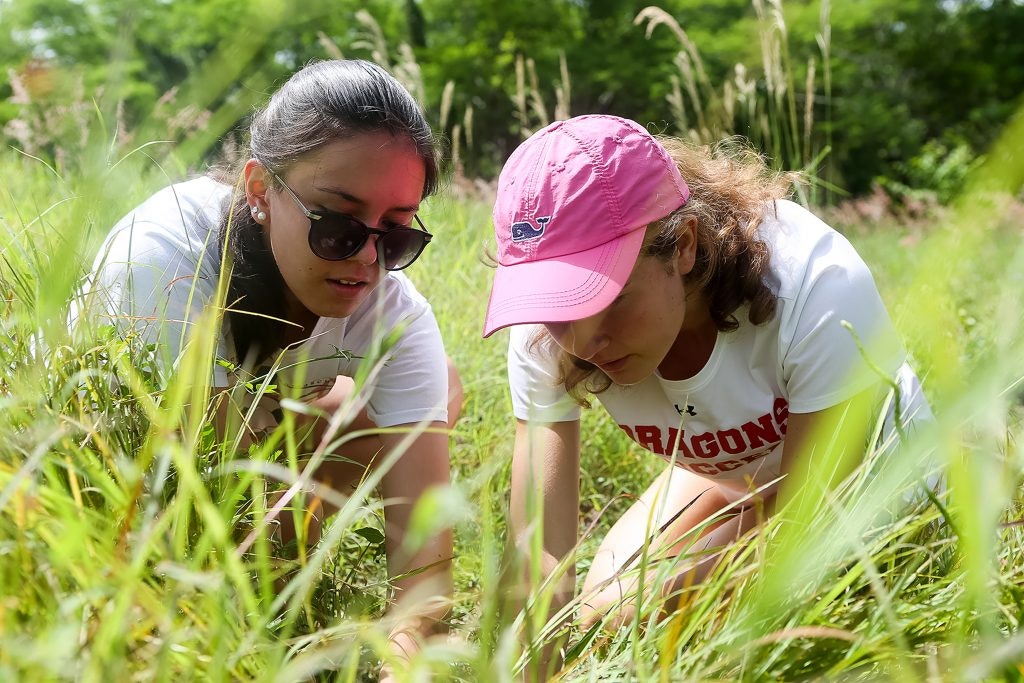
The work is physical and repetitive. It is also the category where students most often underestimate the labor, because planting looks lighter on a program page than it is at 9am in humidity.
Groups in the Dominican Republic plant mangroves against coastal erosion on the north shore, which is slower work than the beach cleanups that sit alongside it.
Mangrove restoration in the Dominican Republic. Mangrove root systems hold shoreline sediment against storm surge.
2. Animal conservation
Animal conservation projects protect threatened species through population monitoring, habitat protection, and nursery management. Sea turtle work dominates this category because nesting seasons overlap with the summer travel window.
Students work with 5 sea turtle species: critically endangered hawksbill, endangered green, endangered loggerhead, vulnerable leatherback, and vulnerable olive ridley. Tasks include clearing beach debris that blocks nesting females, relocating eggs to protected nurseries, and recording nest counts.
Night patrols are standard. Hatchling releases are not guaranteed on any given itinerary, because release timing depends on incubation rather than on the program calendar, and admissions gets this question more than any other in the category.
Students monitor loggerhead nests on a Greek island from a base in the Ionian Sea.

A hatchling release in Costa Rica. Nest relocation to a guarded nursery raises survival odds against poaching and tidal flooding.
3. Infrastructure and clean water
Infrastructure projects build and repair the physical systems a community lacks: water pipelines, storage tanks, sanitation blocks, classrooms, and housing. This category produces the highest countable unit output of the 5.
Rustic Pathways students built 6 houses and repaired 55 in 2025. Totals since 2013 are 143 houses built and 959 repaired.
Infrastructure carries the longest itineraries at 7 to 23 days, because masonry and pipe work need continuity across a build cycle rather than a rotating crew. Students build water and school infrastructure in Peru’s Sacred Valley across 12 days, and Thailand: Come With Nothing runs 23 days, the longest service itinerary in the catalog.
4. Agriculture and food security
Agriculture and food security projects address food access through farm labor, distribution work, and garden construction. Food insecurity inside fertile agricultural regions is the specific pattern this category targets.
Hawaii’s Big Island is the case students find hardest to believe before arrival. The island grows produce year-round and still runs a food bank network, because a large share of land in agricultural production is committed to export crops rather than local consumption.
Students sort donations with the Hawaii Food Basket and work 2 farm sites on the same itinerary. In Fiji the equivalent work is pineapple harvesting and meal preparation for a women’s and children’s shelter, which is the shortest turnaround between labor and visible result of anything in this category.
5. Education exchange
Education exchange projects pair students with peers in the host country for reciprocal language and culture teaching. The exchange runs in both directions, which is what separates it from one-way English tutoring.
This category runs 8 to 15 days and opens at the lowest entry price of $2,995, because it needs no build materials and no field equipment. It also carries the only service itinerary built for ages 12 to 14.
Students teach English and learn Korean alongside Seoul students across 2 weeks. Choosing between these 5 categories comes down to 2 variables.
Which service learning project should a student choose?
Match the project to the student’s tolerance for physical work first and the student’s age second.
| If the student | Choose | Reason |
|---|---|---|
| Is 14 and traveling internationally for the first time | Education exchange | Shortest itinerary, lowest physical demand, most structured days |
| Wants visible output by the last day | Infrastructure | The only category that produces a single completed object |
| Is applying to environmental science programs | Environmental or animal conservation | Field data collection transfers directly to a research write-up |
| Needs documented hours for a school requirement | Any of the 5 | All categories log verified hours; infrastructure logs the most per day |
| Has a capstone or IB CAS project to complete | Environmental or animal conservation | Nest counts and planting records give a measurable dataset |
| Is 12 or 13 | Education exchange or environmental conservation | The only 2 categories with dedicated middle school itineraries |
Students unsure of the fit can match a student profile to a project type in 3 minutes. Cost and length are the next filter.
What service learning projects abroad cost and how long each type runs
Service learning projects abroad through Rustic Pathways cost $1,995 to $13,680, with a median price of $4,195. Service-focused itineraries fall in the lower half of that range, with no dive certification, trek permit, or multi-country flight cost included.
Program lengths range from 7 to 23 days, with education exchange lasting 8 to 15 days and infrastructure projects lasting 7 to 23 days.
| Program | Country | Duration | Price |
|---|---|---|---|
| Beachside Service | Dominican Republic | 8 days | $1,995 |
| Pura Vida Service | Costa Rica | 8 days | $2,495 |
| Turtle Conservation Project | Costa Rica | 8 days | $2,895 |
| Seoul Searching | South Korea | 8 days | $2,995 |
| Surf, Snorkel, and Service | Hawaii | 8 days | $3,395 |
| Island Turtle Conservation | Greece | 9 days | $3,495 |
| Sacred Valley Service | Peru | 12 days | $4,195 |
| Aloha Service | Hawaii | 12 days | $5,995 |
| Come With Nothing | Thailand | 23 days | $6,995 |
Program tuition covers accommodation, meals, in-country transport, and staffing. Airfare is not included in the program tuition.
Payment runs as 4 installments across 6 weeks, or as monthly installments starting up to 23 months before departure, and a full breakdown of what a program tuition includes lists every exclusion. Outcome evidence is the last thing families ask about.
What the research shows about service learning outcomes
Research on service learning outcomes points to civic purpose development beyond skill acquisition alone.
A peer-reviewed study published in the journal Adolescents in February 2024 by Lincoln, Patel, Binder, Lund and Liang analyzed interviews with 9 Rustic Pathways fellowship participants aged 15 to 17. Rustic Pathways funded the study and published the result rather than summarizing it.
The study reports that program structure and peer accountability were central to project completion, and that participants moved from motivation to action only where scaffolding existed.
Rustic Pathways had no role in study design, execution, interpretation, or writing. The sample is 9 students, which makes the findings qualitative and directional.
“It’s like you’re putting on glasses when you’re really blind.”
Fellowship participant, quoted in Lincoln et al., Adolescents 4(1), 2024
A separate 2023 assessment by the Boston College Purpose Lab found that 86% of participants reported the program affected participant values and the contribution those participants hope to make. That figure comes from 43 post-trip respondents against 216 pre-trip respondents, so the attrition matters and the number should be read as directional rather than as a population estimate.
Service learning project questions
Do service learning projects abroad count toward school service hour requirements?
Yes, service learning projects abroad can count toward school service hour requirements when the school accepts verified hours. Rustic Pathways logs verified service hours for every student and provides documentation on request, totaling 44,200 hours in 2025 and 1,327,000 since 2013.
What is the minimum age for a service learning project abroad?
The minimum age for a service learning project abroad is 14 across all 5 project types. Rustic Pathways runs dedicated middle school service itineraries from age 12 at an enhanced 1 to 5 supervision ratio.
Is a service learning project abroad safe for a 14 year old?
A service learning project abroad can be safe for a 14 year old when the program provides structured supervision, trained staff, and established safety protocols. Rustic Pathways traveled 2,238 students in 2025 at a verified 4.37-to-1 staff-to-student ratio against a published 7-to-1 promise, 87.7% of logged incidents that year were classified as minor, and how Rustic Pathways staffs and supervises service projects sets out the protocol.
Do students need previous volunteer experience?
No, students do not need previous volunteer experience for a service learning project abroad. Every project includes on-site training before activities begin, and 92% of Rustic Pathways seasonal staff come from the host country.
Can a service learning project abroad support a capstone or IB CAS requirement?
Yes, a service learning project abroad can support a capstone or IB CAS requirement by providing measurable project data for written reflections and assessments. Environmental and animal conservation projects generate datasets such as nest counts, planting records, and water quality readings that students can use to support a written submission.
How long does a service learning project abroad run?
A service learning project abroad runs between 7 and 23 days. Education exchange projects run 8 to 15 days and infrastructure projects run 7 to 23 days.
Which service learning project type produces the most community output?
Infrastructure projects produce the most measurable community output among service learning project types. In 2025 Rustic Pathways students helped build 6 houses and repair 55 houses, the highest countable unit output across the 5 Rustic Pathways project types.


