School Trips to the PhilippinesBohol, Palawan & the Ifugao Rice Terraces

School trips to the Philippines are educational group tours across the country's limestone islands, coral coasts, and rice-terrace highlands.
In 2026, Rustic Pathways programs to the Philippines priced between $2,390 and $2,980 per student, excluding international airfare, on itineraries of 8 days.
No commitment, and no sales call unless you ask for one.
4.9on Trustpilot and Google
Philippines School Travel Itineraries
The three Philippines school travel itineraries are Limestone, Living Forests and Reefs, Caves, Mangroves and Reef Coast, and Rice Terraces and Living Culture. Limestone, Living Forests and Reefs starts at $2,390 for 8 days, Caves, Mangroves and Reef Coast starts at $2,935 for 8 days, and Rice Terraces and Living Culture starts at $2,980 for 8 days.
Compare the three itineraries side by side
| Itinerary | Bohol: Limestone, Living Forests and Reefs | Palawan: Caves, Mangroves and Reef Coast | Ifugao: Rice Terraces and Living Culture |
|---|---|---|---|
| Length | 8 days | 8 days | 8 days |
| Starting price | From $2,390 | From $2,935 | From $2,980 |
| Learning focus | Earth Science · Marine Biology · Conservation | Environmental Science · Conservation · Geology | History · Cultural Geography · Environmental Engineering |
| Route | Cebu · Panglao Island · Bohol · Chocolate Hills · Loboc River | Manila · Sabang · Puerto Princesa Underground River · Puerto Princesa · Honda Bay | Manila · Cauayan · Banaue · Batad Rice Terraces · Hapao |
| Overnight bases | Cebu (1) · Panglao / Bohol (4) · Cebu (2) | Manila (1) · Sabang (2) · Puerto Princesa (3) · Manila (1) | Manila (1) · Banaue (4) · Cauayan (1) · Manila (1) |
| Physical profile | 6 low · 2 moderate | 7 low · 1 moderate | 6 low · 2 moderate |
| On-program flights | None on program: the group arrives and departs Cebu (CEB) | One domestic leg each way: Manila (MNL) to Puerto Princesa (PPS) and back; international flights arrive and depart Manila | Two domestic legs each way: Manila (MNL) to Cauayan and back; international flights arrive and depart Manila |
| Days on the water | 3 water days: the Loboc river, the licensed reef excursion, and two ferry crossings | 3 water days: the Underground River, the mangrove paddle, and the Honda Bay reef excursion | 0; the route stays on land, with terrace walks and a mountain museum in place of a water day |
| Best for | Best for earth science and biology departments that want a limestone landscape, a licensed reef day with qualified instructors, and a manageable two-island route through Cebu and Bohol. | Best for environmental science departments that want a permitted cave system, a mangrove comparison, and a guided reef ecology day, without the longer road legs of a Port Barton or El Nido route. | Best for history and geography departments that want the Ifugao terraces, Hapao, and a public ethnographic museum, based from one mountain town rather than split across several. |
- Cebu · Arrive; two nights before the ferry crossing
- Panglao / Bohol · Four nights; the Chocolate Hills, the Loboc river, and the reef day
- Cebu · Return by ferry; two nights before departure
- Manila · Arrive; one night before the flight to Palawan
- Sabang · Two nights; the Underground River and the mangrove paddle
- Puerto Princesa · Three nights; Honda Bay reef ecology
- Manila · Return by flight; one night before departure
- Manila · Arrive; one night before the flight north
- Banaue · Four nights; the Batad and Hapao terraces, National Museum Cordillera
- Cauayan · One night at the airport town before the return flight
- Manila · Return by flight; one night before departure
 Cebu · Bohol · Chocolate Hills · Loboc River
8 days · From $2,390
Cebu · Bohol · Chocolate Hills · Loboc River
8 days · From $2,390
Bohol: Limestone, Living Forests and Reefs
Groups travel from Cebu to Bohol to explore the Chocolate Hills, the Loboc River, tarsier conservation, and coastal ecosystems. The eight-day itinerary combines earth science and marine biology with a licensed reef excursion before returning to Cebu to examine the city's colonial port history.
Choose this programThe route connects Cebu, Panglao Island, Bohol, Chocolate Hills, and Loboc River.
- Cebu1 night
- Panglao / Bohol4 nights
- Cebu2 nights
Your eight-day itinerary
-
Day 1
Arrive in Cebu
The group lands in Cebu, meets the Program Leaders who stay for the whole program, and settles in before a welcome dinner.
MorningArrival at Cebu's airport and the transfer to the hotel.AfternoonLunch and rest, with a short orientation if the arrival time allows.EveningWelcome dinner and the full orientation: the route, the ground rules, the week ahead.- Route
- Cebu's airport to the hotel.
- Travel
- A private transfer; timing depends on the arrival flight.
- Overnight
- Program-approved hotel in Cebu, shared rooms.
- Meals
- Dinner included; earlier meals depend on arrival time.
- Physical demand
- Easy; a short transfer and an early night.
- Learning outcome
- Students say what they already believe about the Philippines and where that belief came from.
-
Day 2
The crossing to Bohol
A scheduled ferry carries the group across the strait to Bohol, where an independent educator leads a stop at the National Museum's Natural History gallery before the group settles into Panglao.
MorningThe Cebu to Tagbilaran ferry, on assigned seats with the group's baggage checked.AfternoonNational Museum Bohol's Natural History gallery with a paid independent educator, then settling into Panglao.EveningDinner and an orientation walk near the hotel.- Route
- Cebu to Tagbilaran by ferry, then overland to Panglao.
- Travel
- A licensed passenger ferry on a fixed schedule; a coach transfer follows on landing.
- Overnight
- Program-approved hotel in Panglao / Bohol, shared rooms.
- Meals
- Breakfast, lunch, and dinner included.
- Physical demand
- Easy; a seated crossing and a museum visit.
- Learning outcome
- Students read Bohol's limestone geology before they see the landscape it shaped.
- Customization
- If the ferry schedule is suspended for weather, the crossing is deferred rather than replaced with an unlicensed boat.
-
Day 3
The Chocolate Hills
The group drives inland to the Chocolate Hills viewpoint before the midday heat, then works through a paid dessert-making workshop in the afternoon.
MorningThe drive inland to the Chocolate Hills viewpoint.AfternoonLunch and a paid dessert-making workshop, then rest.EveningDinner and a reflection on the day's landforms.- Route
- Panglao inland to the Chocolate Hills viewpoint and back.
- Travel
- Coach transfer on paved roads.
- Overnight
- Program-approved hotel in Panglao / Bohol, shared rooms.
- Meals
- Breakfast, lunch, and dinner included.
- Physical demand
- Moderate; viewpoint stairs, with a lower viewing platform for a student who needs it.
- Learning outcome
- Students connect the Chocolate Hills' karst landforms to rainfall and land use across Bohol.
- Customization
- A student who cannot manage the stairs uses the lower viewpoint with a Program Leader.
-
Day 4
The Loboc River and the tarsier sanctuary
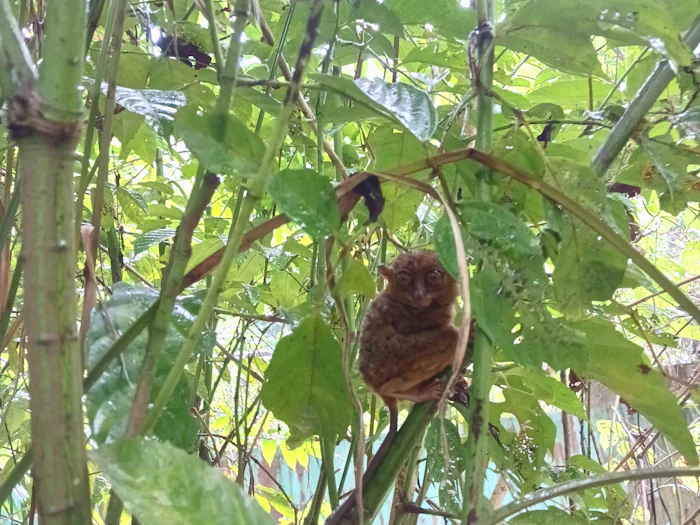
A gentle outing on the Loboc River in the morning is followed by small, quiet rotations through the Philippine Tarsier Foundation at Corella.
MorningA guided outing on the Loboc River, by licensed boat or a qualified paddle session.AfternoonSmall, quiet rotations through the Philippine Tarsier Foundation sanctuary at Corella.EveningDinner and a reflection on habitat and disturbance.- Route
- Panglao to the Loboc River, then to the tarsier sanctuary at Corella.
- Travel
- Coach transfer with a licensed river outing included.
- Overnight
- Program-approved hotel in Panglao / Bohol, shared rooms.
- Meals
- Breakfast, lunch, and dinner included.
- Physical demand
- Easy; a seated river outing and a quiet walking visit.
- Learning outcome
- Students compare a river ecosystem with a wildlife sanctuary's habitat requirements and its rules on visitor disturbance.
- Customization
- If river conditions are unsuitable, the group uses a land-based river walk instead. No handling or flash photography at the sanctuary.
-
Day 5
A licensed reef day
Qualified instructors lead an assessed snorkeling excursion with flotation support and a separate arrangement for any non-swimmer in the group.
MorningThe boat excursion out to the reef, with instructors briefing the group before entry.AfternoonContinued snorkeling within the day's sea and permit limits, then return to the hotel.EveningDinner and a reflection on what the group observed underwater.- Route
- Panglao out to the day's reef site and back by boat.
- Travel
- A licensed boat, with the route confirmed locally on the day.
- Overnight
- Program-approved hotel in Panglao / Bohol, shared rooms.
- Meals
- Breakfast, lunch, and dinner included.
- Physical demand
- Moderate; a full day of water activity, with a land-based alternative for any student who needs one.
- Learning outcome
- Students observe reef organisms and describe why the group never feeds or touches them.
- Customization
- A non-swimmer snorkels with dedicated flotation and a Program Leader alongside; a student who prefers to stay on the boat may do so.
-
Day 6
Return to Cebu
The group returns to Cebu on the scheduled ferry well ahead of the international departure, then takes a short heritage walk once settled.
MorningThe scheduled ferry back to Cebu.AfternoonCheck-in, rest, and a short heritage walk if time allows.EveningDinner and supervised free time.- Route
- Tagbilaran to Cebu by ferry, then to the hotel.
- Travel
- A licensed passenger ferry on a fixed schedule.
- Overnight
- Program-approved hotel in Cebu, shared rooms.
- Meals
- Breakfast, lunch, and dinner included.
- Physical demand
- Easy; a seated crossing.
- Learning outcome
- Students describe how inter-island ferry schedules shape daily life in the Visayas.
-
Day 7
Cebu's colonial port and a buffer day
A guided walk through Cebu's historic port takes in Fort San Pedro before an optional paid cooking class or a chance to recover any lost time from the crossing.
MorningA guided walk to Fort San Pedro and the public museum spaces that are open.AfternoonA paid cooking class, or recovered time if the crossing schedule shifted earlier in the week.EveningA closing dinner and group reflection.- Route
- A walking route through Cebu's historic port district.
- Travel
- On foot within the city, with no coach leg.
- Overnight
- Program-approved hotel in Cebu, shared rooms.
- Meals
- Breakfast, lunch, and dinner included.
- Physical demand
- Easy; a walking day on city streets.
- Learning outcome
- Students connect Cebu's colonial port history to the migration and food culture of the city today.
-
Day 8
Departure from Cebu
A last breakfast and a closing circle come before the transfer to Cebu's airport for the international flight home.
MorningBreakfast, packing, and the closing circle.AfternoonTransfer to Cebu's airport.EveningThe flight home departs.- Route
- The hotel to Cebu's airport.
- Travel
- A private transfer, with time built in for check-in.
- Overnight
- No program night; the group is on its flight home.
- Meals
- Breakfast included; later meals depend on the flight.
- Physical demand
- Easy; mostly seated.
- Learning outcome
- Students say what they thought Bohol and Cebu would be before the trip, and what changed it.
 Sabang · Underground River · Puerto Princesa · Honda Bay
8 days · From $2,935
Sabang · Underground River · Puerto Princesa · Honda Bay
8 days · From $2,935
Palawan: Caves, Mangroves and Reef Coast
Students explore Palawan's connected cave, mangrove, and reef ecosystems on an eight-day journey through Sabang and Puerto Princesa. Groups visit the Underground River, paddle through mangroves, and study reef ecology in Honda Bay, with a weather-buffer day built into the itinerary.
Choose this programThe route connects Manila, Sabang, Puerto Princesa Underground River, Puerto Princesa, and Honda Bay.
- Manila1 night
- Sabang2 nights
- Puerto Princesa3 nights
- Manila1 night
Your eight-day itinerary
-
Day 1
Land in Manila
The group lands in Manila and meets the Program Leaders who stay for the whole program before an early night ahead of tomorrow's flight south.
MorningArrival at Manila's airport and the transfer to the hotel.AfternoonRest, with no mandatory sightseeing scheduled after the long flight.EveningWelcome dinner and a short orientation for tomorrow's early flight.- Route
- Manila's airport to the hotel.
- Travel
- A private transfer; timing depends on the arrival flight.
- Overnight
- Program-approved hotel in Manila, shared rooms.
- Meals
- Dinner included; earlier meals depend on arrival time.
- Physical demand
- Easy; a transfer and an early night ahead of a morning flight.
- Learning outcome
- Students say what they already believe about Palawan and where that belief came from.
-
Day 2
Fly to Palawan and settle in Sabang
A domestic flight carries the group to Puerto Princesa, then a coach continues on to Sabang, with no excursion planned for the rest of the day.
MorningThe domestic flight from Manila to Puerto Princesa, on confirmed group seats.AfternoonA coach transfer on to Sabang and settling in; no boat excursion after the flight.EveningDinner and an early night ahead of the cave visit.- Route
- Manila to Puerto Princesa by air, then overland to Sabang.
- Travel
- A domestic flight with checked bags, followed by a coach transfer.
- Overnight
- Program-approved hotel in Sabang, shared rooms.
- Meals
- Breakfast, lunch, and dinner included.
- Physical demand
- Easy; a travel day, mostly seated.
- Learning outcome
- Students introduce Palawan's island geography and karst coast before the cave visit.
- Customization
- If the flight is disrupted, the group keeps its Puerto Princesa hotel and reschedules the onward crossing rather than improvising transport.
-
Day 3
The Underground River
With permits secured in advance, licensed boats carry the group into the Puerto Princesa Underground River, one of the trip's two protected-area visits.
MorningThe permitted Underground River visit by licensed boat.AfternoonRest and a short shore walk near Sabang.EveningDinner and a reflection on cave formation.- Route
- Sabang to the Underground River entrance and back by boat.
- Travel
- A licensed boat operating inside the park's daily visitor limit.
- Overnight
- Program-approved hotel in Sabang, shared rooms.
- Meals
- Breakfast, lunch, and dinner included.
- Physical demand
- Easy; a seated boat visit with a short walk.
- Learning outcome
- Students connect cave formation to the park's own visitor-limit rules for a protected area.
- Customization
- If sea access closes for the day, the visit moves to day 4 rather than being dropped.
-
Day 4
Mangroves, then a shorter base at Puerto Princesa
A small-group mangrove paddle through Sabang's enterprise-run tour precedes the drive back to a three-night base in Puerto Princesa.
MorningThe Sabang mangrove paddle boat tour, in small rotations.AfternoonLunch, then the drive back to Puerto Princesa for the rest of the stay.EveningDinner and settling into the new base.- Route
- Sabang mangroves, then overland to Puerto Princesa.
- Travel
- A small boat tour, followed by a coach transfer.
- Overnight
- Program-approved hotel in Puerto Princesa, shared rooms.
- Meals
- Breakfast, lunch, and dinner included.
- Physical demand
- Easy; a seated paddle tour and a road transfer.
- Learning outcome
- Students compare the mangrove system with the cave ecosystem they saw the day before.
- Customization
- If the cave and the mangroves cannot both fit the day's conditions, the cave visit is kept and the mangrove tour is openly dropped rather than rushed.
-
Day 5
Honda Bay reef ecology
Qualified guides lead the group through a licensed Honda Bay excursion, pairing an assessed snorkel with a reef ecology interpretation session.
MorningTravel to the Sta. Lourdes wharf and the licensed Honda Bay boat excursion.AfternoonAssessed snorkeling with flotation support and a non-swimmer alternative, then return to rest.EveningDinner and a reflection on reef conservation.- Route
- Puerto Princesa to Sta. Lourdes wharf, then out to Honda Bay by boat.
- Travel
- A coach to the wharf, then a licensed boat within its certified capacity.
- Overnight
- Program-approved hotel in Puerto Princesa, shared rooms.
- Meals
- Breakfast, lunch, and dinner included.
- Physical demand
- Moderate; a full day of water activity, with a shore-based alternative for any student who needs one.
- Learning outcome
- Students connect reef observations to the interpretation the guide gives on conservation.
- Customization
- If sea access closes, the day trades with day 6. A non-swimmer snorkels with dedicated flotation and a Program Leader alongside.
-
Day 6
Weather buffer and local life
A full day held in reserve for marine weather recovers yesterday's reef excursion if the sea closed, or turns to guided city heritage and a paid cooking demonstration if it did not.
MorningThe reef excursion if it was closed on day 5, or a guided city heritage walk along the waterfront.AfternoonA paid local cooking demonstration, or rest.EveningDinner and a group reflection.- Route
- Local movement within Puerto Princesa; no intercity transfer.
- Travel
- Short coach legs within the city.
- Overnight
- Program-approved hotel in Puerto Princesa, shared rooms.
- Meals
- Breakfast, lunch, and dinner included.
- Physical demand
- Easy; a walking or seated day depending on the weather.
- Learning outcome
- Students compare tourism livelihoods around Puerto Princesa with the protected marine habitats they visited.
- Customization
- If the sea stays closed for a second day, the group uses land-based coastal ecology and the cooking session rather than waiting for a marine window.
-
Day 7
Return flight to Manila
The group flies back to Manila a day ahead of the international departure, with the afternoon left open for hotel rest.
MorningThe domestic flight from Puerto Princesa to Manila, with checked bags included.AfternoonHotel rest, with a short city orientation if timing allows.EveningDinner and a closing reflection on the week.- Route
- Puerto Princesa to Manila by air.
- Travel
- A domestic flight with checked bags.
- Overnight
- Program-approved hotel in Manila, shared rooms.
- Meals
- Breakfast, lunch, and dinner included.
- Physical demand
- Easy; a travel day, mostly seated.
- Learning outcome
- Students describe how inter-island transport shapes daily life across the Philippines.
- Customization
- If the flight is disrupted, funded contingency covers airline rebooking rather than a same-day international connection.
-
Day 8
Depart from Manila
Breakfast and a final packing morning give way to the transfer to Manila's airport for the international flight home.
MorningBreakfast and packing.AfternoonTransfer to Manila's airport for the international departure.EveningThe flight home departs.- Route
- The hotel to Manila's airport.
- Travel
- A private transfer, with time built in for check-in.
- Overnight
- No program night; the group is on its flight home.
- Meals
- Breakfast included; later meals depend on the flight.
- Physical demand
- Easy; mostly seated.
- Learning outcome
- Students say what they now know about Palawan's protected caves and reefs that they did not know a week ago.
 Banaue · Batad · Hapao · Kiangan
8 days · From $2,980
Banaue · Batad · Hapao · Kiangan
8 days · From $2,980
Ifugao: Rice Terraces and Living Culture
Groups spend four nights in Banaue among the mountain landscapes and communities of the Ifugao highlands. Guided walks through the Batad and Hapao rice terraces and a visit to the National Museum Cordillera connect the eight-day itinerary with history, cultural geography, and environmental engineering.
Choose this programThe route connects Manila, Cauayan, Banaue, Batad Rice Terraces, and Hapao.
- Manila1 night
- Banaue4 nights
- Cauayan1 night
- Manila1 night
Your eight-day itinerary
-
Day 1
Arrive and rest in Manila
Program Leaders meet the group on arrival in Manila and hold the evening to rest and recover before the flight north the next morning.
MorningArrival at Manila's airport and the transfer to the hotel.AfternoonRest, with no mandatory activity scheduled after the long flight.EveningWelcome dinner and an early night ahead of tomorrow's flight.- Route
- Manila's airport to the hotel.
- Travel
- A private transfer; timing depends on the arrival flight.
- Overnight
- Program-approved hotel in Manila, shared rooms.
- Meals
- Dinner included; earlier meals depend on arrival time.
- Physical demand
- Easy; a transfer and a quiet evening.
- Learning outcome
- Students say what they already believe about the Cordillera and where that belief came from.
-
Day 2
Fly toward the Cordillera
A domestic flight to Cauayan is followed by a mountain drive up to Banaue, where the group settles in for four nights.
MorningThe domestic flight from Manila to Cauayan, on confirmed group seats.AfternoonThe mountain drive up to Banaue, with rest stops along the way.EveningDinner and rest after a substantial travel day.- Route
- Manila to Cauayan by air, then overland into the mountains to Banaue.
- Travel
- A domestic flight, followed by a coach on mountain roads.
- Overnight
- Program-approved hotel in Banaue, shared rooms.
- Meals
- Breakfast, lunch, and dinner included.
- Physical demand
- Easy; a full travel day, mostly seated.
- Learning outcome
- Students observe how the landscape changes from lowland to mountain agriculture along the route.
- Customization
- If group seats on the flight cannot be confirmed, the route is redesigned rather than replaced with an unplanned long road drive.
-
Day 3
Batad and Bangaan terraces
Locally authorized guides lead a terrace walk chosen for the group's fitness and the day's trail conditions.
MorningA guided walk through the Batad or Bangaan terraces, selected on the day.AfternoonLunch and rest, with an accessible viewpoint kept open for a student avoiding steep steps.EveningDinner and a reflection on rice-water management.- Route
- Banaue to the Batad or Bangaan terrace trailhead, then a guided walk.
- Travel
- A short local road transfer, then a walking route.
- Overnight
- Program-approved hotel in Banaue, shared rooms.
- Meals
- Breakfast, lunch, and dinner included.
- Physical demand
- Moderate to strenuous; uneven stone steps, with a gentler viewpoint alternative.
- Learning outcome
- Students interpret rice-water management through the guide's own account of the terraces.
- Customization
- Rain or unsafe steps move the day to lower viewpoints and guided interpretation instead of the full walk.
-
Day 4
Hapao's terrace landscape
A second terrace landscape at Hapao gives students a different comparison point on a measured public route walk with local guides.
MorningThe visit to Hapao with local guides for a different terrace landscape.AfternoonLunch and an interpretation of irrigation and present-day land use, then return to rest.EveningDinner and a group reflection.- Route
- Banaue to Hapao and back, with a guided walk on arrival.
- Travel
- A local road transfer, then a walking route on a public path.
- Overnight
- Program-approved hotel in Banaue, shared rooms.
- Meals
- Breakfast, lunch, and dinner included.
- Physical demand
- Moderate; sustained walking on uneven ground.
- Learning outcome
- Students compare terrain, water distribution, and settlement patterns between Batad and Hapao.
- Customization
- In poor weather this day trades with day 3. The group does not enter fields or homes without permission, and there is no hot-spring swimming on this itinerary.
-
Day 5
Ifugao culture beyond the viewpoint
An independent educator leads a booked group visit to National Museum Cordillera in Kiangan, followed by an optional paid craft demonstration back in Banaue.
MorningThe guided visit to National Museum Cordillera in Kiangan with an independent educator.AfternoonA paid weaving or craft demonstration at an agreed venue, subject to the artist's availability.EveningDinner and a group reflection.- Route
- Banaue to Kiangan and back, with the museum visit on arrival.
- Travel
- A coach round trip to Kiangan.
- Overnight
- Program-approved hotel in Banaue, shared rooms.
- Meals
- Breakfast, lunch, and dinner included.
- Physical demand
- Easy; a museum visit and an optional demonstration.
- Learning outcome
- Students use the museum's public ethnographic collection to interpret Ifugao material culture, without claiming access to any ceremony.
- Customization
- If the museum is closed for maintenance, the group uses the public Banaue Museum with the same independent educator instead. If the craft artist is unavailable, the educator leads an object-based discussion in its place.
-
Day 6
Down to the airport town
The group leaves Banaue in daylight for the drive down to Cauayan, where the last night sits close to tomorrow's return flight.
MorningA gentle local observation session before departing Banaue in daylight.AfternoonThe drive down to Cauayan, checking into the airport-town hotel.EveningDinner and rest ahead of the flight.- Route
- Banaue down to Cauayan by road.
- Travel
- A coach on mountain roads, with comfort stops.
- Overnight
- Program-approved hotel in Cauayan, shared rooms.
- Meals
- Breakfast, lunch, and dinner included.
- Physical demand
- Easy; a full transfer day, mostly seated.
- Learning outcome
- Students compare the mountain and lowland farming landscapes they pass on the way down.
- Customization
- If the road is delayed, no flight is booked for the same day and the group's overnight stays in Cauayan.
-
Day 7
Back to Manila, a day in hand
A confirmed flight brings the group back to Manila with a full day ahead of the international departure.
MorningThe domestic flight from Cauayan to Manila, with checked bags included.AfternoonHotel rest, with a public city museum visit if timing and traffic allow.EveningA closing dinner and group reflection.- Route
- Cauayan to Manila by air.
- Travel
- A domestic flight with checked bags.
- Overnight
- Program-approved hotel in Manila, shared rooms.
- Meals
- Breakfast, lunch, and dinner included.
- Physical demand
- Easy; a travel day, mostly seated.
- Learning outcome
- Students bring together their terrace and cultural observations from the week.
- Customization
- If the flight is canceled, airline-supported rebooking uses the built-in contingency, with the international departure remaining the next day.
-
Day 8
Fly home from Manila
The week closes with a final breakfast and a transfer to Manila's airport for the international flight home.
MorningBreakfast and a final packing check.AfternoonTransfer to Manila's airport for the international departure.EveningThe flight home departs.- Route
- The hotel to Manila's airport.
- Travel
- A private transfer, with time built in for check-in.
- Overnight
- No program night; the group is on its flight home.
- Meals
- Breakfast included; later meals depend on the flight.
- Physical demand
- Easy; mostly seated.
- Learning outcome
- Students say what surprised them about a rice terrace built and still farmed by the same families.
What applies across every itinerary
- Groups and teachers
- Groups start at ten students; smaller groups are considered on a case-by-case basis. One teacher's Program Tuition is free for every eight paying students.
- Rooming
- Students share gender-separated rooms, each with their own bed. Teachers get private rooms.
- Price
- Program Tuition doesn't cover flights to and from the program, travel insurance, medical insurance, or personal spending money.
- Flights and documents
- Groups book international flights themselves or ask Rustic Pathways to arrange them. Families arrange passports and any required entry authorizations with guidance from Rustic Pathways.
- Supervision
- Program Leaders lead scheduled activities, stay on site, and are available overnight. The approved itinerary specifies any free time, and Program Leaders are present during it.
- Effort
- Easy is limited walking or a seated transfer, and moderate is a full day with water activity, boardwalk stairs, or an uneven terrace trail.
- Getting around
- Every itinerary moves between islands by scheduled ferry or domestic flight rather than by road. The Bohol route flies into and out of Cebu; the Palawan and Ifugao routes both connect through Manila.
What shapes a school trip to the Philippines?
Three constraints shape a school trip to the Philippines: inter-island transport, the December-to-March sea window, and Manila's split airport terminals.
- Inter-island transport: The Philippines is an archipelago, so itineraries move between regions by scheduled ferry or domestic flight, not road. Each carries a buffer day to absorb a missed connection before it reshuffles the rest of the trip.
- Sea window: December through March brings the calm seas that ferry crossings, cave permits, and reef days depend on. Typhoon season runs June through November, when storms cancel boats with little notice.
- Manila terminals: Manila's airport terminals are unconnected buildings, so a same-day domestic connection means a terminal transfer, not a gate change. The Palawan and Ifugao itineraries route through Manila; the Bohol trip skips it, arriving and departing through Cebu.
How much does a school trip to the Philippines cost?
A school trip to the Philippines costs $2,390 to $2,980 per student in program tuition, or approximately $299 to $372 per day. Program tuition covers accommodation, meals, airport transfers, in-country transport, scheduled ferries and domestic flights, activities, guides, and entrance fees.
Schools receive one complimentary program tuition place for every eight paying students. Airfare is not included, and each program is quoted for the specific group.
$2,390 to $2,980
per student across the sample itineraries, excluding international airfare.
8 days
program length across the three itineraries.
Group quote
every school receives its own, built on dates, group size, and route.
| Included | What it covers |
|---|---|
| Travel | Accommodation for every program night, all meals and drinking water, airport transfers, scheduled inter-island ferries and domestic flights where the route uses them, in-country ground transport, guides, and entrance fees. |
| Staff and support | At least two trained Program Leaders, including both a male and a female leader, pre-departure planning, and school documentation. Enrolled families receive a 24/7 emergency number for use during programs and travel days. |
| Community donations | Required by a service project, paid by Rustic Pathways, and never collected from students. |
| Chaperones | One complimentary Program Tuition place per eight paying students. Chaperone airfare, travel insurance and medical insurance are separate. |
Not included: International airfare, travel insurance, medical insurance, personal spending, passport or visa fees, and vaccinations.
| Effect | Factor |
|---|---|
| raises | Peak season travel in the December to March window |
| raises | Reef, cave, and boat activities that need qualified instructors and equipment |
| raises | Domestic flights, used on the Palawan and Ifugao routes |
| raises | Upgraded lodging |
| raises | Extra chaperones beyond the complimentary place |
| lowers | More students in the group means fixed costs split more ways. |
Payment and cancellation
Installment plans are available. Schools pay as a group, or families pay monthly under the current enrollment terms.
What do students learn on a Philippines school trip?
Students on a Philippines school trip learn how geology, marine ecosystems, conservation, and human settlement shape the country's landscapes and communities.
Earth science and marine biology
Students examine the Chocolate Hills as a limestone landform and study marine ecosystems during a guided reef excursion in Bohol.
Environmental science and conservation
Students study cave formation at the Underground River and compare the connected cave, mangrove, and reef ecosystems of Palawan.
History and cultural geography
Students explore the Batad and Hapao rice terraces and use the National Museum Cordillera's ethnographic galleries to study Ifugao irrigation, settlement, and land use.

What makes Rustic Pathways educational trips different?
A Rustic Pathways school trip is one private group on your school's own dates, one bed per student, and an itinerary built to your curriculum.
- 01No mixed groups. Just your school
- 02One student, one bed
- 03Your school picks the dates
- 04Monthly payment plans available
- 05No tipping; Rustic Pathways Program Tuition includes community donations
- 06Aligned to your curriculum
How safety is managed on a school trip to the Philippines
Program Leaders manage local operations and safety procedures alongside school chaperones. Across 13 years of published incident data from every Rustic Pathways program worldwide, 87% of reports were GREEN, the minor tier where the group stays intact.
What the team plans for
Manila and Cebu
City traffic, group movement through separated airport terminals, and crowded public areas
Inter-island ferries
Scheduled licensed crossings with assigned seats, subject to local clearance before departure
Domestic flights
Confirmed group seats and checked baggage, with a planned buffer ahead of each connection
Reef, cave, and mangrove days
Assessed water activities with flotation, qualified supervision, and a non-swimmer alternative on every water day
Terrace and trail terrain
Guided walks on uneven steps, with a gentler viewpoint alternative for students who need one
Typhoon season
Storms and boat cancellations remain possible June through November, with routes reviewed locally before any water day
Controls built into every trip
Written risk plan. A score above 5 requires new controls, reassessment, or cancellation.
Two-Deep Leadership. A single staff member is never alone with students, and at least two trained Program Leaders, including both a male and a female leader, support each School Group Travel trip.
Assessed activity vendors. Ferry, dive, and cave operators are reviewed before use, every one to two years, and on site when high risk.
Medical readiness. WFR coverage for remote programs and a dedicated Medical Director who has led medical planning since 2015.
Is Rustic Pathways the right partner for your school trip to the Philippines?
Rustic Pathways is the right partner when your school wants one private group, on your dates, built around your curriculum. Students travel only with their teachers and classmates; individual students join fixed-departure Philippines programs instead.
- You want one private group with your dates and your teachers.
- You can travel for 8 days.
- You have 10 or more students.
- You want to read the day-by-day before you commit.
- A student has significant mobility, medical, sensory, mental-health, dietary, or religious support needs. Raise these before booking so Rustic Pathways can adapt the route and support plan where feasible.
- You have fewer than 10 students.
- You want the Palawan or Ifugao itinerary. Both connect through Manila, where a same-day domestic leg means a terminal transfer.
- You are traveling June through November, when typhoon season can close a boat route with little notice.
- You are an individual student or parent.
- You want your group merged with another school.
- You need a Mindanao or Sulu itinerary. None of the three routes go there.
Questions about school trips to the Philippines
The questions schools ask most before requesting a Philippines proposal, answered from the itineraries and prices shown here.
What is the average cost of a trip to the Philippines?
In 2026, an 8-day Rustic Pathways trip to the Philippines costs $2,390–$2,980 per student, excluding international airfare. The final cost varies by season, trip length, and group size. Groups require at least 10 students and include one free teacher place for every eight paying students.
When is the best time to travel to the Philippines?
Travel to the Philippines from December through March for calmer seas during island crossings, reef days, and cave activities. Typhoon season runs from June through November, when storms can cause boat cancellations and route closures. Rustic Pathways schedules trips around your school calendar.

Ask Keegan about your Philippines trip
Keegan Kennedy answers Philippines school-trip questions with the school travel team.
Send your group size, dates, trip length, and what you want students to learn. I’ll reply within 1 business day and send you options within 48 hours, and no sales call unless you ask for one.
Request your Philippines proposal
Start your Philippines trip proposal with your travel dates, group size, and learning goals. Receive a reply within 1 business day and customized trip options within 48 hours.
Or reach a person directly: +1 440-975-9691 or groups@rusticpathways.com
Need approval or funding first?
Certificate of insurance, risk management plans, and fundraising templates for families, on request.
Destinations related to the Philippines
Browse all school trip destinations- Rustic Pathways has operated student travel since 1983. Recent industry recognition:
- 2026 GoAbroad Innovation AwardsInnovation in Adventure-Based Programming · Global Adventure Learning Model
- 2025 International Travel AwardsBest Group Tour Operator
- 2024 Skift IDEA AwardsIndustry Innovators – Tour Operators
- 4x WYSETC Best Youth Tour Operator2015, 2017, 2018, 2019
- BBB A+ RatingBetter Business Bureau profile
- NESA Affiliate OrganizationNear East South Asia Council of Overseas Schools
- 2025 World Travel AwardsUnited States’ Leading Tour Operator