School Trips to North Carolina

Study first-flight experiments on the Outer Banks, civil rights in the Piedmont, Cherokee history in the mountains, or marine science on the Cape Fear coast.
Choose from six routes lasting 5–7 days, based in the Triangle, Outer Banks, Wilmington, or western North Carolina. Prices range from $2,010 to $3,255 per student, excluding airfare; the five-day Evidence, Innovation and Public History program is $2,010 per student.
No commitment, and no sales call unless you ask for one.
4.9on Trustpilot and Google
- $2,010–$3,255
- Price per student; airfare excluded.
- 5–7 days
- Six North Carolina routes
- Your school
- Private group on agreed dates
- 1:8
- One teacher place per eight paying students
- 321
- School partners since 2012, each counted once

Compare school trips to North Carolina
Compare the learning focus, overnight bases, and price, then open a route for its daily sequence. Travel days are included in the stated length.
Compare the six programs
| Program | Length | Overnight bases | Learning focus | Price, USD per student |
|---|---|---|---|---|
| Evidence, Innovation and Public History | 5 days | One Raleigh or Durham hotel, four nights | Environmental Science · STEM · US History | $2,010, excluding airfare |
| Outer Banks, Flight and Coastal Ecology | 6 days | Norfolk → Nags Head, five nights → Norfolk | STEM · US History · Marine Science | Price from $2,790 per student, excluding airfare |
| Raleigh, Innovation and Civil Rights | 6 days | Raleigh–Durham, four nights → Greensboro, one night | Civics · Civil Rights · STEM | Price from $2,790 per student, excluding airfare |
| Asheville, Cherokee and the Blue Ridge | 7 days | Asheville, four nights → Cherokee, two nights → AVL | Indigenous Studies · Ecology · Appalachian Culture | Price from $3,255 per student, excluding airfare |
| Wilmington and Cape Fear History | 5 days | Wilmington, four nights → ILM | Naval History · Marine Science · Coastal Geography | Price from $2,010 per student, excluding airfare |
| Piedmont and High Country Colleges | 6 days | Durham, three nights → Winston-Salem, one night → Boone, one night | College Readiness · Arts · Campus Life | Price from $2,790 per student, excluding airfare |

North Carolina: Evidence, Innovation and Public History
One evidence framework applied to a natural-history museum, a field ecostation, and a historic plantation site, from one base.
Choose this programYour five-day itinerary
-
Day 1
Arrive in the Triangle
One evidence framework, source to observation to interpretation to uncertainty, and a question each student picks to carry.
MorningTravel to the Research Triangle. The orientation is short and near the hotel.AfternoonRDU pickup, hotel check-in, and short nearby orientation.EveningDinner and introduction to a common evidence framework: source, observation, interpretation, and uncertainty. Students choose a question to investigate.- Route
- RDU to the Raleigh or Durham hotel.
- Travel
- Private group transfer
- Overnight
- Raleigh/Durham area.
- Meals
- Meals and drinking water while on program; arrival and departure meals follow flight times.
- Physical demand
- Low effort
-
Day 2
Science you can examine
A booked school program, then the framework applied to a single exhibit, with time to revise a claim rather than defend it.
MorningNC Museum of Natural Sciences visit and a booked age-appropriate school program. Use two student cohorts if room capacity requires it.AfternoonLunch and a Program Leader-facilitated workshop applying the evidence framework to one exhibit or investigation. Allow time to revisit a claim and revise it.EveningDinner and downtime.- Route
- Hotel to the North Carolina Museum of Natural Sciences in Raleigh.
- Travel
- Coach, then on foot
- Overnight
- Raleigh/Durham area.
- Meals
- Meals and drinking water while on program; arrival and departure meals follow flight times.
- Physical demand
- Low effort
-
Day 3
Field evidence
A field site, a second observation block, and the limits of what one visit can establish.
MorningPrairie Ridge Ecostation is closed to general visitors during construction. Request one of its limited registered small-group programs; staff availability and capacity determine whether this day can run there. Otherwise agree a different naturalist-led field site before booking.AfternoonPacked lunch and a second observation block at the confirmed field site, followed by student analysis. Name sampling limitations and avoid claiming one visit establishes environmental change.EveningDinner and brief peer explanation.- Route
- Hotel to the confirmed field site and back; Prairie Ridge Ecostation only if its limited program is booked.
- Travel
- Coach
- Overnight
- Raleigh/Durham area.
- Meals
- Meals and drinking water while on program; arrival and departure meals follow flight times.
- Physical demand
- Moderate effort, a full day outdoors
-
Day 4
Whose history is preserved?
Enslaved people's lives and the evidence that survives, then how a science museum and a historic site each support a claim.
MorningTake Historic Stagville’s reserved guided school tour, normally Tuesday–Friday, 10 a.m.–noon. Construction during 2026–2027 limits facilities and group capacity; the site must approve the booking. Interpret enslaved people’s lives through surviving buildings and records, with no reenactment or promised descendant encounter.AfternoonLunch and rest, then student synthesis. Compare how scientific and historical institutions support claims; produce a credited short exhibition panel with an unanswered question.EveningDinner and presentations.- Route
- Hotel to Historic Stagville, north of Durham.
- Travel
- Coach
- Overnight
- Raleigh/Durham area.
- Meals
- Meals and drinking water while on program; arrival and departure meals follow flight times.
- Physical demand
- Moderate effort
-
Day 5
Departure
Breakfast, a closing reflection, and the airport.
MorningBreakfast, closing reflection, and packing.AfternoonRDU transfer and departure, with meals while on program.EveningMeals continue while the group is on program.- Route
- Hotel to RDU.
- Travel
- Private group transfer
- Overnight
- None; program ends.
- Meals
- Meals and drinking water while on program; arrival and departure meals follow flight times.
- Physical demand
- Low effort

North Carolina: Outer Banks, Flight and Coastal Ecology
Test flight ideas at Kill Devil Hills, compare English and Algonquian histories on Roanoke Island, and study the coast from dunes to sea-turtle care.
Choose this programYour 6-day itinerary
- Day 1
Arrive on the Outer Banks
ORF to Nags Head; no timed attraction on arrival.
MorningTravel to Norfolk International Airport in Virginia; flights are outside the program price.AfternoonAllow about three hours, plus traffic and a rest stop, for the transfer to Nags Head. Check in and introduce barrier-island geography.EveningDinner and a short beach observation from an agreed safe area.- Route
- ORF to Nags Head; no timed attraction on arrival.
- Travel
- Private group transport
- Overnight
- Nags Head
- Meals
- Meals and drinking water while on program; arrival and departure meals follow flight times.
- Physical demand
- Moderate walking
- Day 2
First flight and moving dunes
Nags Head to Kill Devil Hills and Jockey’s Ridge.
MorningVisit Wright Brothers National Memorial in Kill Devil Hills. Use the reproduction 1903 Wright Flyer and flight markers to examine how Wilbur and Orville Wright tested their ideas.AfternoonAt Jockey’s Ridge State Park, observe wind-shaped dunes and run a teacher-led lift-and-drag design challenge. Follow park rules and stay clear of hang-gliding activity.EveningCompare measured observations with predictions.- Route
- Nags Head to Kill Devil Hills and Jockey’s Ridge.
- Travel
- Private group transport
- Overnight
- Nags Head
- Meals
- Meals and drinking water while on program; arrival and departure meals follow flight times.
- Physical demand
- Moderate effort: walking on sand and exposed slopes
- Day 3
Roanoke Island and competing accounts
Nags Head to Manteo and back; advance school reservations.
MorningExplore Fort Raleigh National Historic Site with a requested ranger program or teacher-led materials about the English voyages of the 1580s, the Lost Colony, and Carolina Algonquian peoples. Visit the Elizabethan Gardens to compare a commemorative landscape with historical evidence.AfternoonAt Roanoke Island Festival Park, examine the representational Elizabeth II ship and living-history exhibits. Distinguish modern reconstruction from surviving evidence.EveningDiscuss what the records reveal and what remains uncertain.- Route
- Nags Head to Manteo and back; advance school reservations.
- Travel
- Private group transport
- Overnight
- Nags Head
- Meals
- Meals and drinking water while on program; arrival and departure meals follow flight times.
- Physical demand
- Moderate walking
- Day 4
Pier science and sea-turtle conservation
Nags Head to Jennette’s Pier, then Roanoke Island.
MorningJoin a booked marine-science or renewable-energy lesson at Jennette’s Pier. Sessions typically take 45–60 minutes, with the program matched to the students’ grade.AfternoonVisit the North Carolina Aquarium on Roanoke Island for coastal habitats and sea-turtle conservation. Use public exhibits; animal treatment and behind-the-scenes access are not included.EveningRecord one connection between dune, sound, and ocean habitats.- Route
- Nags Head to Jennette’s Pier, then Roanoke Island.
- Travel
- Private group transport
- Overnight
- Nags Head
- Meals
- Meals and drinking water while on program; arrival and departure meals follow flight times.
- Physical demand
- Moderate walking
- Day 5
Hatteras shorelines and shipwrecks
Full Hatteras day; lighthouse grounds only, with no climb during the 2026 restoration closure.
MorningTravel south on NC 12 through Cape Hatteras National Seashore. Study storm exposure, dunes, and shoreline change at an open beach access and the Cape Hatteras Lighthouse area.AfternoonVisit the Graveyard of the Atlantic Museum in Hatteras for navigation and shipwreck history. Allow roughly two hours each way from Nags Head and return before dinner.EveningPresent a coastal-risk map supported by the week’s observations.- Route
- Full Hatteras day; lighthouse grounds only, with no climb during the 2026 restoration closure.
- Travel
- Private group transport
- Overnight
- Nags Head
- Meals
- Meals and drinking water while on program; arrival and departure meals follow flight times.
- Physical demand
- Long coach day; beach walking
- Day 6
Return through Norfolk
Nags Head to ORF.
MorningBreakfast, packing, and final reflection.AfternoonTransfer to ORF with a generous traffic allowance; book an afternoon or evening flight.EveningProgram ends at the agreed airport handoff.- Route
- Nags Head to ORF.
- Travel
- Private group transport
- Overnight
- Home
- Meals
- Meals and drinking water while on program; arrival and departure meals follow flight times.
- Physical demand
- Low effort

North Carolina: Raleigh, Innovation and Civil Rights
Connect state government and engineering in Raleigh with Black community history in Durham, the Greensboro sit-ins, and Moravian life in Old Salem.
Choose this programYour 6-day itinerary
- Day 1
Arrive in the state capital
RDU to one Raleigh–Durham base.
MorningTravel to Raleigh-Durham International Airport.AfternoonTransfer to the Raleigh–Durham hotel and introduce the week’s question: who can influence public decisions?EveningDinner near the hotel. A Sunday arrival supports the weekday school-booking sequence.- Route
- RDU to one Raleigh–Durham base.
- Travel
- Private group transport
- Overnight
- Raleigh–Durham
- Meals
- Meals and drinking water while on program; arrival and departure meals follow flight times.
- Physical demand
- Low effort
- Day 2
Engineering and public knowledge
Raleigh campus transfers; allow time between Main and Centennial campuses.
MorningExplore NC State University’s Main Campus and Memorial Bell Tower using an approved group visit or registered self-guided route.AfternoonTransfer to Centennial Campus for the James B. Hunt Jr. Library’s public areas and a teacher-led study of library design and the bookBot. Discuss Research Triangle Park’s biotechnology economy using public company and university evidence; research labs are not a scheduled stop.EveningDinner in Raleigh’s historic City Market area, with the restaurant chosen for group capacity.- Route
- Raleigh campus transfers; allow time between Main and Centennial campuses.
- Travel
- Private group transport
- Overnight
- Raleigh–Durham
- Meals
- Meals and drinking water while on program; arrival and departure meals follow flight times.
- Physical demand
- Moderate walking
- Day 3
Artifacts, government, and freedom
Mordecai to downtown Raleigh; arrange the Capitol and legislature through Capital Area Visitor Services.
MorningTake Mordecai Historic Park’s reserved 10 a.m.–12:30 p.m. school field trip, including house artifacts and Slavery and Archaeology activities.AfternoonVisit the North Carolina State Capitol and Legislative Building in separately booked afternoon slots, then read the public inscriptions at North Carolina Freedom Park. Use Museum of History digital resources before the trip while its Raleigh building is closed.EveningDiscuss how an artifact, law, and memorial each convey a different kind of evidence.- Route
- Mordecai to downtown Raleigh; arrange the Capitol and legislature through Capital Area Visitor Services.
- Travel
- Private group transport
- Overnight
- Raleigh–Durham
- Meals
- Meals and drinking water while on program; arrival and departure meals follow flight times.
- Physical demand
- Moderate walking
- Day 4
Durham industry and Black community history
Raleigh to Durham and back; Hayti interior programming is an optional quoted addition.
MorningVisit Duke Homestead to examine tobacco production, labor, and the industry’s economic and health consequences.AfternoonStudy Hayti Heritage Center’s former church building from public exterior space and use the center’s published history to examine Black cultural life in Durham. Continue with downtown Durham and American Tobacco Campus; a center-led interior visit requires separate confirmation.EveningDinner and a comparison of industrial growth and community change.- Route
- Raleigh to Durham and back; Hayti interior programming is an optional quoted addition.
- Travel
- Private group transport
- Overnight
- Raleigh–Durham
- Meals
- Meals and drinking water while on program; arrival and departure meals follow flight times.
- Physical demand
- Moderate walking
- Day 5
The Greensboro sit-ins
Raleigh–Durham to Greensboro, about 1.5 hours plus traffic; allow 90–120 minutes at the museum.
MorningTravel to Greensboro and visit the International Civil Rights Center & Museum in the former F.W. Woolworth building. A reserved staff-guided tour examines the 1960 sit-ins and nonviolent organizing.AfternoonVisit North Carolina A&T State University using its approved high-school group tour or requested self-guided visit. Connect the students’ activism with the university’s continuing role as an HBCU.EveningStay in Greensboro and review sources without requiring students to share personal experiences.- Route
- Raleigh–Durham to Greensboro, about 1.5 hours plus traffic; allow 90–120 minutes at the museum.
- Travel
- Private group transport
- Overnight
- Greensboro
- Meals
- Meals and drinking water while on program; arrival and departure meals follow flight times.
- Physical demand
- Moderate walking
- Day 6
Old Salem and departure
Greensboro to Winston-Salem, then GSO; allow about 45 minutes for each drive.
MorningSpend about three hours at Old Salem Museums & Gardens on the reserved Footsteps Through History school visit, normally Wednesday–Friday. Examine Moravian trades and the histories of people who lived and worked in the town.AfternoonLunch, closing discussion, and transfer to GSO for a late-afternoon or evening departure. An early flight needs an added night or a revised route.EveningProgram ends at the airport handoff.- Route
- Greensboro to Winston-Salem, then GSO; allow about 45 minutes for each drive.
- Travel
- Private group transport
- Overnight
- Home
- Meals
- Meals and drinking water while on program; arrival and departure meals follow flight times.
- Physical demand
- Moderate walking

North Carolina: Asheville, Cherokee and the Blue Ridge
Read mountain ecosystems, craft traditions, and Cherokee history through Asheville, the Blue Ridge, and two nights near the Smokies.
Choose this programYour 7-day itinerary
- Day 1
Arrive in Asheville
AVL to Asheville.
MorningTravel to Asheville Regional Airport; the day allows for flight time.AfternoonTransfer to the hotel and take a short downtown orientation. Introduce Appalachian geography and the Eastern Band of Cherokee Indians’ present-day sovereignty.EveningDinner and route briefing.- Route
- AVL to Asheville.
- Travel
- Private group transport
- Overnight
- Asheville
- Meals
- Meals and drinking water while on program; arrival and departure meals follow flight times.
- Physical demand
- Low effort
- Day 2
Botanical science and watershed evidence
Asheville to the Arboretum; schedule this day Tuesday–Thursday when using a guided school program.
MorningVisit the North Carolina Arboretum for botanical observation and a pre-booked, grade-appropriate education program. For eighth grade, request Freshwater Ecology in its spring or fall window; older groups agree suitable programming before booking.AfternoonContinue a Program Leader-led comparison of planted gardens and forest habitats. Collect observational water-quality evidence using permitted methods; no sampling from restricted areas.EveningDiscuss what a single field visit can and cannot establish.- Route
- Asheville to the Arboretum; schedule this day Tuesday–Thursday when using a guided school program.
- Travel
- Private group transport
- Overnight
- Asheville
- Meals
- Meals and drinking water while on program; arrival and departure meals follow flight times.
- Physical demand
- Moderate walking
- Day 3
Blue Ridge ecology and Appalachian craft
Asheville and the Parkway’s Folk Art Center access; no promise of an uninterrupted scenic drive.
MorningUse an open section of the Blue Ridge Parkway for a short ecology walk, with a route selected against current NPS road and trail notices. Closed sections are bypassed on regular roads.AfternoonVisit the Folk Art Center for Appalachian textiles, woodwork, and pottery. Arrange a Southern Highland Craft Guild hands-on outreach session in advance, with artist time and materials included in the group quote.EveningCompare how raw materials, tools, and geography shape craft traditions.- Route
- Asheville and the Parkway’s Folk Art Center access; no promise of an uninterrupted scenic drive.
- Travel
- Private group transport
- Overnight
- Asheville
- Meals
- Meals and drinking water while on program; arrival and departure meals follow flight times.
- Physical demand
- Moderate walking
- Day 4
Biltmore and Asheville’s writers
Asheville local touring; Biltmore admission and Wolfe tour confirmed before booking.
MorningExplore Biltmore House through its school-group self-guided audio visit, then examine landscape design and estate management on the grounds.AfternoonReturn to Asheville for the Thomas Wolfe Memorial and a short architecture walk. Connect the Gilded Age estate with literature about town life and social differences.EveningPrepare questions for the Cherokee visits.- Route
- Asheville local touring; Biltmore admission and Wolfe tour confirmed before booking.
- Travel
- Private group transport
- Overnight
- Asheville
- Meals
- Meals and drinking water while on program; arrival and departure meals follow flight times.
- Physical demand
- Moderate walking
- Day 5
Cherokee history and sovereignty
Asheville to Cherokee; the village’s published 2026 season is April 21–October 31.
MorningTransfer to Cherokee via I-40 and US 74, allowing about 1.5 hours plus a break. Visit the Museum of the Cherokee People on a reserved school tour.AfternoonVisit Oconaluftee Indian Village during its operating season for living-history interpretation. Contemporary Cherokee identity and sovereignty remain part of the discussion; the village depicts a historical period.EveningStay in Cherokee. A private cultural-specialist session is an optional quoted addition, not an assumed part of admission.- Route
- Asheville to Cherokee; the village’s published 2026 season is April 21–October 31.
- Travel
- Private group transport
- Overnight
- Cherokee
- Meals
- Meals and drinking water while on program; arrival and departure meals follow flight times.
- Physical demand
- Moderate walking
- Day 6
Smokies forest and river systems
Cherokee to Oconaluftee and back; weather and current trail conditions determine the walk.
MorningEnter Great Smoky Mountains National Park from Cherokee for an agreed ecology walk near Oconaluftee. The guide chooses an open trail appropriate to the group.AfternoonCompare forest layers, stream habitat, and watershed processes through observation and permitted fieldwork. Keep the day on the North Carolina side so it has time for investigation and rest.EveningFinish the capstone: whose knowledge shapes how Western North Carolina is understood?- Route
- Cherokee to Oconaluftee and back; weather and current trail conditions determine the walk.
- Travel
- Private group transport
- Overnight
- Cherokee
- Meals
- Meals and drinking water while on program; arrival and departure meals follow flight times.
- Physical demand
- Moderate effort: outdoor walking on uneven paths
- Day 7
Return to Asheville Regional Airport
Cherokee to AVL on regular roads.
MorningBreakfast and final reflection.AfternoonTransfer to AVL, allowing about two hours plus a buffer; schedule an afternoon flight.EveningProgram ends at the airport handoff.- Route
- Cherokee to AVL on regular roads.
- Travel
- Private group transport
- Overnight
- Home
- Meals
- Meals and drinking water while on program; arrival and departure meals follow flight times.
- Physical demand
- Low effort
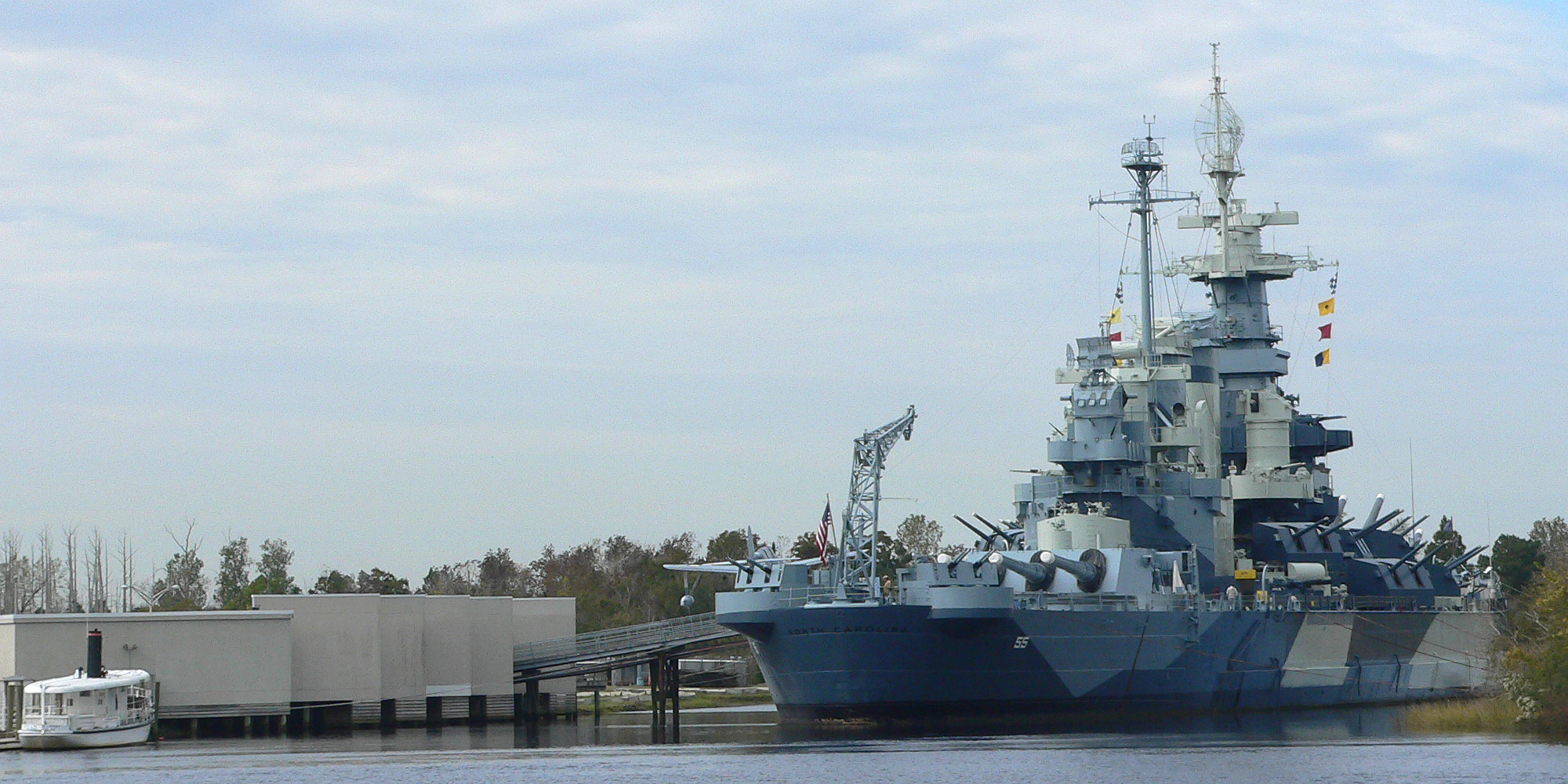
North Carolina: Wilmington and Cape Fear History
Compare wartime engineering, colonial port history, and coastal erosion from a Wilmington base.
Choose this programPhoto: Ken Thomas, public domain, Wikimedia Commons.
Your 5-day itinerary
- Day 1
Arrive at the Cape Fear River
ILM to Wilmington; no timed visit on arrival.
MorningTravel to Wilmington International Airport.AfternoonTransfer to the hotel, then orient to the historic downtown waterfront and the Cape Fear River estuary.EveningDinner and an introduction to navigation and coastal trade.- Route
- ILM to Wilmington; no timed visit on arrival.
- Travel
- Private group transport
- Overnight
- Wilmington
- Meals
- Meals and drinking water while on program; arrival and departure meals follow flight times.
- Physical demand
- Low effort
- Day 2
Battleship engineering and the waterfront
Wilmington to the battleship and downtown dock; allow time for ship ladders and rest.
MorningVisit Battleship North Carolina with the school’s reserved self-guided product. Compare machinery, crew spaces, and shipboard roles in World War II; the Program Leader supports the evidence activity.AfternoonTake the Wilmington Water Tours narrated river cruise, subject to group capacity and weather, then examine waterfront maps. Water sampling and macroinvertebrate analysis use teacher-supplied data and prepared specimens ashore, not an unverified onboard laboratory.EveningDiscuss how river geography influenced shipping and defense.- Route
- Wilmington to the battleship and downtown dock; allow time for ship ladders and rest.
- Travel
- Private group transport
- Overnight
- Wilmington
- Meals
- Meals and drinking water while on program; arrival and departure meals follow flight times.
- Physical demand
- Moderate effort: ship ladders; extended walking
- Day 3
Brunswick Town and Fort Anderson
Wilmington to Winnabow and back; keep this visit Tuesday–Saturday.
MorningTravel to Brunswick Town and Fort Anderson for colonial trade, the destruction of Brunswick in the Revolutionary War, and later Civil War defenses.AfternoonCompare foundations, earthworks, and interpretive evidence before returning to Wilmington.EveningOptional, separately quoted Ghost Walk of Old Wilmington treats stories as local folklore and compares them with historical evidence.- Route
- Wilmington to Winnabow and back; keep this visit Tuesday–Saturday.
- Travel
- Private group transport
- Overnight
- Wilmington
- Meals
- Meals and drinking water while on program; arrival and departure meals follow flight times.
- Physical demand
- Moderate walking
- Day 4
Fort Fisher and barrier-island change
Wilmington to Fort Fisher State Recreation Area, then Discovery Bay at Independence Mall if approved, and back; no in-water activity.
MorningVisit Fort Fisher State Recreation Area for a teacher-led study of dunes, erosion, and estuarine habitats, or a ranger program if confirmed.AfternoonOn the return to Wilmington, visit Discovery Bay, the NC Aquarium at Fort Fisher’s mini-aquarium at Independence Mall, if the operator accepts the school group. Compare marine and freshwater habitats. Rustic Pathways must confirm group capacity, coach access, and any educational program in the final quote; no lab or animal encounter is promised. If access is unavailable, use the Aquarium’s digital resources. The Fort Fisher building remains closed for renovation.EveningPresent a coastal management recommendation supported by observations and sources.- Route
- Wilmington to Fort Fisher State Recreation Area, then Discovery Bay at Independence Mall if approved, and back; no in-water activity.
- Travel
- Private group transport
- Overnight
- Wilmington
- Meals
- Meals and drinking water while on program; arrival and departure meals follow flight times.
- Physical demand
- Moderate effort: beach sand and exposed walking
- Day 5
Departure from Wilmington
Wilmington to ILM.
MorningBreakfast and final discussion.AfternoonTransfer to ILM for departure, with meals while on program.EveningProgram ends at the airport handoff.- Route
- Wilmington to ILM.
- Travel
- Private group transport
- Overnight
- Home
- Meals
- Meals and drinking water while on program; arrival and departure meals follow flight times.
- Physical demand
- Low effort

North Carolina: Piedmont and High Country Colleges
Compare Duke, UNC-Chapel Hill, Elon, Wake Forest, and Appalachian State through campus visits and a student-built college decision journal.
Choose this programYour 6-day itinerary
- Day 1
Arrive in Durham
RDU to Durham; Monday arrival supports the weekday tour sequence.
MorningTravel to RDU.AfternoonTransfer to Durham and discuss how to compare academic programs, cost, campus setting, and student support.EveningDinner and a walk through American Tobacco Campus to consider Durham’s shift from industry to education and research.- Route
- RDU to Durham; Monday arrival supports the weekday tour sequence.
- Travel
- Private group transport
- Overnight
- Durham
- Meals
- Meals and drinking water while on program; arrival and departure meals follow flight times.
- Physical demand
- Low effort
- Day 2
Duke’s campus and gardens
Durham local visits; campus and gardens require separate arrangements.
MorningJoin a school-requested Duke University group tour if approved, normally Tuesday–Thursday at 10 a.m. or noon. Duke excludes group tours in March, April, May, and August; a self-guided visit is agreed in advance when official tours are unavailable.AfternoonVisit Duke Chapel during public opening hours, then Sarah P. Duke Gardens on a separately registered, self-guided school visit in its 1–3 p.m. window. Consider architecture, landscape design, and student life; the universities do not sponsor this trip.EveningComplete a comparison journal with sourced academic and financial-aid questions.- Route
- Durham local visits; campus and gardens require separate arrangements.
- Travel
- Private group transport
- Overnight
- Durham
- Meals
- Meals and drinking water while on program; arrival and departure meals follow flight times.
- Physical demand
- Moderate walking
- Day 3
UNC-Chapel Hill: science and visual evidence
Durham to Chapel Hill and back, allowing about 45 minutes each way.
MorningVisit UNC-Chapel Hill through its confirmed high-school group tour or self-guided route, including the Old Well.AfternoonAttend a reserved Morehead Planetarium and Science Center program, then a one-hour Ackland Art Museum school tour, normally Wednesday–Friday. Compare scientific models and visual interpretation. Confirm compatible slots and school-price eligibility before booking.EveningReview how the day changed each student’s college criteria.- Route
- Durham to Chapel Hill and back, allowing about 45 minutes each way.
- Travel
- Private group transport
- Overnight
- Durham
- Meals
- Meals and drinking water while on program; arrival and departure meals follow flight times.
- Physical demand
- Moderate walking
- Day 4
Elon and Wake Forest
Durham to Elon, then Winston-Salem; both visits depend on confirmed compatible slots.
MorningTransfer to Elon University for a confirmed high-school group visit. If only a later slot is available, add a night or revise this two-campus day before booking.AfternoonContinue to Wake Forest University for its requested Thursday 2 p.m. group visit. Allow about one hour between campuses, plus lunch and arrival time.EveningStay in Winston-Salem and compare the two institutions using the same questions.- Route
- Durham to Elon, then Winston-Salem; both visits depend on confirmed compatible slots.
- Travel
- Private group transport
- Overnight
- Winston-Salem
- Meals
- Meals and drinking water while on program; arrival and departure meals follow flight times.
- Physical demand
- Moderate walking
- Day 5
Appalachian State and the High Country
Winston-Salem to Boone; official group visit is limited to 50.
MorningDrive to Boone, allowing about two hours with a break, for an Appalachian State University group visit for grades 10–12.AfternoonExplore Boone’s campus setting and discuss how location affects daily life, access, and study choices.EveningStay in Boone and prepare a final shortlist with unanswered questions.- Route
- Winston-Salem to Boone; official group visit is limited to 50.
- Travel
- Private group transport
- Overnight
- Boone
- Meals
- Meals and drinking water while on program; arrival and departure meals follow flight times.
- Physical demand
- Moderate walking
- Day 6
College choices and departure
Boone to Charlotte Douglas International Airport.
MorningPresent a short college comparison supported by notes and published information.AfternoonTransfer to CLT, allowing about 2.5 hours plus airport and traffic buffers; choose a late-afternoon or evening flight.EveningProgram ends at the airport handoff.- Route
- Boone to Charlotte Douglas International Airport.
- Travel
- Private group transport
- Overnight
- Home
- Meals
- Meals and drinking water while on program; arrival and departure meals follow flight times.
- Physical demand
- Low effort
Rooming
- Students
- Individual beds in shared, gender-separated rooms.
- Teachers
- Private rooms.
How much does a school trip to North Carolina cost?
Budget from $2,010 per student for five days in Wilmington, $2,790 for the six-day Outer Banks, civics, or college routes, or $3,255 for seven days in Asheville and Cherokee. Prices exclude airfare. The five-day Evidence, Innovation and Public History route is $2,010 per student.
Program Tuition includes the agreed lodging, meals while on program, ground transport, listed visits and activities, Program Leaders, and one complimentary teacher place per eight paying students.
| Included | What it covers |
|---|---|
| Travel | Every program night’s lodging, meals and drinking water while on program, airport transfers, coach transport, scheduled activities, guides, and entrance fees. Arrival and departure meals follow flight times. |
| Staff and support | At least two trained Program Leaders, including both a male and a female leader, pre-departure planning, and school documentation. |
| Chaperones | One complimentary Program Tuition place per eight paying students. Chaperone airfare, travel insurance and medical insurance are separate. |
Not included: Airfare and travel to your departure airport, travel insurance, medical insurance, and personal spending.
| Effect | Factor |
|---|---|
| raises | Peak and holiday weeks; season moves the price most. |
| raises | Shorter trips cost more per day, since fixed costs spread across fewer days. |
| lowers | More students in the group means fixed costs split more ways. |
| raises | Extra chaperones beyond the complimentary place. |
| raises | Upgraded lodging above the standard three-star option. |
What changes the quote?
Paid school programs, including the craft session near Asheville, need confirmed access before booking. Additional nights for coastal service, Nantahala adventure, or High Country geology require a separate quote.
Payment and cancellation
The school can pay as a group, or families can enroll individually and pay in full or through an eligible monthly plan. A deposit is due at enrollment; monthly plans are unavailable within 90 days of departure.
Cancellation charges rise closer to departure, and deposits and ticketed airfare may be nonrefundable. Check the applicable Group Travel enrollment terms before choosing a payment plan.
What do students learn on a North Carolina school trip?
Students on a North Carolina school trip learn to distinguish observation, interpretation, and uncertainty, then use that evidence to support a conclusion. The route determines the question and the sources they can examine.
Science and field methods
Test flight ideas, compare river and forest habitats, or revise a claim after a museum investigation. Name the limits of a short field visit.
History and public decisions
Read Stagville’s surviving evidence, the Greensboro sit-in site, Raleigh’s government buildings, or Cape Fear’s naval and colonial remains.
Culture and college choices
Examine Cherokee sovereignty and Appalachian craft, or compare universities using the same questions about learning, setting, and student support.


What makes Rustic Pathways educational trips different?
A Rustic Pathways school trip is one private group on your school's own dates, one bed per student, and an itinerary built to your curriculum.
- 01No mixed groups. Just your school
- 02One student, one bed
- 03Your school picks the dates
- 04Monthly payment plans available
- 05No tipping; Rustic Pathways Program Tuition includes community donations
- 06Aligned to your curriculum
How is safety managed on a school trip to North Carolina?
Program Leaders manage local operations and safety procedures alongside school chaperones. Across 13 years of published incident data from every Rustic Pathways program worldwide, 87% of reports were GREEN, the minor tier where the group stays intact.
What the team plans for
Field days
Established sites chosen for the group, with stated distance and a shorter alternate arranged in planning
Weather
Daily checks for mountain weather, coastal storms, and park closures, with an agreed alternate or revised activity when conditions require it
Emotionally demanding sites
Quiet time protected, with no required public disclosure
Road transfers
Charter coach with daylight routing and the group kept together
Supervision
Two Program Leaders with the school's chaperones and a named meeting point on every leg
Controls built into every trip
Written risk plan. A score above 5 requires new controls, reassessment, or cancellation.
Two-Deep Leadership. A single staff member is never alone with students, and at least two trained Program Leaders, including both a male and a female leader, support each School Group Travel trip.
Assessed activity vendors. Every named vendor is reviewed before use, every one to two years, and on site when high risk.
Medical readiness. Dr. William R. Smith develops medical protocols and oversees emergency-response planning as Medical Director.
Is Rustic Pathways the right partner for your school trip to North Carolina?
Rustic Pathways runs private school trips to North Carolina on your dates, built around your curriculum. Your students travel only with their own teachers and classmates, never with another school's group.
Individual students can join teen travel programs in the United States instead.
A strong fit
- Your school has 10 or more students and 5–7 days for the selected route.
- You want classmates and teachers traveling as one private group.
- Your curriculum matches the route’s evidence, fieldwork, history, or college focus.
Talk with us first
- A student has mobility, medical, sensory, mental-health, dietary, or religious support needs.
- You have fewer than 10 students or more than a venue’s school-group capacity.
- Official university tours, small-group field programs, or a specific seasonal attraction are essential.
Probably not a fit
- You want individual open enrollment or to join another school’s group.
- Your dates cannot move and a required venue has not approved access.
Questions about school trips to North Carolina
What should schools budget for a North Carolina trip?
Schools should budget $2,010–$3,255 per student for the six North Carolina routes. Airfare, travel insurance, and medical insurance are separate.
A coastal-service day or the three-day Nantahala adventure extension requires extra time and a separate quote.
When is the best time for a school trip to North Carolina?
The best time for a school trip to North Carolina is April–May or September–October for most routes; the Cherokee village’s published season begins in late April.
For official college tours, favor February or September–October: Duke excludes March–May and August. Coastal storms, mountain weather, and venue calendars can change the sequence.

Have a question before you ask for a proposal?
Patrick Ziemnik answers North Carolina school-trip questions with the school travel team.
Send your group size, dates, trip length, and what you want students to learn. I’ll reply within 1 business day and send you options within 48 hours, and no sales call unless you ask for one.
Request a North Carolina school trip proposal
Start your North Carolina trip proposal with your travel dates, group size, and learning goals. Receive a reply within 1 business day and customized trip options within 48 hours.
Or reach a person directly: +1 440-975-9691 or groups@rusticpathways.com
Need approval or funding first?
Certificate of insurance, risk management plans, and fundraising templates for families, on request.

Destinations related to North Carolina
- Atlanta
- Boston
- Charleston
- Great Smoky Mountains
- Houston
- Huntsville
- Memphis
- Nashville
- New Orleans
- Orlando
- San Francisco
- Rustic Pathways has operated student travel since 1983. Recent industry recognition:
- 2026 GoAbroad Innovation AwardsInnovation in Adventure-Based Programming · Global Adventure Learning Model
- 2025 International Travel AwardsBest Group Tour Operator
- 2024 Skift IDEA AwardsIndustry Innovators – Tour Operators
- 4x WYSETC Best Youth Tour Operator2015, 2017, 2018, 2019
- BBB A+ RatingBetter Business Bureau profile
- NESA Affiliate OrganizationNear East South Asia Council of Overseas Schools
- 2025 World Travel AwardsUnited States’ Leading Tour Operator