School Trips to GuatemalaAntigua, Lake Atitlán & Pacaya

School trips to Guatemala are educational group tours that introduce students to Maya highland communities, Spanish colonial cities, and active volcanic landscapes.
In 2026, Rustic Pathways programs to Guatemala priced between $2,995 and $3,995 per student, excluding international airfare, on itineraries of 6 to 8 days.
No commitment, and no sales call unless you ask for one.
4.9on Trustpilot and Google
- per student across the three sample itineraries
- $2,995–$3,995
- three sample itineraries
- 6–8 days
- built around your dates, curriculum, and budget
- Custom school trips
- for every 8 paying students
- 1 free teacher spot
- Rustic Pathways has operated student travel programs
- Since 1983

Choose a Guatemala school group travel program.
The three Guatemala school travel itineraries are Antigua, Lake Atitlán, and Pacaya, Patzún, Pop'Abaj, and Lake Atitlán, and Antigua and Pacaya. Antigua, Lake Atitlán, and Pacaya starts at $3,995 for 8 days, Patzún, Pop'Abaj, and Lake Atitlán starts at $3,495 for 7 days, and Antigua and Pacaya starts at $2,995 for 6 days.
Compare the three itineraries side by side
| Itinerary | Maya Highlands: Antigua, Lake Atitlán, and Pacaya | The Living Maya: Patzún, Pop'Abaj, and Lake Atitlán | Magma and Resilience: Antigua and Pacaya |
|---|---|---|---|
| Length | 8 days | 7 days | 6 days |
| Starting price | $3,995 | $3,495 | $2,995 |
| Learning focus | History · Spanish · Environmental Science · Service Learning | Service Learning · Spanish · Food and Nutrition · History | Earth Science · Economics and Business · Spanish · Environmental Science |
| Route | Antigua · Iximché · Panajachel · San Lucas Tolimán · Atitlán Nature Reserve · San Juan la Laguna · Pacaya Volcano | Patzún · Pop'Abaj · Iximché · San Antonio Palopó · Santiago Atitlán · San Juan la Laguna · Pacaya Volcano | Antigua · Pacaya Volcano |
| Overnight bases | Antigua (2) · Panajachel (3) · Antigua (2) | Patzún lodging (4) · Lake Atitlán (2) | Antigua (5) |
| Physical profile | low: 2 days · moderate: 3 days · high: 3 days | low: 2 days · moderate: 3 days · high: 2 days | low: 2 days · moderate: 2 days · high: 2 days |
| On-program flights | None. The group arrives and departs Guatemala City (GUA) and moves by private coach and passenger launch; international airfare is not in Program Tuition. | None. The group arrives and departs Guatemala City (GUA) and moves by private coach and passenger launch; international airfare is not in Program Tuition. | None. The group arrives and departs Guatemala City (GUA) and travels by private coach; international airfare is not in Program Tuition. |
| Days working with a community | Two half days of agroecological work at San Lucas Tolimán, on the farm's own schedule | Three days of work in Pop'Abaj, set by the village and returning to the same people | One planting afternoon at the macadamia farm, with the trees left in the ground |
| Best for | History and Spanish departments that want the Kaqchikel capital at Iximché, the living Tz'utujil weaving collective at San Juan la Laguna, and an active volcano read in one route. | Service learning and food and nutrition departments that want one community for half the trip, work the village itself defines, and a market and a kitchen as the way into it. | Earth science and economics departments that want one base, a volcanology trek on Pacaya, and the same volcanic soil traced up into coffee, macadamia, and market prices. |
 Guatemala · Antigua · Lake Atitlán · Pacaya Volcano
8 days · $3,995
Guatemala · Antigua · Lake Atitlán · Pacaya Volcano
8 days · $3,995
Maya Highlands: Antigua, Lake Atitlán, and Pacaya
Students explore colonial Antigua and the Kaqchikel capital of Iximché before continuing to Lake Atitlán for two half days of agroecological work and a morning with a Tz'utujil weaving collective. The eight-day program concludes with a trek across the volcanic landscapes of Pacaya.
Choose this programThe route connects Antigua, Iximché, Panajachel, San Lucas Tolimán, Atitlán Nature Reserve, San Juan la Laguna, and Pacaya Volcano.
- Antigua2 nights
- Panajachel3 nights
- Antigua2 nights
Your eight-day itinerary
-
Day 1
Arrive in Guatemala City and transfer to Antigua
The group lands at Guatemala City (GUA), meets the Program Leaders who stay for the whole program, and transfers to Antigua for orientation and a welcome dinner.
MorningArrival at Guatemala City (GUA), then the transfer west to Antigua.AfternoonSettling in, and a first walk on the cobbled grid of Antigua, a World Heritage city.EveningWelcome dinner, then orientation in full: the route, the ground rules, and what the group is here to do.- Route
- Guatemala City (GUA) to Antigua, then on foot around the central square.
- Travel
- Private coach, about an hour.
- Overnight
- Program-approved hotel in Antigua, shared rooms.
- Meals
- Dinner included; earlier meals depend on arrival time.
- Physical demand
- Low effort; a short walk on cobbles at 1,500 m.
- Learning outcome
- Students say what they already believe about Guatemala, and where that belief came from.
- Customization
- An evening arrival pushes the orientation walk to the following morning.
-
Day 2
A family kitchen and the colonial grid
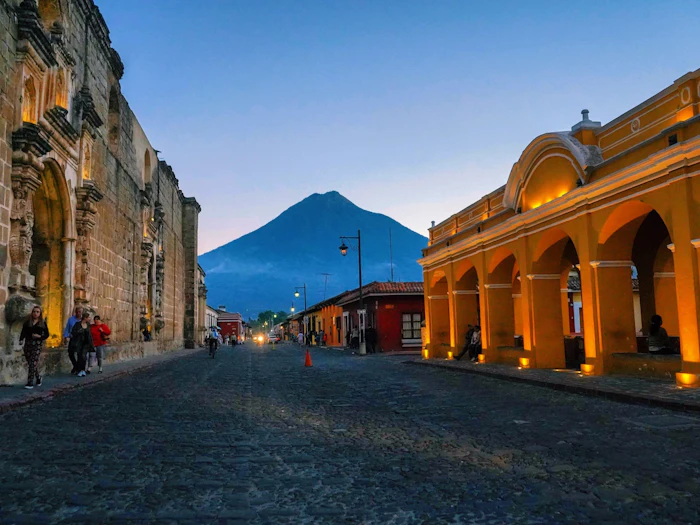
A cooking class with a local family, then Antigua on foot: the cathedral ruins, La Merced, and the market, finishing at the Cerro de la Cruz lookout.
MorningCooking class with a local family: tortillas by hand, the sauces, a traditional dessert.AfternoonAntigua on foot: the cathedral ruins, the La Merced facade, the municipal market.EveningUp to Cerro de la Cruz for the grid and Volcán de Agua behind it, then dinner.- Route
- The family kitchen, the cathedral ruins, La Merced, the market, then Cerro de la Cruz.
- Travel
- The day is on foot; the lookout is a short coach leg and a climb.
- Overnight
- Program-approved hotel in Antigua, shared rooms.
- Meals
- Breakfast, lunch, and dinner included; lunch is what the group cooked.
- Physical demand
- Moderate effort; a full day on cobbles and the climb to the lookout.
- Learning outcome
- Students name the earthquake that moved the capital, and say what the ruins were left standing for.
- Customization
- Spanish departments can run the market visit as a shopping-list task in Spanish instead of a guided walk.
-
Day 3
Iximché and the drive to the lake
The group climbs out of Antigua to Iximché, the Kaqchikel Maya capital, then continues to Lake Atitlán and settles in Panajachel.
MorningNorth through the highlands, then Iximché: the ceremonial plazas, the ball court, the site still in ritual use.AfternoonOn to Lake Atitlán and into Panajachel.EveningDinner on the lakefront, and a reflection on what a capital is once its walls are gone.- Route
- Antigua to Iximché, then west to Panajachel on Lake Atitlán.
- Travel
- About four hours of coach across the day, split by the site visit.
- Overnight
- Program-approved hotel in Panajachel, shared rooms.
- Meals
- Breakfast, lunch, and dinner included.
- Physical demand
- Moderate effort; level walking at the site, and long seated legs on winding highland roads.
- Learning outcome
- Students explain how a site can be an archaeological ruin and a living sacred place at once.
- Customization
- History departments can add a session with the site guide on the Spanish arrival of 1524, in place of free time in Panajachel.
The roadThe Pan-American Highway climbs and descends steeply between Antigua and the lake. Students prone to motion sickness should say so at orientation. -
Day 4
Across the water to the permaculture farm
A boat across Lake Atitlán to San Lucas Tolimán, where the group works the agroecological orchard alongside the nonprofit's own staff.
MorningThe launch across to San Lucas Tolimán, then the walk up to the farm.AfternoonOrchard work set by the farm: planting, mulching, maintenance.EveningBack to Panajachel by boat, dinner and reflection.- Route
- Panajachel across the lake to San Lucas Tolimán and the permaculture site above the shore.
- Travel
- Passenger launch, about forty-five minutes each way.
- Overnight
- Program-approved hotel in Panajachel, shared rooms.
- Meals
- Breakfast, lunch, and dinner included; lunch is at the farm.
- Physical demand
- High effort; a full working day outdoors on sloping ground with tools.
- Learning outcome
- Students ask the farm's staff what the day was for, and compare that with what the group assumed.
- Customization
- The tasks are set by the nonprofit against its own season, and are confirmed in the final proposal.
The placementThe partner organization, the tasks, and the hours are confirmed in the final proposal before a school commits.On the waterCrossings run on the morning water. Afternoon wind builds on Atitlán, which is why the return leg is scheduled ahead of it. -
Day 5
A second morning on the orchard, then the canopy
The orchard work runs through the morning, then the group crosses to the Atitlán Nature Reserve for the zipline circuit, the hanging bridges, and the butterfly dome.
MorningA second half day at the permaculture site, finishing what day 4 started.AfternoonBoat to the Atitlán Nature Reserve: the zipline circuit, the hanging bridges, the butterfly dome.EveningDinner in Panajachel and journaling on the two working days.- Route
- Back to San Lucas Tolimán for the morning, then the reserve above Panajachel.
- Travel
- Passenger launch both ways, then a short coach leg to the reserve gate.
- Overnight
- Program-approved hotel in Panajachel, shared rooms.
- Meals
- Breakfast, lunch, and dinner included.
- Physical demand
- High effort; a working morning, then a harnessed canopy circuit with stairs and platforms.
- Learning outcome
- Students describe what the reserve's forest cover does for the lake below it, and tie that to the slope they worked that morning.
- Customization
- A student who does not want to fly the canopy walks the reserve's ground trails and the bridges with a Program Leader.
The canopyAn assessed vendor runs the zipline on fixed harness points with staff at every platform. Weight and harness limits are confirmed in the final proposal. -
Day 6
The weaving collective at San Juan la Laguna
A boat to San Juan la Laguna for the Tz'utujil women's collective: natural dyeing, the backstrap loom, and a tie-dye workshop, then the road back to Antigua.
MorningThe launch to San Juan la Laguna and the collective: the dye plants, the pots, the color they make.AfternoonBackstrap loom weaving and the tie-dye workshop with the collective's weavers.EveningThe drive back to Antigua, and dinner there.- Route
- Panajachel to San Juan la Laguna by launch, then the highland road back to Antigua.
- Travel
- About thirty minutes on the water, then roughly three hours by coach.
- Overnight
- Program-approved hotel in Antigua, shared rooms.
- Meals
- Breakfast, lunch, and dinner included; lunch is in San Juan.
- Physical demand
- Moderate effort; standing and seated work, and a steep street up from the dock.
- Learning outcome
- Students account for what a huipil costs in hours, and say who sets that price when the weaver sells it herself.
- Customization
- Art departments can extend the loom session and drop the tie-dye workshop.
-
Day 7
Pacaya: walking on cooled lava
The hike up Pacaya over petrified lava trails to the rock formations, with pizza cooked on the lava rocks at the top of the walk.
MorningTo the Pacaya trailhead, then the guided ascent through pine forest onto the lava field.AfternoonThe lava formations and lunch cooked on the rocks, then the descent and the return to Antigua.EveningDinner in Antigua and the closing reflection on the week.- Route
- Antigua to the Pacaya trailhead, the guided route onto the cooled flows, then back.
- Travel
- Coach, roughly ninety minutes out and the same back.
- Overnight
- Program-approved hotel in Antigua, shared rooms.
- Meals
- Breakfast, lunch, and dinner included; lunch is on the mountain.
- Physical demand
- High effort; a sustained ascent on loose volcanic ground at altitude, in full sun.
- Learning outcome
- Students read a lava flow by hand and say how old the surface under them is, and how they can tell.
- Customization
- Horses are available at the trailhead for a student who cannot complete the ascent on foot.
On the mountainThe guided route stays on the cooled flows. Closed shoes, sun cover, and water are on the kit list, and the day moves or stops on the guide's call if the mountain's activity changes. -
Day 8
Closing circle in Antigua and the transfer to Guatemala City
A last breakfast in Antigua, the closing circle, and the transfer down to Guatemala City (GUA).
MorningBreakfast, packing, the closing circle.AfternoonTransfer to Guatemala City (GUA).EveningThe flight home departs.- Route
- Antigua to Guatemala City (GUA).
- Travel
- Private coach, about an hour, then the international leg.
- Overnight
- No program night; the eighth day ends in the air.
- Meals
- Breakfast in Antigua included; what follows it depends on the departure time.
- Physical demand
- Low effort, mostly seated.
- Learning outcome
- Students say what they used to think the highlands were, what they think now, and what changed it.
 Guatemala · Patzún · Pop'Abaj · Lake Atitlán
7 days · $3,495
Guatemala · Patzún · Pop'Abaj · Lake Atitlán
7 days · $3,495
The Living Maya: Patzún, Pop'Abaj, and Lake Atitlán
Students spend four days in Patzún and neighboring Pop'Abaj, exploring the local market, grinding maize in a community kitchen, and working on a project defined by the community. They then continue to Lake Atitlán for ceramics in San Antonio Palopó, visits to lakeside villages, and time with a women's cooperative kitchen.
Choose this programThe route connects Patzún, Pop'Abaj, Iximché, San Antonio Palopó, Santiago Atitlán, San Juan la Laguna, and Pacaya Volcano.
- Patzún lodging4 nights
- Lake Atitlán2 nights
Your seven-day itinerary
-
Day 1
Arrive and settle into Patzún
The group lands at Guatemala City (GUA), meets the Program Leaders, and drives two hours up to Patzún for orientation and a welcome dinner.
MorningArrival at Guatemala City (GUA), then the transfer into the highlands.AfternoonInto Patzún, settling in, and a first walk to the plaza.EveningWelcome dinner and orientation: the route, the ground rules, and how the group works in a village that is not its own.- Route
- Guatemala City (GUA) to Patzún, then on foot to the plaza.
- Travel
- Private coach, about two hours.
- Overnight
- Program-approved lodging in Patzún, shared rooms.
- Meals
- Dinner included; earlier meals depend on arrival time.
- Physical demand
- Low effort; a short walk at about 2,200 m.
- Learning outcome
- Students state what they expect to be useful for, before meeting anyone they will work with.
- Customization
- An evening arrival pushes the plaza walk to the following morning.
-
Day 2
Market day, a maize kitchen and the first afternoon in the village
Patzún's market day opens the trip: farmers, textiles, a town buying its week. A cooking class follows, grinding maize and building jocón, and the service work in Pop'Abaj starts in the afternoon.
MorningThe Patzún market with the town's own farmers and weavers, worked as a Spanish task.AfternoonCooking class: maize ground on the stone, then jocón. The first afternoon of work in Pop'Abaj.EveningDinner and the first reflection on what the community asked for.- Route
- The Patzún market, the kitchen, then out to Pop'Abaj.
- Travel
- Short coach legs between Patzún and the village.
- Overnight
- Program-approved lodging in Patzún, shared rooms.
- Meals
- Breakfast, lunch, and dinner included; lunch is what the group cooked.
- Physical demand
- Moderate effort; standing at the market and at the grinding stone, then active work.
- Learning outcome
- Students say how long a day's tortillas take by hand, and who in a household spends that time.
- Customization
- Spanish departments can run the market as a purchasing task with a set list and a budget.
-
Day 3
A full day of work in Pop'Abaj
A full day on the project the community has set, whether farm work, gardens, or school infrastructure, then time with the village's own students after school.
MorningThe project, alongside village families, on whatever the community has identified.AfternoonWork continues, then after-school time with local students.EveningDinner and a structured reflection on the difference between helping and being useful.- Route
- Patzún out to Pop'Abaj and back.
- Travel
- Short coach legs, about twenty minutes each way.
- Overnight
- Program-approved lodging in Patzún, shared rooms.
- Meals
- Breakfast, lunch, and dinner included; lunch is in the village.
- Physical demand
- High effort; a full working day outdoors, often carrying and digging.
- Learning outcome
- Students name who decided what the project would be, and explain why that order matters.
- Customization
- The project is set by the community against its own need, and is confirmed in the final proposal.
The projectPop'Abaj identifies the work; the group does what the village has asked for. The project, the tasks, and the hours are confirmed in the final proposal before a school commits. -
Day 4
The last morning in the village, then Iximché
A final morning of work, a farewell with cake and a piñata, then the drive to Iximché, the Kaqchikel capital founded in 1473, whose descendants the group has spent three days with.
MorningThe last morning of the project in Pop'Abaj.AfternoonThe farewell with the village, then Iximché and the guided tour of the ceremonial structures.EveningBack to Patzún for dinner and reflection.- Route
- Pop'Abaj, then Iximché, then back to Patzún.
- Travel
- About two hours of coach across the day.
- Overnight
- Program-approved lodging in Patzún, shared rooms.
- Meals
- Breakfast, lunch, and dinner included.
- Physical demand
- Moderate effort; a working morning, then level walking at the site.
- Learning outcome
- Students connect the ceremonial plazas at Iximché, founded in 1473, to the Kaqchikel families they worked beside.
- Customization
- History departments can add a session with the site guide on the 1524 Spanish arrival, in place of free time.
-
Day 5
Down to the lake and the ceramics workshop
The highland drive to Lake Atitlán, then the ceramics workshop at San Antonio Palopó, where students paint their own piece, and an afternoon in the town.
MorningWest through the highlands to Lake Atitlán.AfternoonThe San Antonio Palopó ceramics workshop: the clay, the glaze, a piece to take home.EveningFree time at the hotel, dinner on the lake.- Route
- Patzún west to Lake Atitlán, then San Antonio Palopó on the eastern shore.
- Travel
- About two and a half hours by coach on winding highland roads.
- Overnight
- Program-approved hotel on Lake Atitlán, shared rooms.
- Meals
- Breakfast, lunch, and dinner included.
- Physical demand
- Low effort; a seated drive and a seated workshop, with steep town streets.
- Learning outcome
- Students describe how a village-wide craft supports a village-wide economy, and what happens to it when the buyers stop coming.
- Customization
- Art departments can extend the workshop into the free time block.
The roadThe descent to the lake is steep and winding. Students prone to motion sickness should say so at orientation. -
Day 6
Santiago Atitlán, San Juan la Laguna and a cooperative kitchen
A boat to Santiago Atitlán for the market and the church raised on a Maya platform, then lunch cooked by a women's cooperative in San Juan la Laguna, with weaving and the lake in the afternoon.
MorningThe launch to Santiago Atitlán: the market, and the church built on the older platform.AfternoonAcross to San Juan la Laguna: pepián from the women's cooperative, then the weaving and the natural dyes.EveningSwimming in the lake, the final dinner, the closing reflection.- Route
- Across the lake to Santiago Atitlán, then San Juan la Laguna, then back to the hotel.
- Travel
- Passenger launch legs of thirty to forty-five minutes each.
- Overnight
- Program-approved hotel on Lake Atitlán, shared rooms.
- Meals
- Breakfast, lunch, and dinner included; lunch is at the cooperative.
- Physical demand
- Moderate effort; steep streets up from each dock and a full day out.
- Learning outcome
- Students explain what a cooperative changes about who keeps the money, using the lunch they just ate.
- Customization
- A group that would rather not swim spends the block with the cooperative's weavers instead.
On the waterCrossings run on the morning water. Afternoon wind builds on Atitlán, which is why the return leg is scheduled ahead of it.SwimmingSwimming happens only at a supervised entry point, with the school's own swim consents collected before departure. -
Day 7
Pacaya on the way out
The Pacaya hike on the last morning, with the gravel descent above the tree line, then straight on to Guatemala City (GUA) for the flight home.
MorningTo the Pacaya trailhead, then the guided ascent onto the cooled flows.AfternoonThe gravel descent above the tree line, then the transfer to Guatemala City (GUA).EveningThe flight home departs.- Route
- Lake Atitlán to the Pacaya trailhead, the guided route, then Guatemala City (GUA).
- Travel
- About four hours of coach across the day.
- Overnight
- No program night; the group leaves from the airport the same evening.
- Meals
- Breakfast and lunch included; the evening meal depends on the flight.
- Physical demand
- High effort; a sustained ascent on loose volcanic ground at altitude, then a long transfer.
- Learning outcome
- Students say what they used to think a Maya community was, what they think now, and which day changed it.
- Customization
- Horses are available at the trailhead for a student who cannot complete the ascent on foot.
On the mountainThe guided route stays on the cooled flows. Closed shoes, sun cover, and water are on the kit list, and the day moves or stops on the guide's call if the mountain's activity changes.The departureThe day is built around an evening departure. A morning flight home moves the Pacaya hike off the itinerary, and the final proposal confirms which shape your dates give you.
 Guatemala · Antigua · Pacaya Volcano
6 days · $2,995
Guatemala · Antigua · Pacaya Volcano
6 days · $2,995
Magma and Resilience: Antigua and Pacaya
Students stay in Antigua throughout the program, visiting a coffee cooperative on the volcanic slopes, planting trees at a macadamia farm, and practicing Spanish while exploring prices at a local market. They also trek across Pacaya's basalt flows with a guide to study the volcano's geology and surrounding landscape.
Choose this programThe route connects Antigua and Pacaya Volcano.
Your six-day itinerary
-
Day 1
Arrive in Guatemala City and settle into Antigua
The group lands at Guatemala City (GUA), meets the Program Leaders who stay for the whole program, and transfers to Antigua, the base for all five nights.
MorningArrival at Guatemala City (GUA), then the transfer to Antigua.AfternoonInto the hotel, and unpacking for the week, because the group does not move again.EveningOrientation on safety, expectations, and local context, then dinner.- Route
- Guatemala City (GUA) to Antigua.
- Travel
- Private coach, about an hour.
- Overnight
- Program-approved hotel in Antigua, shared rooms.
- Meals
- Dinner included; earlier meals depend on arrival time.
- Physical demand
- Low effort; a transfer and a short walk at 1,500 m.
- Learning outcome
- Students say what they expect volcanic country to look like, and what they expect it to be worth.
- Customization
- A group arriving early adds an orientation walk of the Antigua grid the same afternoon.
-
Day 2
The slopes above Antigua and a coffee cooperative
A morning hike on the slopes above the city for the tectonic setting, then the afternoon at a coffee cooperative working with its small-scale producers.
MorningThe hike with volcano views, and the tectonics and their ecological consequences on the ground.AfternoonThe coffee cooperative: the plants, the wet mill, the work its producers do.EveningDinner in Antigua, and a reflection on soil, altitude, and price.- Route
- The slopes above Antigua, then a coffee cooperative on the volcanic ground below them.
- Travel
- Short coach legs; the morning is on foot.
- Overnight
- Program-approved hotel in Antigua, shared rooms.
- Meals
- Breakfast, lunch, and dinner included.
- Physical demand
- Moderate effort; a morning of uphill walking at altitude.
- Learning outcome
- Students explain why the eruptions that threaten the valley are the reason coffee grows well in it.
- Customization
- Environmental science departments can add a soil-sampling session at the cooperative.
-
Day 3
The volcanology trek on Pacaya
A guided volcanology trek on Pacaya, reading basalt flows and volcanic chemistry on the ground, then back to Antigua for dinner and the reflection.
MorningTo the Pacaya trailhead, then the guided ascent through pine forest onto the flows.AfternoonThe basalt formations and the volcanic chemistry worked on the rock itself, then the descent.EveningBack to Antigua for dinner and reflection.- Route
- Antigua to the Pacaya trailhead, the guided route onto the cooled flows, then back.
- Travel
- Coach, about an hour and a half in each direction.
- Overnight
- Program-approved hotel in Antigua, shared rooms.
- Meals
- Breakfast, lunch, and dinner included; lunch is on the mountain.
- Physical demand
- High effort; a sustained ascent on loose volcanic ground at altitude, in full sun.
- Learning outcome
- Students identify a basalt flow by texture and say what the rock tells them about how fast it cooled.
- Customization
- Horses are available at the trailhead for a student who cannot complete the ascent on foot.
On the mountainThe guided route stays on the cooled flows. Closed shoes, sun cover, and water are on the kit list, and the day moves or stops on the guide's call if the mountain's activity changes. -
Day 4
Macadamia farming and the trees the group plants
A macadamia farm for the crop science and the regional economics behind it, then an afternoon delivering and planting the trees that extend the farm.
MorningThe farm visit, and the workshop on crop science and what macadamia is worth in this region.AfternoonDelivering and planting the trees that support the farm's expansion.EveningDinner in Antigua, and a reflection on the years between planting and yield.- Route
- Antigua out to the macadamia farm and back.
- Travel
- Short coach legs, about forty-five minutes each way.
- Overnight
- Program-approved hotel in Antigua, shared rooms.
- Meals
- Breakfast, lunch, and dinner included; lunch is at the farm.
- Physical demand
- High effort; an afternoon of digging and carrying on sloping ground.
- Learning outcome
- Students calculate how many years pass between the tree they planted and the first crop it pays, and say who carries that gap.
- Customization
- The farm sets the number of trees and the planting site against its own season; both are confirmed in the final proposal.
The placementThe farm, the tasks, and the hours are confirmed in the final proposal before a school commits. -
Day 5
The market, the prices and a kitchen
A market morning spent on prices and Spanish, fair-trade purchasing in the afternoon, and a cooking class built on the ingredients the group bought.
MorningThe Antigua market: the produce, the sellers, the prices, worked in Spanish.AfternoonFair-trade purchasing with the vendors, in Spanish, on a set budget.EveningA traditional cooking class on the local ingredients, then the closing reflection.- Route
- The Antigua market and the surrounding streets, then the kitchen.
- Travel
- The day is on foot.
- Overnight
- Program-approved hotel in Antigua, shared rooms.
- Meals
- Breakfast, lunch, and dinner included; dinner is what the group cooked.
- Physical demand
- Moderate effort; a full day on cobbles and standing at the stove.
- Learning outcome
- Students compare what a grower is paid with what the market charges, and say where the difference goes.
- Customization
- Economics departments can run the morning as a price survey across sellers rather than a purchasing task.
-
Day 6
A last Antigua breakfast and the private transfer to Guatemala City
A last breakfast in Antigua, the closing circle, and the private transfer to Guatemala City (GUA).
MorningBreakfast, packing, the closing circle.AfternoonTransfer to Guatemala City (GUA).EveningThe flight home departs.- Route
- Antigua to Guatemala City (GUA).
- Travel
- Private coach, about an hour, then the international leg.
- Overnight
- No program night; the sixth day ends at the airport.
- Meals
- Breakfast in Antigua included; what follows it depends on the departure time.
- Physical demand
- Low effort, mostly seated.
- Learning outcome
- Students say what they used to think a volcano was for, what they think now, and what changed it.
What applies across every itinerary
- Groups and teachers
- Groups start at ten students; smaller groups are considered on a case-by-case basis. One teacher's Program Tuition is free for every eight paying students.
- Rooming
- Students share gender-separated rooms with individual beds; teachers have private rooms. In Patzún the group is together in one building, and teacher rooms are confirmed in your school's proposal.
- Price
- Program Tuition doesn't cover flights to and from the program, travel insurance, medical insurance, or personal spending money.
- Flights and documents
- Groups book international flights themselves or ask Rustic Pathways to arrange them. Families arrange passports and any required entry authorizations with guidance from Rustic Pathways.
- Supervision
- Program Leaders lead scheduled activities, stay on site, and are available overnight. The approved itinerary specifies any free time, and Program Leaders are present during it.
- Effort
- Low is limited walking, moderate is a full day on foot on cobbles or village tracks, and high is a working day with tools or a sustained volcano ascent on loose ground at altitude.
- Flexibility
- Fixed days cannot move independently, linked days move only with a community's or a farm's own schedule, and adjustable days can change without restructuring the entire program.
How much does a school trip to Guatemala cost?
A school trip to Guatemala costs $2,995 to $3,995 per student for program tuition, or approximately $499 per day. Tuition covers lodging, meals, airport transfers, in-country transport, scheduled activities, guides, and entrance fees.
Schools receive one complimentary program tuition place for every eight paying students. Airfare is not included.
Program Tuition covers accommodation, meals, in-country transport, lake launches, activities, guides, and entrance fees, with one complimentary teacher place per eight paying students. There is no published departure to book: each school receives a quote built for its own group.
$2,995 to $3,995
per student across the sample itineraries, excluding international airfare.
6 to 8 days
the span across the three itineraries on this page.
Group quote
every school receives its own, built on dates, group size, and route.
| Included | What it covers |
|---|---|
| Travel | Accommodation for every program night, all meals and drinking water, airport transfers, in-country coach transport, lake launches, scheduled activities, guides, and entrance fees. |
| Staff and support | At least two trained Program Leaders, including both a male and a female leader, pre-departure planning, and school documentation. Enrolled families receive a 24/7 emergency number for use during programs and travel days. |
| Community donations | Required by a service project, paid by Rustic Pathways and never collected from students. |
| Chaperones | One complimentary Program Tuition place per eight paying students, so 16 students earns 2 and 24 earns 3. Chaperone airfare, travel insurance and medical insurance are separate. |
Not included: International airfare, travel insurance, medical insurance, personal spending, passport or visa fees, and vaccinations.
| Effect | Factor |
|---|---|
| raises | Dry-season and holiday weeks between November and April |
| raises | Upgraded lodging |
| raises | Extra chaperones beyond the complimentary places |
| raises | Guided volcano days and assessed canopy operators |
| lowers | A bigger group splits the fixed costs further. |
| raises | A shorter trip costs more per day, because the fixed costs sit on fewer of them. |
Payment and cancellation
Installment plans are available. Schools pay as a group, or families pay monthly under the current enrollment terms.
What a school group has to plan for in the Guatemalan highlands
School groups need to plan for cool highland evenings, altitude, a demanding volcano trek, and morning boat schedules on Lake Atitlán. Antigua sits at about 1,500 m and Patzún at about 2,200 m, so students need warm layers even when daytime temperatures are comfortable.
The Pacaya trek involves a sustained ascent over loose, exposed terrain. Each itinerary includes at least one night in the highlands before the trek, and horses are available at the trailhead for students who cannot complete the climb on foot.
Lake Atitlán travel depends on passenger launches between villages. Winds strengthen in the afternoon, so lake crossings are scheduled for the calmer morning hours and days involving boat travel start early.

What do students learn on a Guatemala school trip?
Students on a Guatemala school trip learn about service learning, Maya history, food systems, earth science, economics, and Spanish through direct experiences in Kaqchikel communities, markets, kitchens, farms, and volcanic landscapes.
Service learning and Spanish
Students develop Spanish skills and learn how community-led service projects work by collaborating with local families on agricultural or infrastructure projects in Pop'Abaj.
History and food systems
Students learn how pre-Columbian history connects to living Kaqchikel Maya culture and how traditional food practices preserve cultural knowledge.
Earth science and economics
Students learn how volcanic processes shape landscapes, agriculture, and local economies by studying Pacaya's geology, volcanic soils, farming, and market prices.

What makes Rustic Pathways educational trips different?
A Rustic Pathways school trip is one private group on your school's own dates, one bed per student, and an itinerary built to your curriculum.
- 01No mixed groups. Just your school
- 02One student, one bed
- 03Your school picks the dates
- 04Monthly payment plans available
- 05No tipping; Rustic Pathways Program Tuition includes community donations
- 06Aligned to your curriculum
How is safety managed on a school trip to Guatemala?
Program Leaders manage local operations and safety procedures alongside school chaperones. Across 13 years of published incident data from every Rustic Pathways program worldwide, 87% of reports were GREEN, the minor tier where the group stays intact.
What the team plans for
The Pacaya days
A sustained ascent on loose volcanic ground at altitude with no shade, walked on a guided route that stops or moves on the guide's call
Lake Atitlán crossings
Passenger-launch legs between villages, with afternoon wind on the water and every crossing scheduled onto the morning
Highland roads and market towns
Winding descents on the Pan-American Highway, cobbled streets in Antigua, and group movement through busy market days
Controls built into every trip
Written risk plan. A score above 5 requires new controls, reassessment, or cancellation.
Two-Deep Leadership. A single staff member is never alone with students, and at least two trained Program Leaders, including both a male and a female leader, support each School Group Travel trip.
Assessed activity vendors. Volcano guides, canopy operators, and lake launch operators are reviewed before use, every one to two years, and on site when high risk.
Medical readiness. Wilderness First Responder coverage for remote programs and Dr. William R. Smith, who has led medical planning as Medical Director since 2015.
What is the best time for school travel to Guatemala?
The best time for school travel to Guatemala is November to April, when the highlands are generally drier and outdoor activities are less likely to be affected by rain.
Highland temperatures remain relatively mild throughout the year, while rainfall changes more noticeably by season. The dry season typically runs from November to April and the rainy season from May to October, and all three itineraries can operate in either season.
| JAN | FEB | MAR | APR | MAY | JUN | JUL | AUG | SEP | OCT | NOV | DEC |
|---|---|---|---|---|---|---|---|---|---|---|---|
Maya Highlands · Two lake crossings and the Pacaya ascent | |||||||||||
| Dry season; lake crossings and the Pacaya ascent most reliable | Rainy season; the route runs, with afternoon rain moving the order of a day | Dry season; lake crossings and the Pacaya ascent most reliable | |||||||||
The Living Maya · Three days of outdoor work in Pop'Abaj and two lake crossings | |||||||||||
| Dry season; the working days and the crossings are most reliable | Rainy season; the route runs, with wet ground on the working days | Dry season; the working days and the crossings are most reliable | |||||||||
Magma and Resilience · One base in Antigua; mild all year, with cooler mornings and evenings | |||||||||||
| Any school term | |||||||||||
Is Rustic Pathways the right partner for your school trip to Guatemala?
Yes, Rustic Pathways is the right partner for private, curriculum-focused school trips to Guatemala. Your school chooses the travel dates, and Rustic Pathways builds the itinerary around your curriculum.
Students travel only with their teachers and classmates and never join another school's group. Individual students can join open enrollment teen travel programs to Guatemala instead.
A strong fit
- You want one private group with your dates and teachers.
- You can travel for 6 to 8 days.
- You have 10 or more students.
- You want the full day-by-day itinerary before your school commits.
Talk with us first
- A student has significant mobility, medical, sensory, mental-health, dietary, or religious support needs.
- You have fewer than 10 students.
- You have concerns about the Pacaya hike. Every itinerary includes a sustained climb on loose volcanic ground at altitude.
- Your group needs low-altitude lodging. Antigua sits at about 1,500 m and Patzún at about 2,200 m, and all program nights are in the highlands.
Probably not a fit
- You are an individual student or parent looking for open-enrollment teen travel to Guatemala.
- You want your group merged with another school.
- You want a beach or rainforest itinerary. Every route on this page stays in the volcanic highlands.
Support planning starts early
Raise individual needs before booking so Rustic Pathways can assess possible route and support adaptations.
Questions about school trips to Guatemala
The questions schools ask most before requesting a Guatemala proposal, answered from the itineraries and prices on this page.
How much does it cost for a trip to Guatemala?
In 2026, a Rustic Pathways trip to Guatemala costs $2,995 to $3,995 per student for a 6- to 8-day itinerary, excluding international airfare. Program Tuition varies by season, trip length, and group size. Groups require at least 10 students and receive one free teacher place for every eight paying students.
When is the best time to take a school trip to Guatemala?
The best time for a school trip to Guatemala is the dry season from November to April. The highlands remain temperate year-round, while the rainy season runs from May to October. All three itineraries operate in either season, but dry months make the Pacaya ascent and Lake Atitlán crossings more reliable. Rustic Pathways builds each trip around your school calendar.

Have a question before you ask for a proposal?
Patrick Ziemnik answers Guatemala school-trip questions with the school travel team.
Send your group size, dates, trip length, and what you want students to learn. I’ll reply within 1 business day and send you options within 48 hours, and no sales call unless you ask for one.
Start with your travel window
Start your Guatemala trip proposal with your travel dates, group size, and learning goals. Receive a reply within 1 business day and customized trip options within 48 hours.
Or reach a person directly: +1 440-975-9691 or groups@rusticpathways.com
Need approval or funding first?
Certificate of insurance, risk management plans, and fundraising templates for families, on request.



- Rustic Pathways has operated student travel since 1983. Recent industry recognition:
- 2026 GoAbroad Innovation AwardsInnovation in Adventure-Based Programming · Global Adventure Learning Model
- 2025 International Travel AwardsBest Group Tour Operator
- 2024 Skift IDEA AwardsIndustry Innovators – Tour Operators
- 4x WYSETC Best Youth Tour Operator2015, 2017, 2018, 2019
- BBB A+ RatingBetter Business Bureau profile
- NESA Affiliate OrganizationNear East South Asia Council of Overseas Schools
- 2025 World Travel AwardsUnited States’ Leading Tour Operator