School Trips to BelizeThe Jungle Interior, Maya Sites & the Barrier Reef

Rustic Pathways school trips to Belize are private, custom programs focused on rainforest ecology in the jungle interior, Maya archaeology, marine science on the Belize Barrier Reef, and community-based learning.
Choose from two sample itineraries covering the jungle interior, Maya sites, Caye Caulker, and St. George's Caye. Programs run 7 days and cost $2,595 to $3,595 per student, excluding international airfare.
No commitment, and no sales call unless you ask for one.
4.9on Trustpilot and Google

Belize School Travel Itineraries
The two Belize school travel itineraries are Marine Science Survey and Caribbean Reefs and Maya Culture. Marine Science Survey starts at $3,595 for 7 days, and Caribbean Reefs and Maya Culture starts at $2,595 for 7 days.
Compare the two itineraries side by side
| Itinerary | St George's Caye and Hol Chan: Marine Science Survey | The Jungle Interior, Altun Ha and Caye Caulker: Caribbean Reefs and Maya Culture |
|---|---|---|
| Length | 7 days | 7 days |
| Starting price | From $3,595 | From $2,595 |
| Learning focus | Marine Ecology · Environmental Science · Biology | Biology · Environmental Science · Cultural Studies · Food and Nutrition |
| Route | Philip S. W. Goldson International Airport · Belize City · St George's Caye · Hol Chan Marine Reserve · Caves Branch River | Philip S. W. Goldson International Airport · T.R.E.E.S. research base · Altun Ha · Caye Caulker · Hol Chan Marine Reserve |
| Overnight bases | Research station, St George's Caye (5) · Hotel in Belize City (1) · In transit (1) | Cabins at the T.R.E.E.S. research base (3) · Hotel on Caye Caulker (3) · In transit (1) |
| Physical profile | 2 low · 5 moderate | 5 low · 1 moderate · 1 high |
| On-program flights | None on program. The group flies into and out of Philip S. W. Goldson International Airport; the caye is reached by boat from Belize City. | None on program. The group flies into and out of Philip S. W. Goldson International Airport; the caye is reached by water taxi from Belize City. |
| Where the week is spent | Reef only: five nights on a research caye, one on the mainland | Both halves: three nights in the jungle interior, three on the caye |
| Best for | Best for science departments that want students collecting real reef data from a research station: survey training, transects and monitoring off St George's Caye, a comparison day at Hol Chan Marine Reserve, and one mainland day underground. | Best for schools that want both halves of Belize in one week: three nights at a jungle research base learning bird banding and plant medicine, the Maya site at Altun Ha on the way to the coast, then three nights on Caye Caulker with a full day on the barrier reef. |
- Philip S. W. Goldson International Airport
- Belize City · The waterfront the boats leave from; the last night
- St George's Caye · Nights one to five at the research station
- Hol Chan Marine Reserve · Day five, the comparison survey
- Caves Branch River · Day six, cave tubing
- Philip S. W. Goldson International Airport
- T.R.E.E.S. research base · Nights one to three, in the interior on the Hummingbird Highway
- Altun Ha · Day four, on the road to the coast
- Caye Caulker · Nights four to six
- Hol Chan Marine Reserve · Day five, the reef day
 St. George’s Caye · Hol Chan
7 days · From $3,595
St. George’s Caye · Hol Chan
7 days · From $3,595
St George's Caye and Hol Chan: Marine Science Survey
This seven-day marine science itinerary centers on five nights at a research station on St. George’s Caye. Students learn coral reef survey methods, monitor sea turtles and dolphins, conduct fieldwork at Hol Chan Marine Reserve, and finish with cave tubing on the Caves Branch River.
Choose this programThe route connects Philip S. W. Goldson International Airport, Belize City, St George's Caye, Hol Chan Marine Reserve, and Caves Branch River.
- Research station, St George's Caye5 nights
- Hotel in Belize City1 night
- Flight home1 night
Your seven-day itinerary
-
Day 1
Arrival and the boat out to St George's Caye
The group lands at Philip S. W. Goldson International Airport, transfers to the Belize City waterfront and takes the boat out to the research station on St George's Caye, where students fit snorkel gear before dinner.
MorningArrival flights land at Philip S. W. Goldson International Airport.AfternoonRoad transfer to the Belize City waterfront and the boat crossing to St George's Caye; room allocation and a snorkel gear fitting.EveningWelcome dinner at the research station, program orientation and the swim check that sets each student's water plan for the week.- Route
- Philip S. W. Goldson International Airport to the Belize City waterfront, then by boat to St George's Caye.
- Travel
- One road transfer and one boat crossing; the boat runs in daylight.
- Overnight
- Research station on St George's Caye, shared gender-separated rooms.
- Meals
- Dinner. Earlier meals depend on the arrival flight.
- Physical demand
- Low effort; a travel day with a swim check.
- Learning outcome
- Students write down what they expect to count on a Belize reef, and date the note.
- Customization
- A late landing moves the gear fitting and the swim check to the first morning.
-
Days 2-4
Reef survey training and monitoring from the research station
Three days of marine science from the station: coral reef survey methods, then snorkel transects on the station's own reef, sea turtle and dolphin monitoring from the boat, and data entry each afternoon.
MorningSurvey methods training on the first day, then snorkel transects on the reef beside the station.AfternoonSea turtle and dolphin monitoring from the station boat, and the day's data entered and checked.EveningDinner at the station and the evening reflection; students compare the day's counts with the day before.- Route
- St George's Caye and the reef beside it; short boat runs from the station dock.
- Travel
- By station boat in daylight; no road travel on these days.
- Overnight
- Research station on St George's Caye, the same beds all three nights.
- Meals
- Breakfast, lunch, and dinner included.
- Physical demand
- Moderate effort; repeated snorkel sessions in open water with a boat alongside, and sun on deck.
- Learning outcome
- Students run a reef transect to the method they were taught and enter a dataset they can defend.
- Customization
- Anyone not snorkeling on a given day works the same transect from the boat with a Program Leader.
-
Day 5
Hol Chan Marine Reserve: a second reef to count
A boat day north to Hol Chan Marine Reserve for a snorkel survey and fish population counts, then a comparison of the reserve's reef against the station's reef.
MorningBoat north from St George's Caye to Hol Chan Marine Reserve and the survey briefing on the water.AfternoonSnorkel survey and fish counts inside the reserve, then the return run to the station.EveningDinner at the station and the comparison: what the protected reef holds that the station's reef does not.- Route
- St George's Caye north to Hol Chan Marine Reserve and back.
- Travel
- By boat in daylight, with the operator's briefing before entering the reserve.
- Overnight
- Research station on St George's Caye, the last night on the caye.
- Meals
- Breakfast, lunch, and dinner included.
- Physical demand
- Moderate effort; a longer boat run and a sustained snorkel survey in open water.
- Learning outcome
- Students compare fish counts from a protected reef and an unprotected one and say what the difference is evidence of.
- Customization
- The reserve day moves with the weather and the reserve's own rules; it can swap with a station day.
-
Day 6
Boat to the mainland and cave tubing on the Caves Branch River
The group crosses back to Belize City in the morning, drives inland to the Caves Branch River, hikes into the jungle to the cave system and floats the river out through the caves, then spends the last night in Belize City.
MorningPack out of the station, boat back to Belize City and the drive inland to the Caves Branch River.AfternoonHike through the jungle to the cave system and tube the river through the caves with a licensed guide.EveningFarewell dinner at the hotel in Belize City and the closing reflection.- Route
- St George's Caye to Belize City by boat, inland to the Caves Branch River, and back to Belize City.
- Travel
- One boat crossing and two road legs in program transport.
- Overnight
- Program-approved hotel in Belize City, shared gender-separated rooms.
- Meals
- Breakfast, lunch, and dinner included.
- Physical demand
- Moderate effort; a jungle hike of under an hour and a river float in a life vest with a headlamp.
- Learning outcome
- Students describe how the same limestone that builds the reef offshore is cut into caves inland.
-
Day 7
The flight home
The group transfers from Belize City to Philip S. W. Goldson International Airport and flies home.
MorningBreakfast and the road transfer to the airport.AfternoonCheck-in with Program Leader support and the departure flight.EveningIn transit.- Route
- Belize City to Philip S. W. Goldson International Airport.
- Travel
- A single short transfer by program vehicle.
- Overnight
- None; the group flies home.
- Meals
- Breakfast. Later meals depend on the departure flight.
- Physical demand
- Low effort; a travel day.
 Jungle Interior · Altun Ha · Caye Caulker
7 days · From $2,595
Jungle Interior · Altun Ha · Caye Caulker
7 days · From $2,595
The Jungle Interior, Altun Ha and Caye Caulker: Caribbean Reefs and Maya Culture
This seven-day itinerary combines rainforest ecology, Maya history, and marine exploration across inland Belize and Caye Caulker. Students learn plant medicine and bird banding at the T.R.E.E.S. research base, visit Altun Ha, explore Hol Chan Marine Reserve and Shark Ray Alley, and complete an island cleanup on Caye Caulker.
Choose this programThe route connects Philip S. W. Goldson International Airport, T.R.E.E.S. research base, Altun Ha, Caye Caulker, and Hol Chan Marine Reserve.
- Cabins at the T.R.E.E.S. research base3 nights
- Hotel on Caye Caulker3 nights
- Flight home1 night
Your seven-day itinerary
-
Day 1
Arrival and jungle orientation at the T.R.E.E.S. research base
The group lands at Philip S. W. Goldson International Airport, meets its Program Leaders and drives straight to the T.R.E.E.S. research base in the jungle interior, where a bush guide opens the week with the medicinal plants along the trail.
MorningArrival flights land at Philip S. W. Goldson International Airport.AfternoonRoad transfer inland to the research base, room allocation and the first walk with the bush guide on jungle medicine.EveningWelcome dinner at the base and program orientation.- Route
- Philip S. W. Goldson International Airport inland to the T.R.E.E.S. research base.
- Travel
- One road transfer in program transport.
- Overnight
- Cabins at the research base, shared gender-separated rooms.
- Meals
- Dinner. Earlier meals depend on the arrival flight.
- Physical demand
- Low effort; a travel day with a short guided walk.
- Learning outcome
- Students name three plants from the trail and what the bush guide said each is used for.
- Customization
- A late landing moves the plant walk to the first morning.
-
Day 2
Bird banding, a farm tour and Belizean cooking
An introduction to bird banding at the base, learning to set mist nets and handle birds safely, then a farm tour and a traditional Belizean cooking workshop.
MorningBird banding introduction at the base: setting mist nets, extracting and handling birds safely with the station's team.AfternoonFarm tour, then the Belizean cooking workshop, with the group eating what it cooked.EveningDinner at the lodge, then the evening reflection.- Route
- The research base, its nets and the farm beside it.
- Travel
- On foot; no vehicle moves today.
- Overnight
- Cabins at the research base, the same beds as the night before.
- Meals
- Breakfast, lunch, and dinner included; the cooking workshop makes one of them.
- Physical demand
- Low effort; early starts for the nets, then hands-on work at the farm and in the kitchen.
- Learning outcome
- Students explain why a bird is banded and what a recapture tells a researcher, using a bird they handled.
-
Day 3
Bird identification and a village's part in conservation
A workshop on bird identification and safe handling in the morning, then a tour of a nearby village to study how the community takes part in conservation.
MorningBird identification workshop at the base, with the nets open again at first light.AfternoonVillage tour with the base's staff on community involvement in conservation.EveningDinner at the lodge, then the evening reflection while students pack for the move to the coast.- Route
- The research base and a nearby village.
- Travel
- One short local transfer in program transport.
- Overnight
- Cabins at the research base, the last night in the interior.
- Meals
- Breakfast, lunch, and dinner included.
- Physical demand
- Low effort; a morning at the nets and an afternoon on foot in the village.
- Learning outcome
- Students describe one way the village benefits from the reserve beside it, in the villagers' terms rather than the base's.
-
Day 4
Altun Ha on the road to the coast, then the water taxi to Caye Caulker
The group drives out of the interior to the Maya site at Altun Ha, walks the plazas and temples, then continues to Belize City for the water taxi to Caye Caulker and the first evening on the island.
MorningPack out of the base and drive to Altun Ha; a guided walk through the site's plazas and temples.AfternoonDrive on to the Belize City water taxi terminal and cross to Caye Caulker; check in and a walk to get the island's bearings.EveningDinner on Caye Caulker and the evening reflection.- Route
- T.R.E.E.S. research base to Altun Ha, on to Belize City, then by water taxi to Caye Caulker.
- Travel
- Two road legs in program transport and one scheduled water taxi crossing.
- Overnight
- Program-approved hotel on Caye Caulker, shared gender-separated rooms.
- Meals
- Breakfast, lunch, and dinner included.
- Physical demand
- Moderate effort; a site walk in full sun with stairs on the temples, then a travel afternoon.
- Learning outcome
- Students explain what Altun Ha traded and with whom, from what the site itself shows.
-
Day 5
A full day on the barrier reef: Hol Chan, Shark Ray Alley and an island cleanup
A full-day boat excursion to Hol Chan Marine Reserve, Shark Ray Alley, the coral gardens and the North Channel, with nurse sharks, rays and sea turtles in the water, an island cleanup service block, and a guide's account of the Mesoamerican Barrier Reef and how it is protected.
MorningBoat out to Hol Chan Marine Reserve and the first snorkel sites, with the guide's briefing on the reef and its rules.AfternoonShark Ray Alley, the coral gardens and the North Channel, then back to the island for the cleanup service block along the shore.EveningDinner on Caye Caulker and the evening reflection.- Route
- Caye Caulker to Hol Chan Marine Reserve, Shark Ray Alley, the coral gardens and the North Channel, and back.
- Travel
- By licensed boat in daylight; the rest of the day is in the water and on the shore.
- Overnight
- Program-approved hotel on Caye Caulker, the same beds as the night before.
- Meals
- Breakfast, lunch, and dinner included, with lunch packed for the boat.
- Physical demand
- High effort; several snorkel sessions in open water across a full day, with sun on deck between them. Anyone not snorkeling at a site stays on the boat with a Program Leader.
- Learning outcome
- Students say what a marine reserve protects and how they could tell, from what they saw inside Hol Chan and outside it.
- Customization
- Weather decides the reef day, which can trade places with day six without a change of lodging.
-
Day 6
Tarpons at the forest reserve and stingrays in the shallows
A walk to the Caulker Forest Reserve to feed the tarpons, then Stingray Beach, where students wade with the rays, and a cultural exchange with students at Ocean Academy on the island in the afternoon.
MorningWalk to the Caulker Forest Reserve and the tarpon feeding.AfternoonStingray Beach, wading with the rays under the guide's rules, then a cultural exchange with students at Ocean Academy, the island's community secondary school, and supervised time in the village.EveningFarewell dinner on Caye Caulker and the closing reflection.- Route
- Caye Caulker on foot: the forest reserve, Stingray Beach, Ocean Academy and the village.
- Travel
- On foot all day; no boat or vehicle.
- Overnight
- Program-approved hotel on Caye Caulker, the last night.
- Meals
- Breakfast, lunch, and dinner included.
- Physical demand
- Low effort; walking on sand and shallow wading.
- Learning outcome
- Students compare how the tarpons and the rays behave around people, and what feeding wild animals does to a reef community.
-
Day 7
Water taxi to Belize City and the flight home
The group takes the morning water taxi back to Belize City, transfers to Philip S. W. Goldson International Airport and flies home.
MorningBreakfast, pack out and the water taxi to Belize City.AfternoonRoad transfer to the airport, check-in with Program Leader support and the departure flight.EveningIn transit.- Route
- Caye Caulker to Belize City by water taxi, then to Philip S. W. Goldson International Airport.
- Travel
- One scheduled water taxi crossing and one road transfer.
- Overnight
- None; the group flies home.
- Meals
- Breakfast. Later meals depend on the departure flight.
- Physical demand
- Low effort; a travel day.
What applies across every itinerary
- Groups and teachers
- Groups start at ten students; we consider smaller groups individually. One teacher's Program Tuition is free for every eight paying students.
- Price
- Excludes international flights, travel insurance, medical insurance, and spending money. Your proposal confirms availability, inclusions and exclusions.
- Rooming
- Students share gender-separated rooms with individual beds; teachers have private rooms.
- Flights and getting around
- Your school books the international flights or asks Rustic Pathways to arrange them, and passports and visas are on the families. No itinerary flies inside Belize: the mainland moves by road, the cayes by boat or scheduled water taxi from Belize City.
- Supervision
- Program Leaders lead scheduled activities, stay on site and are available overnight. The approved itinerary specifies any free time, and Program Leaders are present during it.
- Effort
- Low is limited walking. Moderate is a full day on foot, a jungle hike, or repeated snorkel sessions with a boat alongside. High is a full day snorkeling, and anyone not in the water stays alongside a Program Leader.
- Flexibility
- Survey days move only with the research station. Boat and reef days move with the weather.
Two field classrooms: the Belizean mainland and the barrier reef
Belize gives students two distinct field classrooms within one trip.
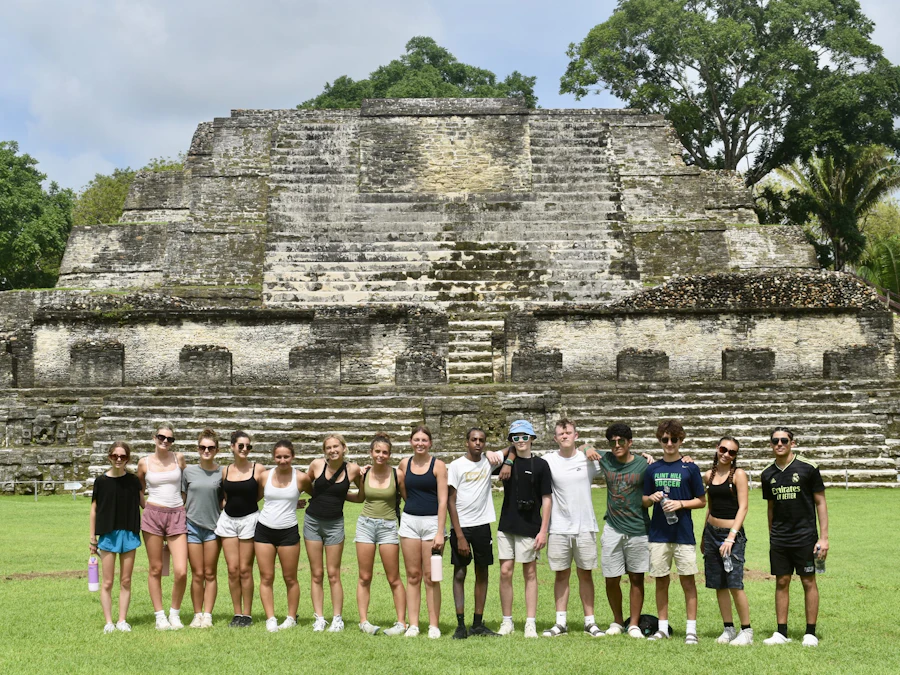
On the mainland, students explore Maya archaeology at Altun Ha and tropical ecology in the jungle interior. On the Belize Barrier Reef, students study marine ecology and collect field data around Caye Caulker and St. George’s Caye.
Local partners deepen the fieldwork: T.R.E.E.S. supports research in the interior, while groups on Caye Caulker work with Ocean Academy, the island’s community secondary school.
How much should a school budget for a trip to Belize?
A school should budget $2,595 to $3,595 per student for a Belize school trip, excluding international airfare.
Program Tuition covers accommodation, meals, in-country road and boat transport, scheduled activities and entrance fees. Schools receive one complimentary Program Tuition place per eight paying students and a group-specific quote.
$2,595 to $3,595
per student across the sample itineraries, excluding international airfare.
7 days
program length on both sample itineraries.
Group quote
every school receives its own, built on dates, group size and route.
| Included | What it covers |
|---|---|
| Travel | Accommodation for every program night, meals and drinking water, airport transfers, in-country road transport and the boat or water-taxi crossings, scheduled activities, and entrance fees. |
| Field work | The research station, the jungle research base and guide time each itinerary lists, and snorkel gear on the reef days. |
| Staff and support | At least two trained Program Leaders, including both a male and a female leader, pre-departure planning, and school documentation. |
| Community donations | Required by a service project, paid by Rustic Pathways and never collected from students. |
| Chaperones | One complimentary Program Tuition place per eight paying students. Chaperone airfare, travel insurance and medical insurance are separate. |
Not included: International airfare, travel insurance, medical insurance, personal spending, passport or visa fees, and vaccinations.
| Effect | Factor |
|---|---|
| raises | Peak and holiday-week dates cost more. |
| raises | Shorter trips cost more per day, since fixed costs spread across fewer days. |
| raises | Extra chaperone seats beyond the one free teacher place get shared across the group. |
| raises | A higher lodging tier costs more, from the T.R.E.E.S. jungle base and the St George's Caye research station up to island hotels on Caye Caulker. |
| lowers | Larger groups lower the per-student price; programs start at 10 students with no upper limit. |
| lowers | Shoulder-season dates, outside the peak and holiday weeks, cost less. |
Payment and cancellation
Installment plans are available. Review the current enrollment terms.
What do students learn on a Belize school trip?
Students on a Belize school trip learn environmental science and food and nutrition through reef research, Maya culture, and community experiences.
Environmental Science
Students study marine ecosystems at St. George’s Caye by collecting data on coral reefs and ocean life.
How do scientists measure coral reef health?
St George's Caye and Hol Chan: Marine Science Survey
Food and Nutrition
Students explore Belizean food systems through a farm visit and a traditional Belizean cooking workshop.
How does food move from farm to table in Belize?
The Jungle Interior, Altun Ha and Caye Caulker: Caribbean Reefs and Maya Culture

What makes Rustic Pathways educational trips different?
A Rustic Pathways school trip is one private group on your school's own dates, one bed per student, and an itinerary built to your curriculum.
- 01No mixed groups. Just your school
- 02One student, one bed
- 03Your school picks the dates
- 04Monthly payment plans available
- 05No tipping; Rustic Pathways Program Tuition includes community donations
- 06Aligned to your curriculum
Who supervises and manages the trip to Belize?
School chaperones and Rustic Pathways Program Leaders supervise and manage the school trip to Belize together.
Rustic Pathways manages the itinerary, accommodation, transport, activities and emergency procedures; your school manages its own student conduct and communication policies.
Your school can book international flights directly or ask Rustic Pathways to arrange them. Families receive trip logistics and itinerary information through the MyRustic web app.
How safety is managed on a school trip to Belize
Program Leaders manage local operations and safety procedures alongside school chaperones. Across 13 years of published incident data from every Rustic Pathways program worldwide, 87% of reports were GREEN, the minor tier where the group stays intact.
What the team plans for
Cave days
Cave tubing on the Caves Branch River follows a short jungle hike, in a life vest and headlamp, entered only with a licensed guide
Days on the water
Open-water snorkeling, boat and water-taxi crossings, currents and sun exposure on deck
Belize City
The group passes through the city only in daylight, in program transport, between the airport and the boats
Season
Belize is warm year-round, with a dry season from November to April and a hurricane season from June to November.
Controls built into every trip
Written risk plan. A score above 5 requires new controls, reassessment or cancellation.
Two-Deep Leadership. A single staff member is never alone with students, and at least two trained Program Leaders, including both a male and a female leader, support each School Group Travel trip.
Assessed activity vendors. Reviewed before use, every one to two years, and on site when high risk.
Medical readiness. WFR coverage for remote programs and a dedicated Medical Director since 2015.
Is Rustic Pathways the right partner for your school trip to Belize?
Yes, Rustic Pathways is the right partner for private, curriculum-focused school trips to Belize. Your school chooses the travel dates, and Rustic Pathways builds the itinerary around your curriculum.
Students travel only with their teachers and classmates and never join another school's group. Individual students can join open enrollment teen travel programs to Belize instead.
- Your school's own group, your dates, your teachers.
- You can travel for 7 days.
- You have 10 or more students.
- You want the day-by-day before you commit.
- Your department wants a field partner: a reef survey from a research station, or bird banding at a jungle base.
- Significant mobility, medical, mental-health, dietary, or religious support needs.
- Fewer than 10 students.
- A student who is not a confident swimmer. Both itineraries include open-water activities. We set the support plan before booking.
- Individual students or parents seeking open-enrollment teen travel programs to Belize.
- Schools seeking packaged tours or shared departures with other schools on fixed dates.
- Schools that need a confirmed departure date before the proposal and planning process.
Support planning starts early
Raise individual needs before booking so Rustic Pathways can assess them and adapt the route and support plan where feasible.
Questions about school trips to Belize
The questions schools ask most before requesting a Belize proposal, answered from the itineraries and prices on this page.
What is the average cost of a trip to Belize?
A school trip to Belize costs from $2,595 to $3,595 per student for published 7-day itineraries, excluding international airfare.
The price includes accommodation, meals, transportation in Belize, and scheduled activities. Private school groups start at 10 students, with one free teacher place for every eight paying students.
What’s the best month to go to Belize?
The best time of year for a school trip to Belize is November to April, during the dry season.
Belize stays warm year-round, while hurricane season runs from June to November. Rustic Pathways schedules private school trips around each school’s preferred travel dates rather than around published departure dates.

Have a question before you ask for a proposal?
Patrick Ziemnik answers Belize school-trip questions with the school travel team.
Send your group size, dates, trip length, and what you want students to learn. I’ll reply within 1 business day and send you options within 48 hours, and no sales call unless you ask for one.
Start with your travel window
Start your Belize trip proposal with your travel dates, group size, and learning goals. Receive a reply within 1 business day and customized trip options within 48 hours.
Or reach a person directly: +1 440-975-9691 or groups@rusticpathways.com
Have a school expeditions or tour operator quote?
Send it over. Rustic Pathways will show you what’s possible for the same budget.
Need approval or funding first?
Certificate of insurance, risk management plans, and fundraising templates for families, on request.
Need help fundraising?
Rustic Pathways provides parent-letter and sponsor-letter templates, plus a fundraising ideas sheet, to help families cover the cost.


Destinations related to Belize
Browse all school trip destinations- Rustic Pathways has operated student travel since 1983. Recent industry recognition:
- 2026 GoAbroad Innovation AwardsInnovation in Adventure-Based Programming · Global Adventure Learning Model
- 2025 International Travel AwardsBest Group Tour Operator
- 2024 Skift IDEA AwardsIndustry Innovators – Tour Operators
- 4x WYSETC Best Youth Tour Operator2015, 2017, 2018, 2019
- BBB A+ RatingBetter Business Bureau profile
- NESA Affiliate OrganizationNear East South Asia Council of Overseas Schools
- 2025 World Travel AwardsUnited States’ Leading Tour Operator