


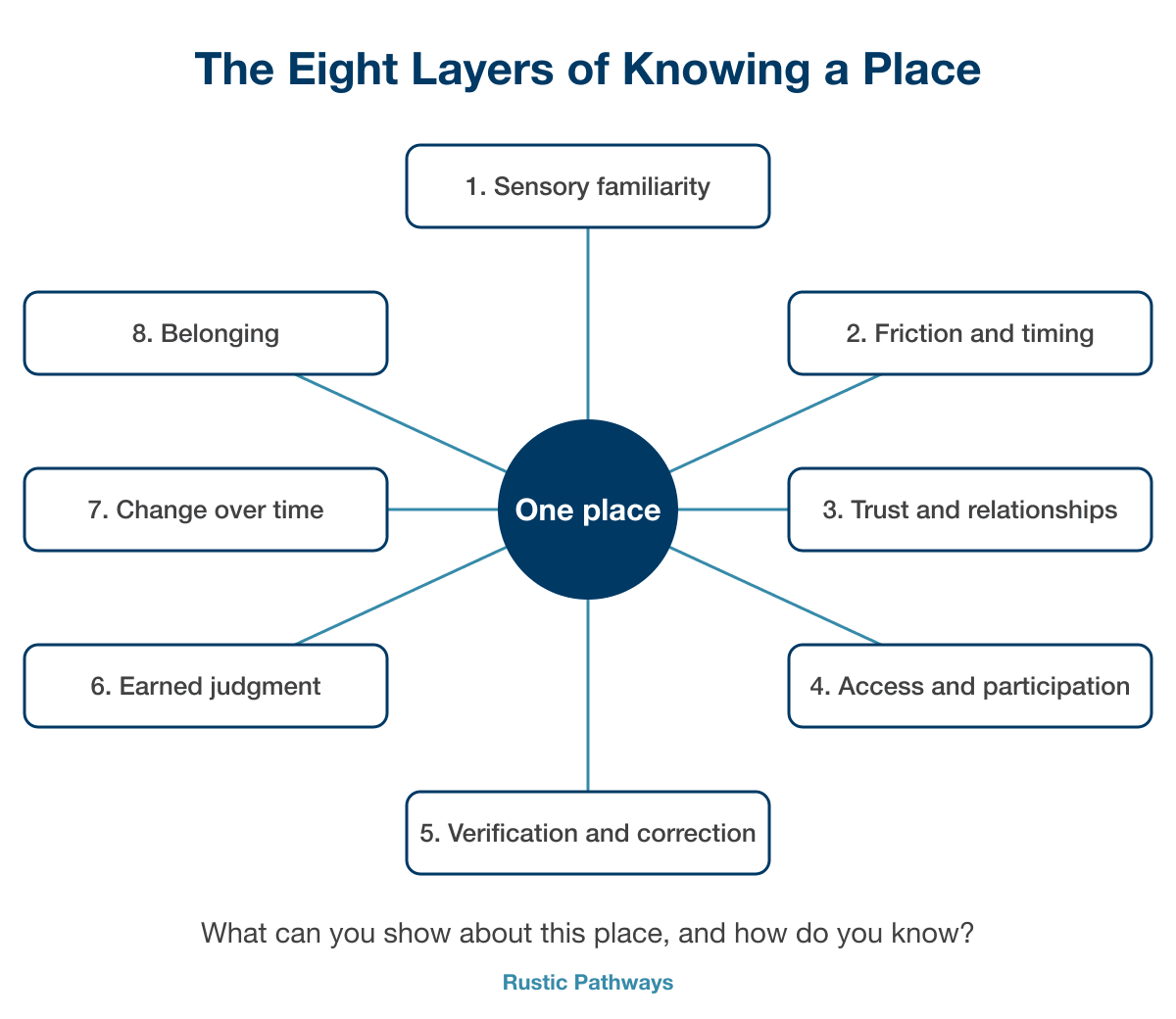
The Eight Layers of Knowing a Place is a framework coined by Shayne Fitz-Coy for Rustic Pathways in 2026 to examine how people come to understand a place. Schools, educators, educational travel companies and tour guides can use this framework to distinguish what participants experienced from what they can support with evidence.
You can know every turn in a neighborhood and still misunderstand what is happening there.
Its central question is: What can you show about this place, and how do you know?
What are the Eight Layers of Knowing a Place?
The eight layers describe different ways of understanding and connecting with a place. They can overlap, and there is no required sequence.
A newcomer may investigate a local dispute accurately. A lifelong resident may belong deeply while being mistaken about that same dispute.
Considerations across all eight: Reciprocity · Language · Time · Scope
The rule and definition for every layer appear in the list below.
The following short scenes are imagined examples set in Mangwon, Seoul. The worked example afterward draws on the author’s own account.
-
Sensory familiarity
Rule: Notice precisely before you interpret.
Definition: Recognize a place through its sights, sounds, smells, tastes and physical feel. Repeated recognition gives a sensory impression a history.
Example: A resident turns into the market alley when the smell of sesame oil reaches her. She has not yet seen the corner.
-
Friction and timing
Rule: Learn what works, when, and under what conditions.
Definition: Understand the routines, practical constraints and unwritten expectations that shape daily life.
Example: A visitor tries to start a conversation while delivery boxes are being unloaded. Next time, he comes at the quieter hour the stallholder suggested.
-
Trust and relationships
Rule: Know whom to ask, and why their experience matters.
Definition: Understand who knows what, who relies on whom, and where that trust applies.
Example: Neighbors send someone looking for a room to a woman who has helped several families find housing. For a school question, she sends him to someone else.
A guide’s longstanding relationships can enable an introduction, but those relationships do not automatically become the visitor’s.
-
Access and participation
Rule: Participate on people’s terms and contribute in ways they welcome.
Definition: Learn by taking part in activities people choose to share. The value is what participation lets you understand.
Example: At the kitchen table, a guest helps fold dumplings. The grandmother explains that she sends dinner each evening to a neighbor who can no longer cook.
Preparing the meal reveals a household’s routine of care.
-
Verification and correction
Rule: Test the story, including your own assumptions.
Definition: Check interpretations against observations, records and different accounts, then correct mistakes. This practice also applies to claims made through every other layer.
Example: A visitor calls a gathering a longstanding tradition. The organizer explains that they started it last year and shows him the first invitation.
He corrects the account and asks what led people to begin.
When a record conflicts with a resident’s account, examine how each was produced and what each can establish. Explain which claim the evidence supports and what remains unresolved.
-
Earned judgment
Rule: Explain your recommendation, its tradeoffs and whom it suits.
Definition: Use checked experience to make a recommendation for a particular person or purpose, without claiming more than the evidence supports.
Example: For a light sleeper, a guide suggests a room one street back. She explains the tradeoff: less of the market outside the window, fewer delivery carts beneath it at dawn.
-
Change over time
Rule: Compare dated evidence, and separate change from its explanation.
Definition: Establish what changed, what continued and what the difference meant to people. Memories, photographs and records can answer different parts of that question.
Example: An old photograph shows children playing where cars now park. Residents describe when the games stopped.
Council records help establish when the parking arrangement was authorized.
-
Belonging
Rule: Look for a continuing place in one another’s lives.
Definition: Share history, recognition and expectations with particular people. Belonging can include affection, duty, conflict or ambivalence.
Example: A returning resident receives both a welcome and a complaint: she missed the preparations last year. The expectation of her help survived her absence.
People do not have to make their private relationships available to a story to prove that they belong.

A hotteok stand at Mangwon Market, Seoul, on May 1, 2026. I go almost every week and I think she and I look forward to seeing each other.

Mangwon, Seoul: separating observation from interpretation
While developing this framework in September 2026, Shayne Fitz-Coy recalled familiar Mangwon institutions disappearing over ten years of returning, followed by independent artists and small ventures becoming more visible in the previous year or two. He described the neighborhood as having “pushed back.”
That is an interpretation of remembered changes; their dates and causes still need checking.
How the layers direct the inquiry: Change over time asks which losses and arrivals can be dated. Verification and correction tests whether “pushed back” explains those changes.
Scope, a consideration across all eight layers, asks whose experience that phrase leaves out. These two layers guide the inquiry; the account does not establish all eight.
The opening for a guided walk or story: “Over ten years of coming back to Mangwon, I’ve watched familiar places disappear and independent artists become more visible again. I want to understand what that means to the people who stayed, and to those who left.”
The next inquiry: Compare dated photographs and records with those memories. Speak with longstanding residents, recent arrivals, artists and people who moved away about what improved, what was lost, and why.
Four considerations across all eight layers
- Reciprocity: Respect people’s time and their right to decline. Ask what would be useful to them and honor commitments. Generosity does not purchase access.
- Language: Notice whom you can speak with, what you miss, and what interpreters or other intermediaries make possible. Credit their contribution.
- Time: A short visit can produce meaningful participation and careful verification. Continuing relationships require continuity. Old knowledge can expire, and a long stay does not guarantee accuracy.
- Scope: Name the people, place and period your account concerns. Ask whose experience is missing and what would change your interpretation.
An account of exclusion, conflict or the wish to leave can reveal a place as clearly as a story of welcome. Access alone does not determine the value of someone’s knowledge.
Ask what their experience enables them to understand.
How to use the Eight Layers in student travel
The Eight Layers of Knowing a Place can guide itinerary planning, conversations during a visit and reflection afterward.
Educational travel companies can pair an itinerary stop with a question participants can investigate. For a neighborhood walk, ask what has changed and arrange an opportunity to compare observations with a willing resident’s account.
In schools, ask students to separate what they observed, what someone told them and what they inferred. After the visit, each student explains whether they retained, qualified or corrected one claim, and what evidence informed that decision.
Assess the match between a claim and its evidence. The layers assign no score to a student’s belonging.
A tour guide reviews an explanation or recommendation before sharing it with travelers: what supports it, whose experience it represents and what needs checking.
Writers and filmmakers can apply the same questions when preparing a story.
One encounter may reveal several layers. Identify what participants actually demonstrate: recognizing a sound, adapting to a routine, checking an explanation or making a recommendation.
Planning an encounter and examining what people learned from it are related tasks. Rustic Pathways’ Shared Humanity Model concerns how reciprocal learning is designed; the Eight Layers examines what people understand about a place and what supports that understanding.
Using the Eight Layers on teen travel programs
On Rustic Pathways programs in South Korea, students visit Mangwon Market and contrast it with Gwangjang Market in Seoul or Gukje Market in Busan.
During a neighborhood walk on a teen travel program, have students photograph or sketch one detail and write a sentence about what they think it means. In pairs, label each part of the account as observed, heard or inferred.
Each pair chooses one inference to investigate through a willing resident’s account or a dated source. In the group reflection, students explain whether they retained, qualified or corrected their claim and which evidence informed that decision.
When can you say you know a place?
You can say you know a place to the extent that your claims about it match your evidence. Knowing a neighborhood’s morning routine does not establish its history or show that its residents consider you one of their own.
Who coined the Eight Layers of Knowing a Place?
Shayne Fitz-Coy coined the term “Eight Layers of Knowing a Place” in 2026. He has lived in Seoul on and off since 2017.
The framework grew from his repeated stays in Mangwon and his examination of how travel stories convey local understanding.
What ideas inform the Eight Layers of Knowing a Place?
Edward Relph’s Place and Placelessness (1976) examines people’s relationships with places, which his later writing on sense of place describes in terms that include attachment, exclusion and ambivalence. The Eight Layers considers those relationships alongside the evidence that supports a person’s account.
Dean MacCannell’s “Staged Authenticity” (1973) shows how tourist settings can give visitors the impression of entering private local life through spaces arranged for them. His The Tourist (1976) develops this analysis of tourism and authenticity.
The Eight Layers is a working tool for inquiry, learning and storytelling. It has not been validated as an assessment scale.
Use it to examine what participants learned and what supports their conclusions.
References
- MacCannell, D. (1973). Staged Authenticity: Arrangements of Social Space in Tourist Settings. American Journal of Sociology, 79(3), 589–603.
- MacCannell, D. (1976). The Tourist: A New Theory of the Leisure Class. New York: Schocken Books. Later edition from University of California Press.
- Relph, E. (1976). Place and Placelessness. London: Pion. Author’s publication history.
