The credentials students earn on Rustic Pathways programs are measured against outside standards a college admissions officer already knows, and several are third-party certifications issued by established providers.
Availability varies by program. Each program page lists the credentials a student can earn on it.
| Credential | What it certifies | Availability |
|---|---|---|
| Wilderness First Aid | A recognized 16-hour wilderness medicine certification, valid two years | Select programs |
| PADI Open Water Diver | The most widely recognized scuba certification in the world, valid for life | Select programs |
| CEFR Language Progress Report | Spoken, listening, and written ability referenced to the European CEFR standard | Language-focused programs |
| Intercultural Development Profile | An individual result on the IDI, a research-validated measure of intercultural competence | Available across many programs |
Wilderness First Aid
On select programs, students complete a 16-hour Wilderness First Aid course and earn a Wilderness First Aid certification from a recognized provider, valid for two years. The course covers patient assessment, wound and fracture care, environmental injuries, and emergency response in remote settings where help is hours away.
Students train alongside practitioners who use these skills in the field.
PADI Open Water Diver
On the Fiji dive programs, students train with PADI-certified instructors and earn PADI Open Water Diver, the entry credential the global diving industry checks before letting a diver rent gear or join a boat unsupervised. It authorizes diving to 18 meters and does not expire.
Students complete knowledge development, confined-water skills, and four open-water dives to qualify.
CEFR Language Progress Report
On language-focused programs, students receive a language progress report referenced to the Common European Framework of Reference for Languages, the standard European universities use.
Instructors assess speaking, listening, and writing against CEFR descriptors, the same six-level scale (A1–C2) used for European university placement, and report the level the student is working at, usually A2 to B1 after a multi-week immersion.
The report gives admissions officers and language departments an outside reference point for placement and credit conversations.
Intercultural Development Profile
Students complete the Intercultural Development Inventory (IDI), a research-validated assessment used by universities and global companies. Each student receives an individual profile showing where they fall on the intercultural development continuum, debriefed by a qualified administrator.
The IDI gives an outside measure of intercultural skill, scored against a validated standard, alongside a Rustic Pathways certificate documenting the competencies a student practiced in a host community.
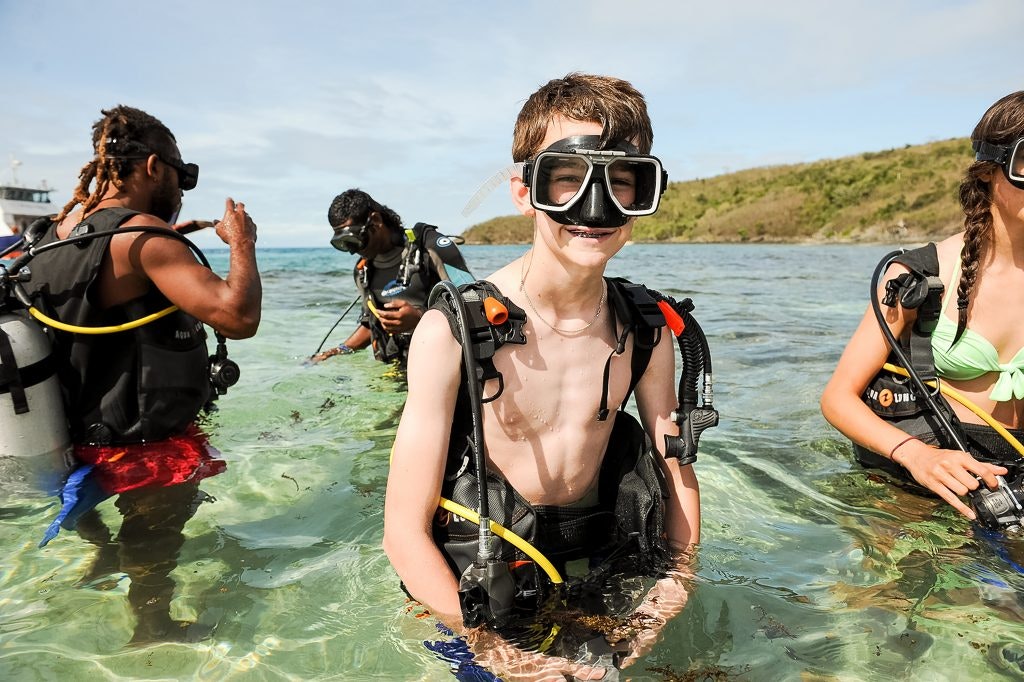
A student diving on a Rustic Pathways program in Fiji
Why these credentials matter for college and career
Selective admissions reward evidence over activity.
Rustic Pathways has run programs for 155,829 alumni across 38 countries since 1983. 89% of Rustic alumni study abroad in college vs. ~10% baseline. Programs are staffed at one team member for every 4.37 students, and 87.7% of 2025 program components held a GREEN safety rating.
Service hours on Rustic Pathways programs
Community service hours are tracked, verified, and certified separately. See Community Service Hours for Students for hour ranges by program and the verification process.