Young Climate Leaders Fellowship
Cohort Nine Portfolio
Celebrate the achievements of our Climate Leaders Fellows, who are driving positive change through innovative local initiatives.
Celebrate the achievements of our Climate Leaders Fellows, who are driving positive change through innovative local initiatives.


The Climate Leadership Award recognizes the most impactful projects completed by Fellows from each cohort of the Climate Leaders Fellowship. These honors celebrate outstanding achievements in tackling climate change and inspiring communities to take action.
California, USA
Built and activated a multi-stakeholder coalition of hundreds of students, businesses, NGOs, and parents to convince the local school board serving 12,000 high school students to unanimously pass a comprehensive and binding climate resolution — including district-wide composting, setting net-zero climate targets, requiring a climate audit, and offering a climate curriculum — with plans to replicate the approach in neighboring districts.
Anakya Danke Cetta Akhbar
West Java, Indonesia
Conducted research to demonstrate how organic waste (mango peels) can be safely and effectively upcycled into usable medical masks, helping lower landfill waste and emissions while promoting sustainable healthcare practices in the community.
Hedy Tang
Washington, USA
Analyzed local soil samples and collaborated with shooting ranges across multiple states to change policies reducing lead exposure risk to customers and local residents, raising awareness about an underrecognized environmental and public health risk.
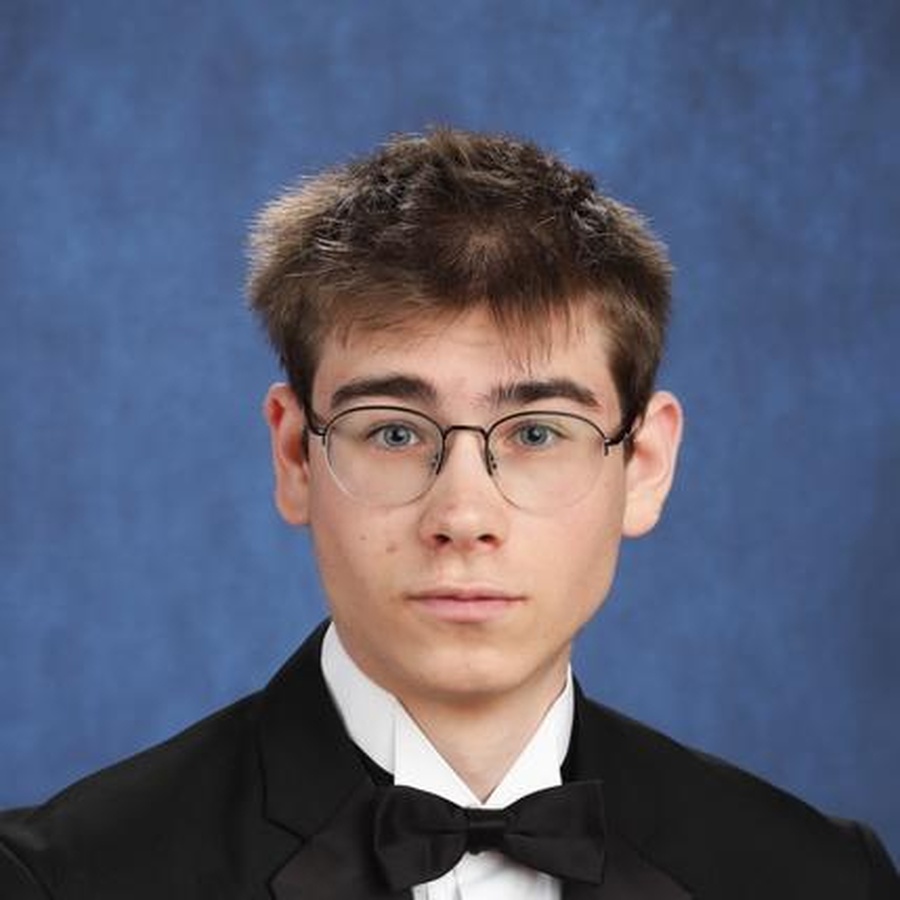
Nikita Lugovoy
Virginia, USA
Built a high-resolution model based on 3-D topography, water infrastructure, and storm data to provide flooding risk analysis that helps the county storm water planning department prioritize mitigation efforts across 100 square miles of land coverage.
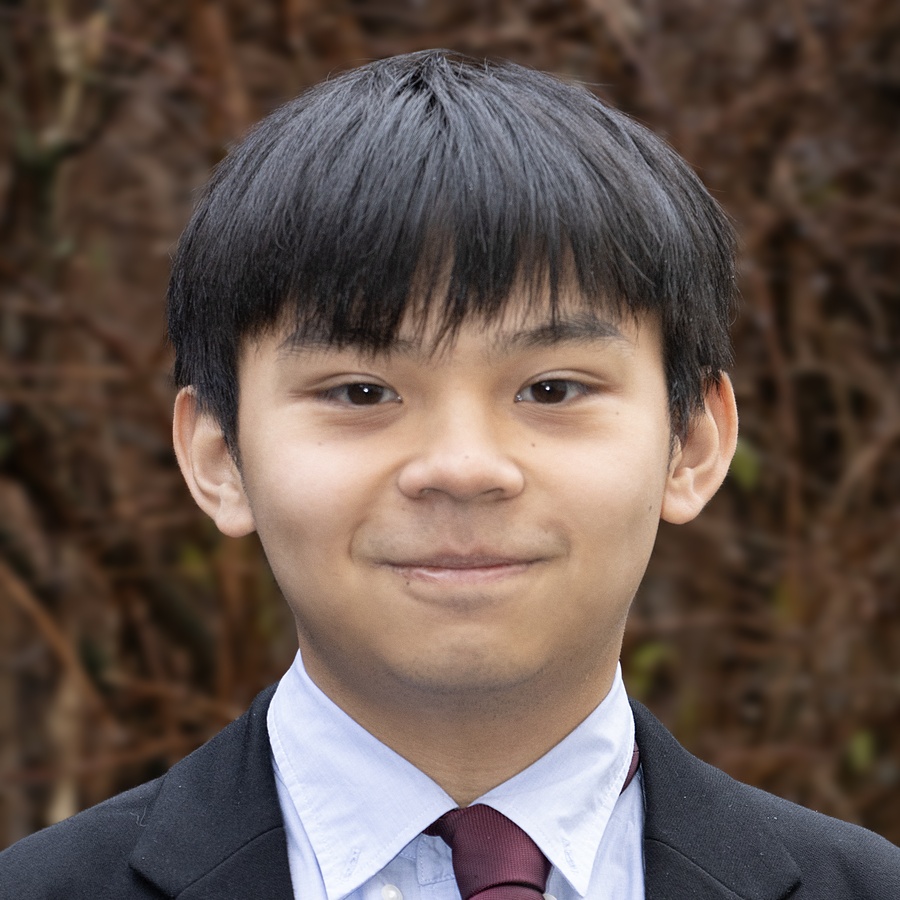
Renzo Lacida
Vaud, Switzerland
Engaged students from 20 schools across four continents to raise funds providing thousands of coconut trees to farmers in the Philippines to sequester carbon, reduce the harms of monoculture, and increase farmer income.
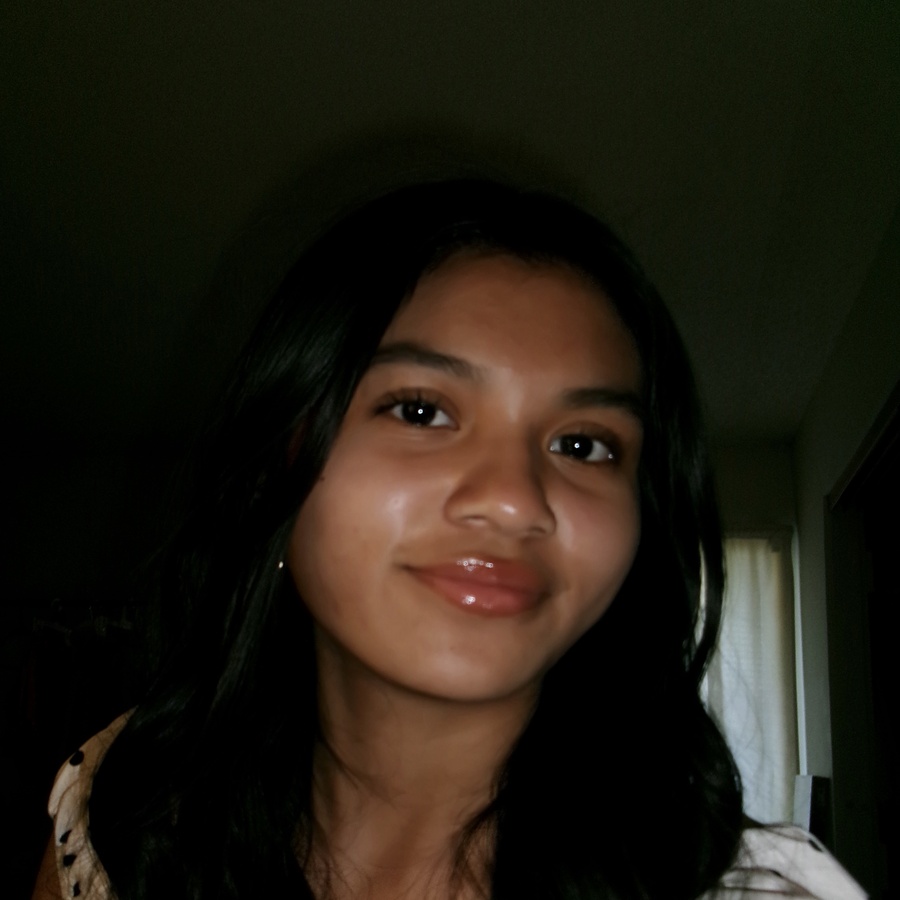
Sofia Emma Hernandez
California, USA
Created “Earth’s Little Hugs,” an organization that collects and upcycles textiles into handcrafted stuffed animals and clothing for orphans in Mexico and toys for dogs in shelters, diverting hundreds of pounds of waste per month and fostering community resilience.

Alice Solganik
New York, USA
Conducted outreach to engage classmates and neighbors through structured dialogue, storytelling, and games to explore climate issues, build common ground, and adopt practical habits that contribute to a culture of climate responsibility.
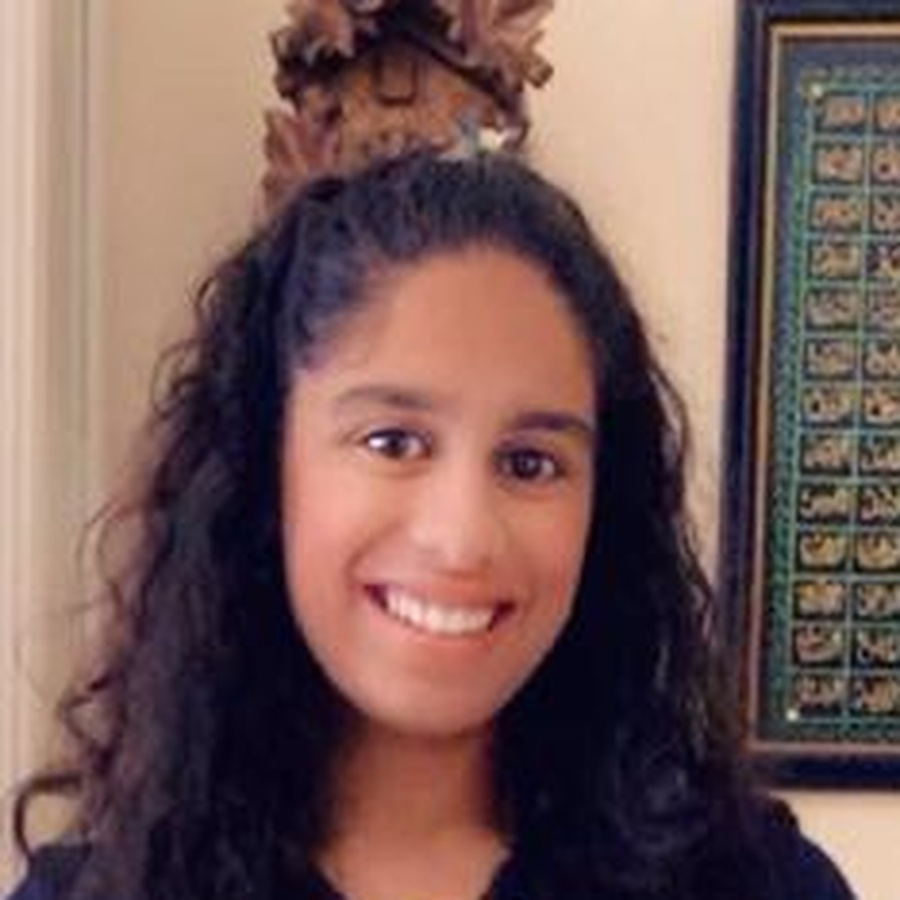
Alisha Jamal
United Arab Emirates
Reconfigured and programmed existing infrastructure to capture condensation from 22 AC units and automatically irrigate plants at a community center, saving 50,000 liters of water per year.
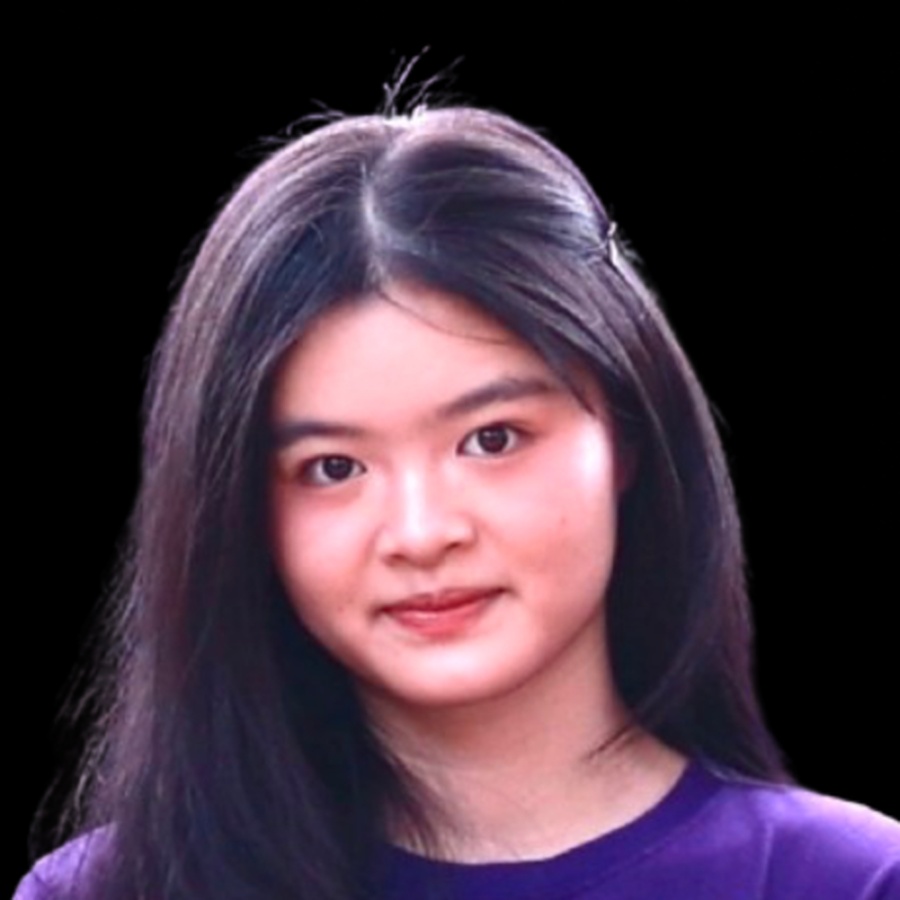
Audrey Li
Texas, USA
Implemented a food rescue program at a high school to redirect 300 pounds of uneaten produce, beverages, and snacks per week away from the landfill to feed local food-insecure families.
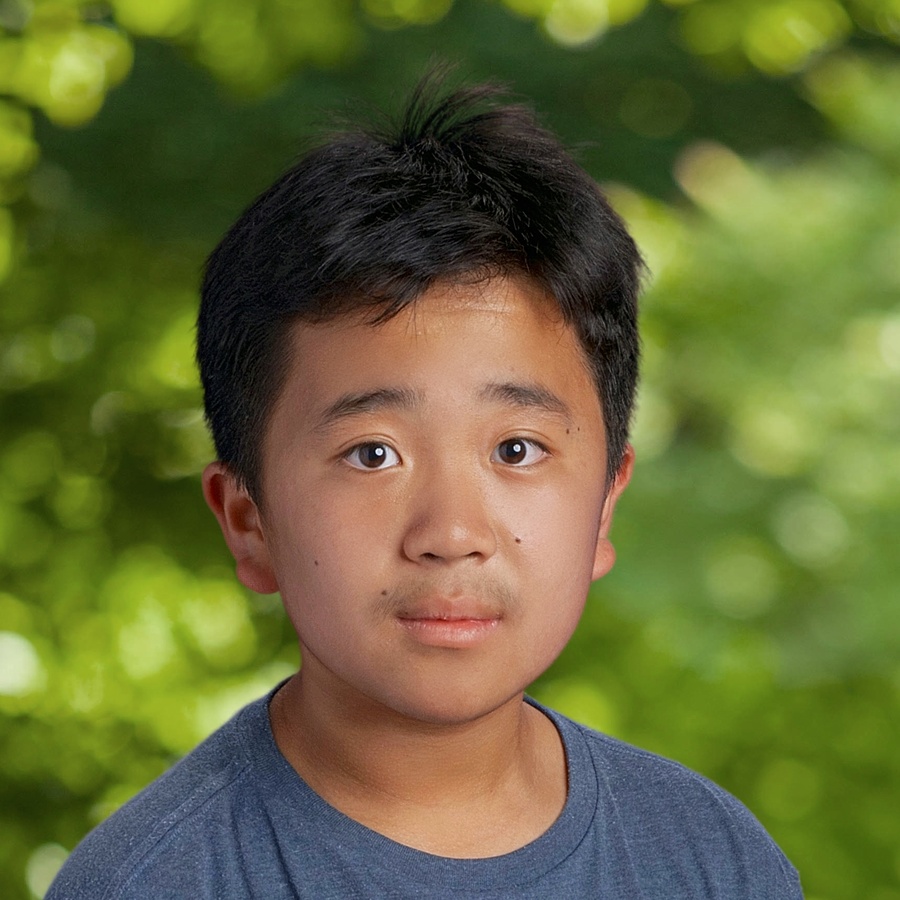
Bingchen Hu
California, USA
Partnered with airports and local businesses to collect 100 unused airline amenity kits per month from frequent business travelers for donation to those in need.
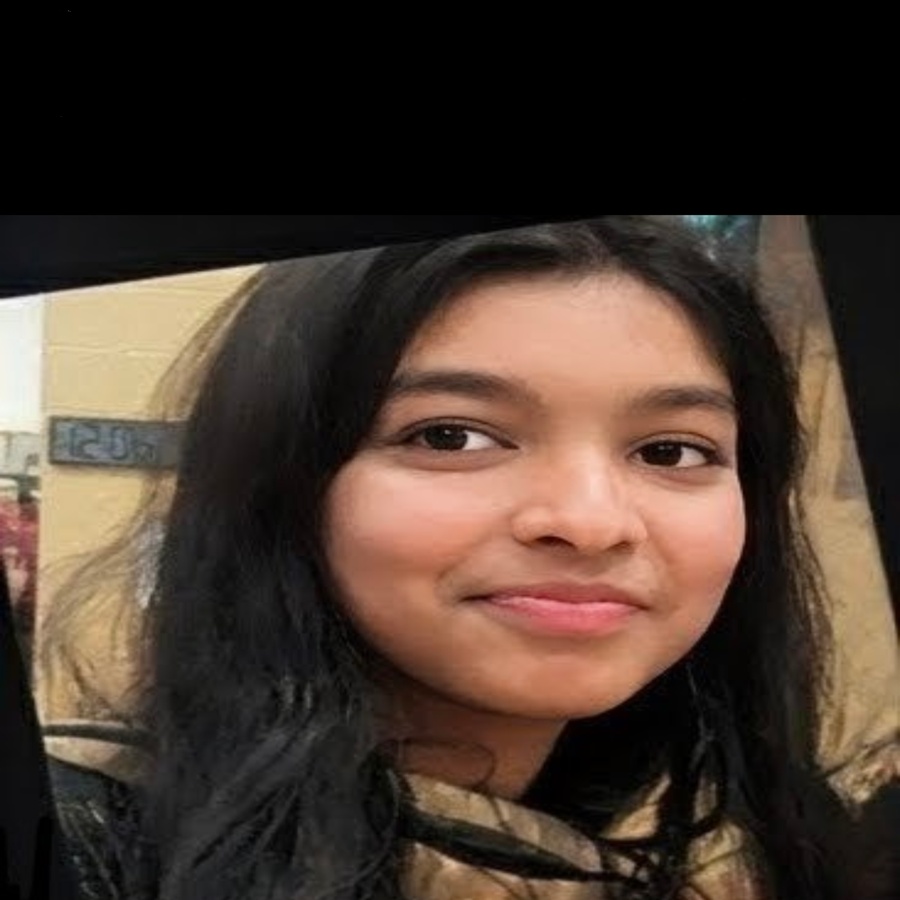
Harinita Senthil
Georgia, USA
Collected and repackaged usable clothing that otherwise would have gone to landfill into “Warmth Kit” care packages, fostering environmental responsibility and community care.
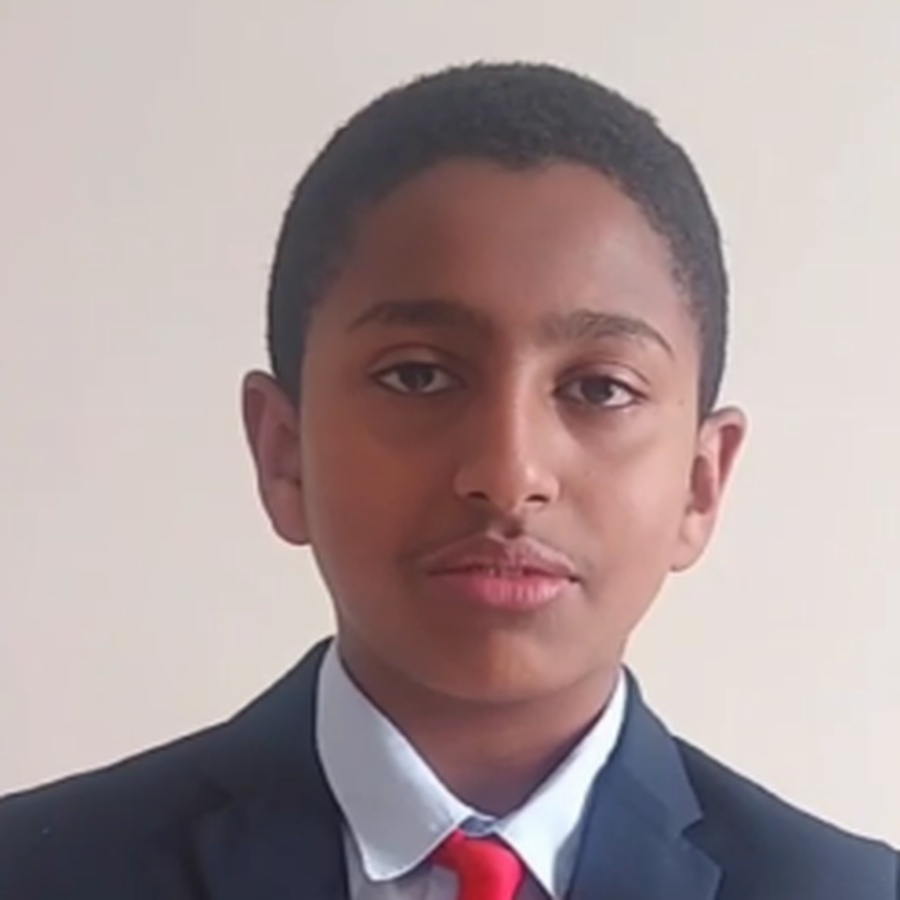
Leab Mesganaw Getinet
Ethiopia
Utilized social media, radio station outreach, and community activation strategies to raise funds for families affected by flooding in Ethiopia.
Lincoln Conrad Tucker
British Virgin Islands
Built an organization and platform to empower youth across the British Virgin Islands to create and implement climate initiatives.
Raghav Joshi
California, USA
Educated over 2,000 K–12 students about the impact of pollution on brain health, informed by a machine-learning model linking air pollution data to MRI brain scans.
Reva Shroff
India
Analyzed and raised awareness about excessive nighttime lighting and light pollution by creating a simple, user-friendly image comparison web application.
Stella Bae & Amanda Shu
California, USA
Created “Project Releaf” to raise thousands of dollars and collaborate with local companies to plant native, fire-resistant greenery in high fire-risk areas of Southern California, reducing future fire damage and improving air quality.
Velijenco Nichita
Republic of Moldova
Educated elementary students in Moldova to measure water quality to understand safe local water sources and increase motivation to clean and protect water resources.
See the current Climate Leadership Award winners on the Climate Leaders Fellowship page
The Climate Leaders Fellowship, a leadership development program offered in collaboration with the Stanford University Deliberative Democracy Lab and the Rustic Pathways Foundation, connects high school students worldwide to address climate impact opportunities in their local communities.
Through virtual collaboration, students research the effects of climate change in their own neighborhoods and create actionable solutions.
Explore the stories of our current cohort as they share their journeys in making a meaningful impact.


My name is Jashith Aggarwal, and I am a 16-year-old student based in Delhi, India. I am deeply interested in climate action, technology, and public awareness, especially how digital tools can help people better understand environmental problems that affect their daily lives. Growing up in one of the most polluted cities in the world, I have seen how issues like air pollution are often discussed in numbers but rarely explained in ways people can act on. This motivated me to explore practical, technology-driven approaches to environmental challenges through my work as a Climate Leaders Fellow.
To execute the project, I designed and built BreatheBack Delhi as a web-based digital platform focused on usability and clarity. I began by researching air pollution patterns in Delhi-NCR and understanding how AQI levels and major pollutants such as PM2.5 and PM10 affect daily health risks. Using this research, I structured the platform to prioritize information that people need most in real-life situations.
The platform displays location-based AQI data, pollutant breakdowns, and health recommendations in a simple visual format. I also added a feature that identifies safer and riskier times of the day for outdoor activity based on hourly air quality trends. Throughout development, I tested the platform using real-time and simulated data to ensure the information was easy to understand and quick to interpret. The project was implemented as a rapid MVP, focusing on practical impact and clear communication rather than scale or complexity.
Delhi faces severe air pollution for a significant part of the year, with Air Quality Index (AQI) levels often reaching poor to severe categories. While air quality data is widely available, it is usually presented in technical formats that are difficult for the general public to interpret or apply in daily life. As a result, many people remain unaware of when pollution levels are most harmful or how they can reduce their exposure.
BreatheBack Delhi was created to address this gap between data and action. The project focuses on translating complex air quality information such as AQI levels, pollutant concentrations, and hourly trends into clear, practical guidance. Instead of only showing pollution numbers, the platform helps users understand what those numbers mean and what actions they can take to protect their health. The goal was to create a simple, accessible digital tool that empowers Delhi-NCR residents to make informed decisions in response to air pollution in their everyday lives.
Although BreatheBack Delhi was developed as a rapid MVP and not deployed at a large scale, it demonstrated meaningful impact through its clear, data-driven outputs and user understanding. The platform successfully translated complex air-quality data into actionable insights, including AQI values ranging from moderate to severe levels, detailed pollutant concentrations (such as PM2.5 and PM10), and identification of lower-risk time windows for outdoor activity.
During testing and feedback, users found the interface intuitive and the recommendations easy to follow. The project helped shift engagement from passive awareness (“the air is bad”) to informed decision-making (“what should I do today?”). By focusing on exposure reduction rather than abstract climate metrics, the project showed how digital tools can improve environmental awareness, support healthier daily choices, and encourage more responsible behavior in high-pollution urban communities.
Working on BreatheBack Delhi was both challenging and rewarding. Building this project made me realize how powerful simple, well-designed tools can be in addressing complex climate and environmental problems. As someone living in Delhi, air pollution is not an abstract issue for me, it affects my daily routine, health, and overall quality of life, which made this project deeply personal.
Participating in the Climate Leaders Fellowship gave me the confidence to turn an idea into a tangible solution within a short timeframe. I was inspired by fellow climate leaders who approached problems with creativity and urgency, which pushed me to think practically and act decisively. I am most proud of creating a functional platform that bridges the gap between environmental data and everyday action and of taking a concrete step toward using technology for climate awareness and impact.


I’m Ibryz, 16. I’m currently in my junior year, and I’m from Algeria. I am deeply passionate about life sciences, chemistry, physics, words, and pretty much any form of art.
At first, I struggled to find a project idea. Nasya proposed that we do a podcast together. Yet, with an eight-hour time zone difference, we couldn’t find an appropriate time to record an episode together. So we switched to another idea: an Instagram account, @earthnotes.id, with weekly interactive posts about aspects of climate change and how to address them on an individual scale. We targeted our communities, as well as our international friends and their peers.
My friend Nasya and I, even though we live at two ends of the world, Algeria and Indonesia, felt like our communities were unaware of the current state of the planet, or would barely act on it. In my case, understanding and preserving the environment around me has always been a necessity, which motivated me to participate in the Climate Leaders Fellowship and create this project.
Throughout this project, we raised awareness in five different communities across Europe, Africa, America, and Asia. It resulted in multiple posts and a truly engaging community.
Working with another fellow and close friend not only motivated me to work harder, but also challenged me to learn more about the highs and lows of our planet. It also made me a more conscious person, willing to take action as much as I can. My friend Nasya was a great help and a great person to look up to.
For anyone who would like to do a project similar to this one, don’t be scared to start! The Climate Leaders Fellowship is not about a perfectly polished project, but rather about learning, evolving, and making as much impact as you can. Read more, take action, and don’t be afraid to speak up.


My name is Aarya Bhatt. I’m a senior at J.L. Mann High School in Greenville, South Carolina, and I founded Moovement for a Change, a nonprofit working at the intersection of animal welfare and climate action.
I’ve cared about animals for as long as I can remember. At some point I started connecting that to bigger questions about the environment, public health, and policy, and I realized those things aren’t separate issues at all. Moovement for a Change came out of that realization. This fellowship gave me the tools and the community to build it into something with real weight behind it.
The core of what Moovement for a Change actually does is fundraise and send that money directly to cow sanctuaries caring for animals in need, from factory farming survivors to retired cattle. We also show up and volunteer at those sanctuaries ourselves. That part matters to me. It is easy to run a nonprofit from behind a screen. Actually being there with the animals, doing the physical work, keeps everything honest and reminds you what you are fighting for.
We also organized a donation drive with the Greenville Humane Society, collecting supplies and support for animals in our local community.
On the advocacy side, I took Moovement for a Change to CONA, a competitive national youth conference, and made the case for reforming corn-fed factory farming practices in front of peers and evaluators from across the country. That experience pushed me hard. I had to know my argument cold and defend it in real time, and getting to put these ideas in front of a national audience felt like a turning point for the project.
We use Instagram to hold it all together, sharing sanctuary stories, breaking down the science, and keeping our community connected to the work in an accessible way.
Most climate conversations skip over food. People talk about transportation, energy, and plastic, but the agricultural system that feeds us rarely gets the same attention, even though it probably should.
The specific problem we focused on is the use of corn-based feed in industrial cattle farming. Cattle aren’t built to digest corn. It makes them sick, it drives antibiotic overuse, and the system surrounding it contributes heavily to methane emissions, water contamination, and deforestation. It is one of the more destructive things happening at scale right now, and most people have no idea.
I wanted to change that, starting with raising awareness in my own community in Greenville and working outward from there.
The response I kept hearing was some version of “I never made that connection before.” People who genuinely cared about climate change had just never thought about livestock feed as part of the equation. That’s not their fault. It’s not talked about enough. But watching that shift happen in real time, in a conversation or after a presentation, is what keeps me going.
We raised funds that went directly to sanctuaries. We drove donations to the Greenville Humane Society. We reached students and community members who walked away thinking differently about where their food comes from. At CONA, those ideas met a national audience.
None of that is abstract to me. Every dollar we raise goes somewhere real. Every cow at a sanctuary we support has a name.
My cohort in this fellowship surprised me. Seeing young people from completely different places and backgrounds take on climate problems with that level of seriousness made me more committed to my own work, not less. It’s easy to feel like your project is too small or too niche. Being around people who refused to think that way changed something for me.
What I’m proudest of is that Moovement for a Change doesn’t stop at awareness. We raise money. We volunteer. We advocate at the policy level. I wanted to build something with real impact, not just good intentions.
Start with something you genuinely cannot stop thinking about. That’s your issue. Get specific. “Helping animals” is a feeling. “Redirecting fundraising dollars to cow sanctuaries while advocating for agricultural reform” is a project.
Show up in person whenever you can. It changes the work and it changes you.
Do the research before you open your mouth publicly. Your credibility is your most important asset and it takes time to build and seconds to lose.
Find mentors and actually use them. Don’t just collect the relationship. Bring them real questions and listen hard to the answers.
Accept that progress is slow and build anyway. The timeline for this kind of change is long. That’s not a reason to wait.


My name is Alan Chen, a high school junior in San Francisco. I enjoy playing volleyball, cooking, and doing my part to protect the environment!
I worked with my school’s environmental club, partnered with the Climate Leaders Fellowship to make this possible. I reached out to the San Francisco Environmental Department to collaborate on the “San Francisco Reusable Cup Challenge.” It was a great opportunity to raise awareness of using your own cups and to expose our club members to making a tangible impact outside of the classroom. We were also able to secure a location at Dots who provided us with a 20% discount for not only our club members but also those who came from other schools to support the challenge.
I noticed that most of our public trashcans are often overfilled with plastic water bottles or cups from cafes/ boba stores. The thought of what our environment would look like if this continues gave me goosebumps. Therefore, my project aimed to reduce the use of plastic cups to encourage people to bring their own reusable cups whenever they grab a quick drink. The practice of bringing your own reusable cups not only saves the planet but also saves local businesses money.
We had a successful boba event gathering ~40+ students and organizers while providing ~35+ community service hours. We worked with the San Francisco Environmental Department and Dots (boba store). Without these partnerships, this wouldn’t have been possible. We wouldn’t have the resources or the location to host the event. They helped spread the word, increase engagement, and co-organized this event!
Working with the Climate Leaders Fellowship High School Chapter Club was very inspiring, as it was inspiring to hear stories and learn about the progress club leaders are making. Ideas are bouncing off one another, and we are always constantly providing constructive feedback to one another, driving these environmental chapters to success. I’m proud of my team and everyone who came, everyone had a great time!
My name is Alida Cuttriss, and I’m a senior at Castilleja School in Palo Alto, California. I’m a filmmaker, climate activist, and social entrepreneur. I co-founded AC Motion, a youth-led media company, serve as the Director of the Palo Alto Student Climate Coalition, and sit on the City of Palo Alto’s Youth Climate Advisory Board. Growing up, I was inspired by my mom’s entrepreneurial creativity and my dad’s dedication to helping children with type 1 diabetes across Latin America. I’ve always wanted to combine her creativity with his compassion to build something both innovative and genuinely impactful, climate action became the place where those two worlds met!
The Green Needs Map is an interactive, community-based platform that visualizes local sustainability challenges and connects businesses with nearby volunteers, donors, and partner organizations. I designed the full visual identity (including the logo, map icons, flyers, QR codes, and social media graphics) and built an action plan for launch. I reached out to partner organizations and began in-person outreach to local businesses downtown. The map covers more than just waste: it also addresses broader climate needs, like matching donated fans to homeless shelters during heat waves, blankets to animal shelters in winter, or surplus food from a restaurant’s weekly prep to a nearby food pantry before it goes to waste. Anyone, a student group, a local business, or a neighbor with an afternoon free, can find a specific, doable way to help. The platform is currently in the developmental stage.
Every time I walk through downtown Palo Alto, I see overflowing trash bins outside cafés and restaurants, and I can’t stop thinking about where it all ends up. The problem isn’t that businesses don’t care; it’s that most small shops lack the time, knowledge, or affordable resources to make sustainable changes. At the same time, volunteers and organizations that could help often have no clear way to connect with those businesses. For instance, someone might be willing to pick up surplus food from a bakery every Friday, or donate supplies to help a café start composting, but right now there’s no simple system- no map, no list, no platform- that makes that connection obvious and local. Sustainability is available, but it isn’t accessible. My project, the Green Needs Map, is being designed to help address this gap. It’s a community-powered map that makes local sustainability needs visible and actionable so businesses and community members can connect at the right time to collaborate on solutions.
Because the project was still in early implementation at the end of the fellowship, formal data collection was just getting started. However, early qualitative feedback is encouraging. Business owners were candid: they want to reduce waste, they just don’t know what local options are available and feasible for their businesses, and having one clear platform to use was genuinely welcome. People who saw the map concept said it made climate action feel more “doable” because the needs were concrete and specific, not abstract and overwhelming. Another theme came up repeatedly in early conversations: people said they’d be more likely to support a business if they could actually see what it was doing-or trying to do- to become more sustainable.
Participating in the Climate Leaders Fellowship gave me the structure to turn something I’d been quietly frustrated about into a real, community-facing project. It pushed me to think beyond the idea and get specific about barriers, audiences, logistics, and impact. What surprised me most was how much people responded to the simplicity of the concept: one map, one need, one action. I’m most proud of working to develop a solution that treats sustainability as an opportunity rather than a burden for business. Making climate action feel local, personal, and accessible to everyone, not just activists, is what I care most about, and this fellowship gave me the tools to start doing that in a real and tangible way.

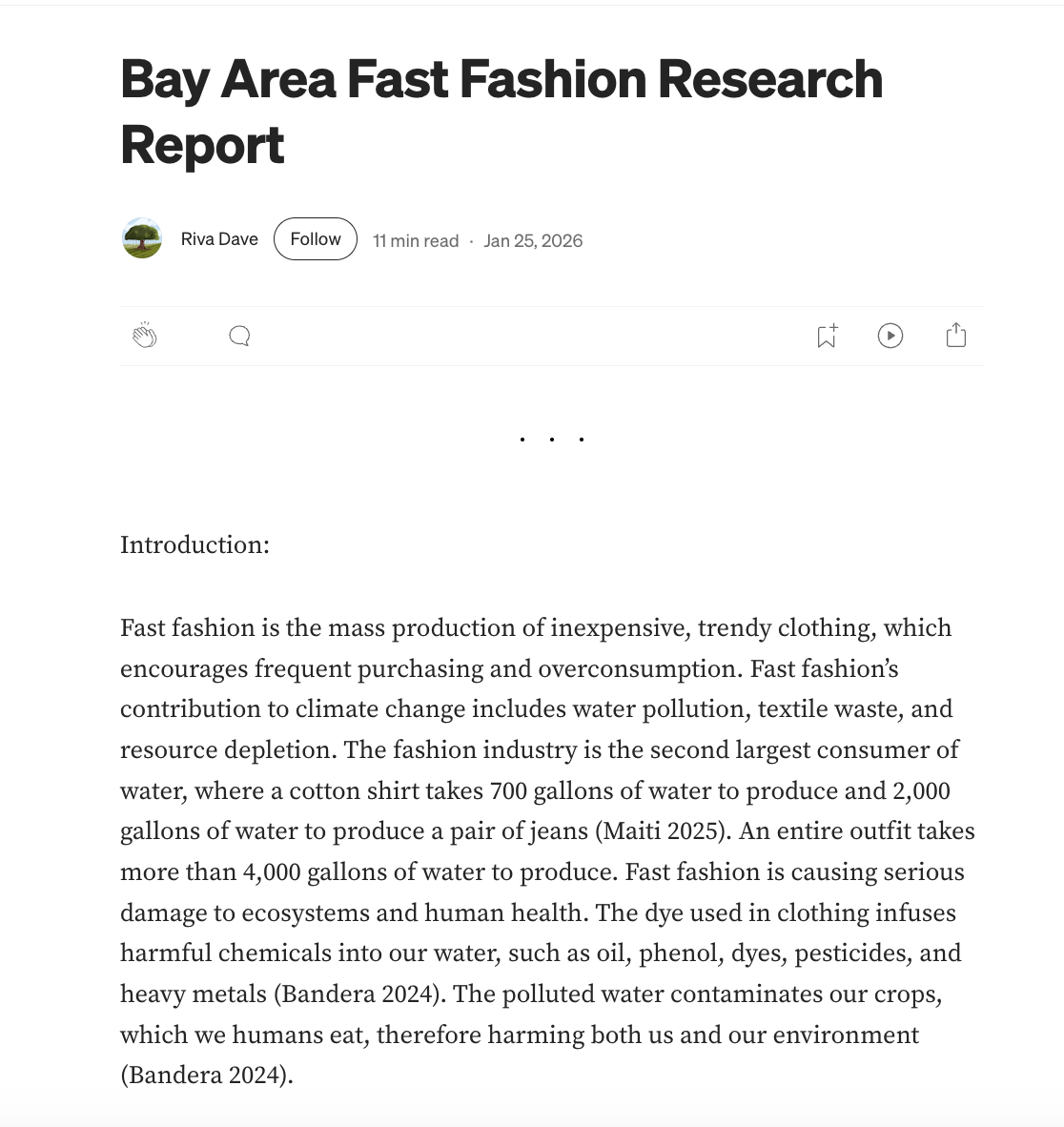
My name is Riva Dave, and I’m 16 years old from the Bay Area. I am committed to advocating for climate action and using my voice and passion to make change. I love doing small things for my community, whether it’s beautifying neighborhoods through trash pick-ups and gardening, or helping neighbors with babysitting. My curiosity and care for the planet and my community inspired my project. When I’m not busy raising awareness about environmental issues, I enjoy tennis, reading, and hanging out with my friends and family!
I led a youth-driven research project on fast fashion and textile waste in my community. In my research paper, I discuss what my research uncovered, why this issue matters locally, and what realistic actions young people and families can take to reduce textile waste. I started by surveying Bay Area residents on their fast fashion awareness and habits. This helped me receive a general understanding of how people shop and how much they know about fast fashion. Next, I began interviewing sustainability experts and organizations. I sent out more than 15 emails and heard back from 3 individuals. These interviews helped me gain further insight into fast fashion and waste, as well as ways to fix the problem. Once my research paper was completed, I published it online, to which readers positively responded. To have my research reach a wider audience, I decided to reach out to my local radio channel to speak about my project. I was able to receive an interview, and I spoke about my research, what inspired me, and ways listeners can change their habits. The radio show successfully helped me spread a large amount of awareness as it has an average of 750,000 listeners across the Bay Area.
Fast fashion is the mass production of trendy, inexpensive clothing. While it is convenient, it contributes to massive environmental waste, pollution, and resource depletion. On top of that, fast fashion brands are hard to escape as they consist of majority of the popular stores you shop at today. Why do people buy fast fashion even while knowing its harms? The answer for this is social media and constant pressure to fit in. Young people are the main consumers of fast fashion. Social media influences youth to purchase from fast fashion brands by marketing clothing such a way. Alongside social media, is pressure to have to constantly keep up with the trends. This causes a cycle of the disposal of clothes as trends come and go. By understanding the harmful environmental affects of fast fashion, young people can transform these trends into sustainable ones.
My research project helped impact my community by spreading awareness on the issues of fast fashion and how to change bad shopping habits into sustainable ones. My findings from my research reveal that fast fashion brands were the most common shopping choice. I also found that the majority of my respondents do not shop at second-hand stores, upcycle, and have very little awareness of fast fashion. This helped me realize that awareness needed to be a major part of my process towards combating fast fashion. I interviewed SCRAP SF, Sanchali Pal, and Megan Chen. SCRAP SF is a nonprofit that offers supplies, fabrics, and other items to upcycle with. Interviewing Laki Rajan, their Marketing & Development Coordinator, helped me determine that upcycling clothing is a creative and highly effective sustainable practice. Sanchali Pal is the CEO and founder of the app, Commons. Commons is an app that tracks the carbon emissions released with each purchase one makes. Sanchali’s insights revealed that seeing the negative impact people make on the environment helps them change their habits and perspective. Megan Chen is a Stanford student who recently spoke at COP30, the United Nations Climate Change Conference. She shared what she spoke about at the conference and introduced me to the idea of the circular economy model. My research helped impact my community by sharing the knowledge I gained through survey results and interviews with sustainability experts.
Participating in the Climate Leaders Fellowship allowed me to be creative and make use of my strong passion for environmental action! I am proud that I was able to make a change through awareness and share my research with over 750,000 listeners.
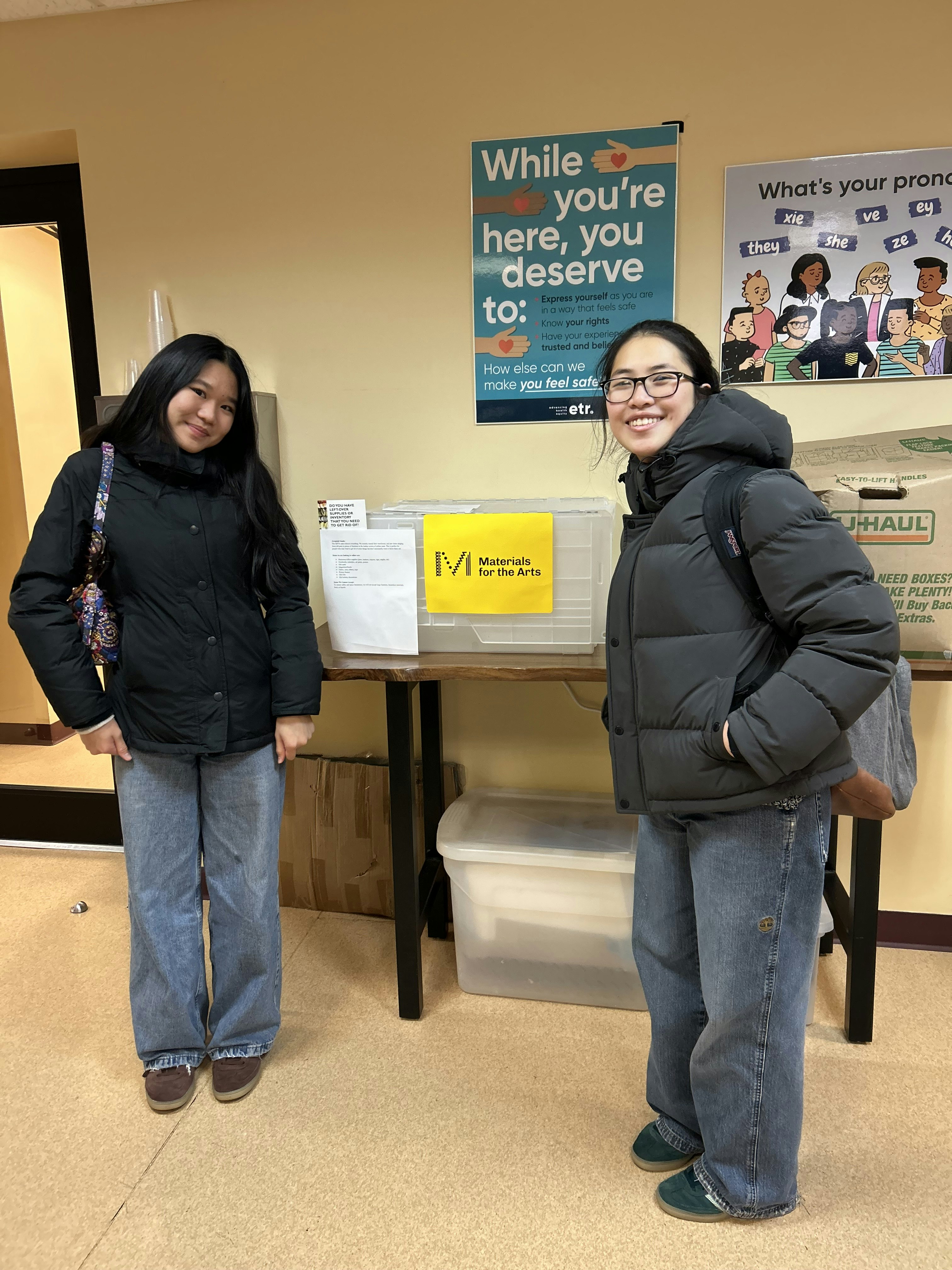


We are Selena and Amanda, two high school juniors from New York City who share a strong passion for sustainability and have loved arts and crafts our whole lives. Combining these two interests, we decided to organize a craft supply drive to not only promote less waste and more reuse, but to also spread the joy of the arts within our community.
As we looked for organizations to donate our collected supplies to, we found Materials for the Arts (MFTA), NYC’s largest creative reuse arts & education center that collects surplus materials and distributes them for free to local students, teachers, artists, and non-profits. After we established a partnership with MFTA, we emailed and called an array of small businesses, community centers, and other organizations to ask if we would be able to place collection bins at their locations. One of the main organizations we worked with was Center for Family Life in Brooklyn, where we placed a collection bin. In addition, we worked with some of our teachers to collect unwanted supplies. All together, we were able to collect a variety of supplies to donate to MFTA.
Our project aimed to benefit our community by redistributing lightly used or unused office and craft supplies, and other miscellaneous items that we thought could serve purpose in works of art. On an annual basis, millions upon millions of these materials end up in landfills and serve no particular function there besides contributing further to global warming through greenhouse gas emissions. By collecting supplies to donate to our partner Materials for the Arts, our project not only allows those in need to have the supplies they need to pursue their passion for art, but it also promotes sustainability through the redistribution and reuse of goods.
While our craft supply drive is still in progress, we have already collected a variety of supplies. We’ve collected mason jars, highlighters, markers, coloring supplies, notebooks, paper clips, decorative tape, and a multitude of other art or office related supplies. We’ve garnered multiple large bins of such items to donate to Materials for the Arts, and we are continuing to accumulate more bins.
Center for Family Life shared that they were glad to be giving away leftover craft and art supplies that were left after an event. They were happy that we were hosting our drive because it gave the excess supplies a new purpose and the opportunity for those in need to utilize them. Teachers we worked with were glad that their extra supplies were being put to meaningful use by other students and teachers. As for Materials for the Arts, they were glad to hear about the variety of items we would be donating. They are especially happy to hear that we would be donating more markers, as those are surprisingly low in quantity within their warehouse.
Our partner Materials for the Arts has been a great support throughout this project of ours. They provided everything we needed to get started, including our donation bins (which came from their warehouse!) and flyers/infographics. They have been able to guide us through the process of contacting various community centers and small businesses, and they continue to be a great partner in brainstorming ideas for the future. We are beyond excited to continue working with them to expand our project’s reach and truly make our mission of spreading creativity and sustainability heard.
The Climate Leaders Fellowship was a transformative experience that challenged me to become an even stronger leader in the field of climate activism. Through weekly meetings with peers who shared the same passion as me for protecting the Earth, I was deeply inspired to take charge and spark change in my community here in NYC. With the craft supply drive that my partner Amanda and I have led, we’ve gained so much confidence as climate advocates by continuing to build on our leadership and communication skills. By actually sending emails and calling up various organizations and speaking to officials, we gained real world experience in how we can advocate for concrete change and pitch our ideas in for the goal of true action.


Hi there! I’m Sofia Emma Hernandez, a 16-year-old from Cerritos, California, with a passion for breathing new life into the old. When I am not on the badminton court or hunting down the best Thai BBQ in town, you’ll likely find me in the garden with my two dogs, Mr. Lucky Chewy Cuddles and Lady Lottie Rose. As a youth environmentalist, I specialize in sustainability and textile upcycling. I am a firm believer that ‘beauty is in everything’, there is nothing more rewarding than transforming a forgotten garment into something beautiful and functional once again.
The journey from concept to implementation required a mix of creative design and community organizing. First, I established a partnership with PAWS (Protect Animals With Support) to turn smaller fabric scraps into dog toys for local shelters. For the primary mission, I worked with my church’s Hannah’s Helpers Program to identify orphanages in Tijuana, Mexico, that serve children living with HIV/AIDS. The execution involved collecting, sorting, and deep-cleaning hundreds of pounds of clothing. I then spent weeks sewing 45 unique “Little Hugs” bears, ensuring each was high-quality and hygienic, before coordinating the logistics of international delivery to ensure these items reached the children who needed them most.
Earth’s Little Hugs aims to disrupt the environmentally destructive “take-make-waste” cycle by upcycling dormant textiles into handcrafted stuffed animals and donating bundles of clothing packed with love, significantly reducing landfill waste and carbon emissions. This youth-led circular model operates at the intersection of resource preservation and compassion: it mitigates the harmful, environmental footprint of fabric production, saving thousands of gallons of water and preventing the leaching of synthetic dyes into the soil, while providing underserved children worldwide with enduring symbols of comfort and dignity. Ultimately, Earth’s Little Hugs proves that diverting waste from the path of incineration or decay is an overlooked effective vehicle for global humanitarian aid, ensuring every child recognizes their success and worth. Earth’s Little Hugs directly mitigates the environmental harms of the textile industry, which is a leading contributor to global carbon emissions and toxic runoff. By upcycling, we prioritize textile conservation, extending the lifecycle of existing materials to bypass the resource-intensive manufacturing of new fabrics, a process that typically consumes thousands of gallons of water per pound of cloth. Furthermore, by diverting these textiles from landfills and incineration, we conserve critical water supplies and prevent the leaching of synthetic, toxic dyes and heavy metals into local groundwater systems. Unused textiles often lay dormant in the closet of individuals’ homes, taking up space as they wait to be thrown in the dumpster, contributing to environmental harm and biodiversity degradation. Earth’s Little Hugs prevents this dreadful fate. Beyond these environmental benefits, Earth’s Little Hugs fosters community resilience by equipping underserved children with comfort and love through upcycled teddy bears and recycled clothing, ensuring that the transition to a greener planet is inclusive and honors the inherent worth of every individual (with a warm, cuddly teddy bear, of course!) In a systemic context where children in crisis often face unstable environments, a “Little Hug” offers a consistent, reliable source of security.
Earth’s Little Hugs successfully diverted over 200 (~232) pounds of textile waste from landfills, transforming discarded fabric into symbols of hope and comfort. We hand-delivered 45 upcycled bears (from the donations of unused, washed clothing due to hygienic concerns) to orphans in Tijuana, Mexico, providing a profound sense of dignity and emotional support to all. We also provided nearly 400 (specifically 386) pieces of clothing, which had been donated and cleaned, to children in 13 orphanages within Mexico’s borders. Furthermore, we extended our mission to animal welfare by donating over 100 upcycled toys (specifically 117) to the County of Los Angeles Department of Animal Care and Control, enriching the lives of over 100 dogs awaiting their forever homes, because dogs deserve our love too! Moreover, Earth’s Little Hugs generated a wave of qualitative impact within the environmental community, transforming the way my peers viewed global responsibility. Through deep dialogue with Citizens’ Climate Lobby, an environmental organization I have been involved with for over a year, the members embraced the idea that environmental health and child welfare are astonishingly linked. One peer noted that the project represents a “win-win situation”: securing a victory for the planet while providing a child with a lasting gift of comfort! Seeing this shift in mindset was a primary result for me; it proved that by centering the needs of underserved children, we were also cultivating a more empathetic and holistic approach to environmental advocacy. The people in charge of Hannah’s Helpers also offered my a lot of support, stating that it was “a great blessing for me to uplift and help the children” and that it was inspiring “to see youth being called to help and serve”. I will definitely remain dedicated to Hannah’s Helpers, and I look forward to partnering with them in the future!
Growing up in an economically disadvantaged household, I understood the quiet ache of feeling overlooked. This project was my way of turning that past empathy into future action. The Climate Leaders Fellowship was the catalyst I needed; it taught me that I don’t have to wait for adulthood to be a changemaker. Seeing a child hold a bear I sewed from a discarded shirt changed my perspective on environmentalism, it’s not just about saving trees or oceans; it’s about protecting the people who live here. I’ve realized that climate justice and human dignity are the same mission. Earth’s Little Hugs isn’t only about protecting the planet, it’s about giving back to others in the act of sustainability and environmental protection. Reflecting on the personal meaning behind Earth’s Little Hugs requires me to look back at my own childhood. Growing up in an economically disadvantaged household, I lived with the quiet ache of knowing other children had access to opportunities and gifts I could only dream of. For a time, that scarcity turned into envy, and eventually, a sense of resentment. Everything changed when I was introduced to the beauty of community gift-giving. It was then I realized how truly fortunate I was, not because I was able to get gifts for my birthday or the holidays, but because I had people who poured every ounce of their love and effort into my life. Earth’s Little Hugs is my way of paying that realization forward. I want to use my voice and my hands to reach the hearts of children standing where I once stood. I want to replace their uncertainty with the assurance that someone, somewhere, cares deeply for them. To me, the new generation of environmentalism isn’t just about protecting the planet’s resources; it’s about a reconfiguration of the word’s definition, one where we protect the people of the planet as fiercely as the Earth itself.
If you want to start your own initiative, my biggest piece of advice is: don’t wait for the perfect plan to take the first step. I initially struggled with the “how,” but the Fellowship taught me to break big goals into manageable tasks. Secondly, leverage your community. You don’t have to do it alone, reach out to school clubs, local churches, or non-profits. Most people want to help; they just need someone to show them how. Finally, find a way to make your environmental work personal. When you connect a global issue (like textile waste) to a human story (like a child’s smile), your impact becomes unstoppable.


Hi, my name is Bingchen Hu, and I live in San Jose, California. I am a 15-year-old high school freshman and a teen stand-up comedian who performs at a local club. I enjoy traveling and photography, have visited over 40 countries, and soccer is my soul.
For my project, I collected unused airline amenity kits and earplugs to reduce waste and support my local community. I partnered with companies in California to request donations of unused amenity kits. I set up collection and recycling points at local libraries and nearby airports, focusing especially on high-travel periods such as Thanksgiving and Christmas. Used earplugs were recycled when possible, and all unopened amenity kits were donated to local charities. My target audiences included employees, travelers, and local organizations, whom I engaged through direct outreach, in-person collection efforts, and community or event partnerships.
The problem I am addressing is the large amount of waste created by unused airline amenity bags. According to the International Air Transport Association (IATA), airlines carry over 4.5 billion passengers each year, many of whom receive amenity kits that are never used. Items like earplugs and plastic-wrapped toiletries are often non-recyclable and end up in landfills. This issue matters to me because I have personally seen the effects of climate change, including wildfires, extreme hail, and flooding in places where it was once rare. As someone who travels frequently, I see this waste firsthand and feel responsible for taking action. My project collects unused airline amenity bags and donates them to charities, reducing waste while helping people in need.
For this project, I collected 300 unused airline amenity bags and contributed approximately 30 volunteer hours. All amenity kits were donated to local charities, helping reduce waste while providing essential items to people in need. The results were measurable and immediate: 300 amenity bags were diverted from landfills and repurposed for community use. Feedback from partner organizations was positive, with charities noting that the items were useful and ready for direct distribution. I worked with large local companies in Silicon Valley (not allowed to share names) that supported the collection. These partnerships were essential to the project’s success, as they helped provide access to unused materials, coordinated logistics, and increased the scale and credibility of the initiative.
Being part of the Climate Leaders Fellowship was an experience that truly stayed with me. From the very first session, I felt inspired by the energy and dedication of my cohort members. I remember one discussion where a fellow participant shared their approach to reducing plastic waste in their community, which sparked an idea that I ended up incorporating into my own project. Learning from others and exchanging ideas made me realize that even small actions can ripple into meaningful change. Participating in the fellowship made me feel both challenged and empowered. There were moments when I questioned whether my project could make a real difference, but the support and feedback from my peers reminded me to keep pushing forward. What I’m most proud of is seeing my project come to life and knowing it sparked conversations about climate action. It gave me confidence to continue advocating for the environment beyond the fellowship.
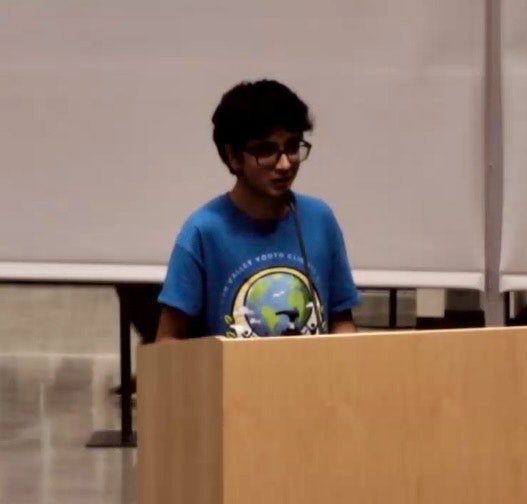

I’m Aahaan Jain, a student at Lynbrook High School in the San Francisco Bay Area. Before participating in the Stanford Climate Leaders Fellowship, I’d been involved in supporting state and national bills relating to climate change (Fix Our Forests Act, AB 285 (environmental education), etc.) but this fellowship was my first introduction to writing policy. Outside of climate advocacy, I’m deeply interested in economics, serving as a national officer at the Youth Economics Initiative. I also conduct research at Johns Hopkins regarding financial market linkages during the Great Financial Crisis. In my free time, I enjoy competitive typing.
After conducting some background research, I created an outline for my climate action resolution. The resolution requires the district to compost, set ambitious electrification and renewable energy goals, designate a climate curriculum to ensure that students graduate climate literate, and more.
I continued to work with my district to modify the resolution, and worked with 15+ environmental organizations including Climate Action California, Sierra Club, Elders Climate Action, and more to support the resolution through support letters. I also canvassed directly in nt school district, working to gather 120+ signatures in support of the policy to be sent to the board, raising support from students, teachers, parents, and even alumni of the district. To spread the word about the policy, I presented the resolution to my local middle school, high school, and several local elected officials in the area. On December 9th, 2025, the FUHSD School District Board unanimously voted to approve this policy, directly affecting over 11,000 students in the district.
Now, I’m reaching out to eventually with other school districts in the area to pass similar climate action resolutions so school districts can do their part in the climate crisis.
When I found out that schools are one of the largest public sector consumers of energy, coupled with the lack of climate awareness in my high school, I set to change district-wide policy on climate action, culminating in the Fremont Union High School District (FUHSD) Climate Action Resolution. To start off, I collaborated with district leadership (the Superintendent and Associate Superintendent) to conduct field research on policies that FUHSD had passed, noting that its climate policies were significantly outdated. I worked with local environmental nonprofits including the Sierra Club and Citizens’ Climate Lobby to create a draft resolution, outlining ambitious goals that the district has to meet. Using a survey with approximately 500 respondents, I found that 81.1% of students indicated that it is important (39.3%), to extremely important (42.9%) to learn about effective action that can be taken regarding climate change.
The impact of this project is multifold, ranging from engaging a wide variety of stakeholders to quantifiable impacts at Fremont Union High School District itself. Primarily, I was able to engage a wide variety of nonprofit organizations, like Ten Strands, Climate Action California, Acterra, and more. We hope that engaging them as stakeholders will help them prioritize focusing on students as a method of climate action. Moreover, I was able to meet several local elected officials and even congress people to discuss the policy before and after it was passed. Beyond that, I presented to a wide variety of age groups, ranging from students at my middle school to fellow high schoolers in my environmental club and district climate collective. Finally, the most tangible impact is on the school district. Clauses range from a composting program, increased electrification, a climate curriculum, and more that will help change student perspective and student action on a district level.
I think I severely underestimated the power of cold outreach and communication, especially cross-generational communication. Adults are so often willing to help youth, and the only thing that you need to do is go out there and ask! Overall, I think building this coalition and passing policy has had a tremendous impact on me as a person, and I’ve become more resilient and ambitious.


Hi, I’m Kanav Jain, a high school student from India and the President of my school’s Entrepreneurship Cell. I’ve always been interested in building ideas, but over time I’ve started thinking more about how those ideas can actually create impact, not just financially, but socially and environmentally as well. For me, climate action isn’t something separate from daily life. It’s in the choices we make, the products we use, and the systems we support. That’s what led me to work on a project that combines sustainability with real-world entrepreneurship.
Through Navrang, we partnered with a rehabilitation centre where artisans create products using biodegradable, recycled, and upcycled materials. We didn’t want to just “source” products, we wanted to be involved in the process.
We visited the centre, learned handicraft skills like crochet, and worked with the artisans to co-create products that would appeal to our target market. In return, we conducted simple financial literacy and transaction-based sessions, making sure they were practical and easy to understand.
Within our school, we structured our team into different roles like training & skill exchange, production, marketing, sales, and finance. We sold products through school events, exhibitions, and parent gatherings, using storytelling to explain both the sustainability aspect and the effort behind each product.
Our main audience was our school community, and we engaged them through direct interaction rather than just promotion. Every stall became an opportunity to have conversations about sustainability, handmade work, and conscious buying.
In my surroundings, I noticed that people are becoming more aware of sustainability, but that awareness doesn’t always translate into action. Most people still prefer convenience, even if it’s not environmentally friendly. At the same time, there are many skilled artisans, including specially-abled individuals, who create eco-friendly, handmade products but don’t have consistent access to markets.
This gap stayed with me. I felt that if sustainability is going to work, it has to be practical and economically viable, not just an idea.
That’s how Navrang: The Kala Exchange started. The idea was simple: to create a student-led enterprise that promotes sustainable, handmade products while also building a fair and respectful collaboration with artisans. Instead of a one-way model, we focused on a skill exchange, where both sides could learn and contribute.
Navrang created impact at different levels.
At an environmental level, we promoted products made from biodegradable and upcycled materials, encouraging people to choose more sustainable alternatives.
At a social level, we worked closely with specially-abled artisans, not just as beneficiaries but as collaborators. The skill exchange model helped build a more equal and respectful relationship.
At a student level, we were able to run a real enterprise managing production, marketing, sales, and finances, which gave us a much deeper understanding of how impact and business can go together.
What stood out to me was the change in conversations. Customers started asking more questions about where products come from and how they are made. That shift, even if small, felt meaningful.
This project made me realise that creating impact is not as straightforward as it sounds. There were moments where things didn’t go as planned, whether it was managing time, getting proposals approved from school administration, coordinating with the team, or aligning production with demand.
But that’s also where the real learning happened. I understood that impact is not about doing something once, but about building something that can sustain itself.
Through the Climate Leaders Fellowship, I moved from just thinking about ideas to actually implementing them. I think that shift, from intention to action, is what I value the most.
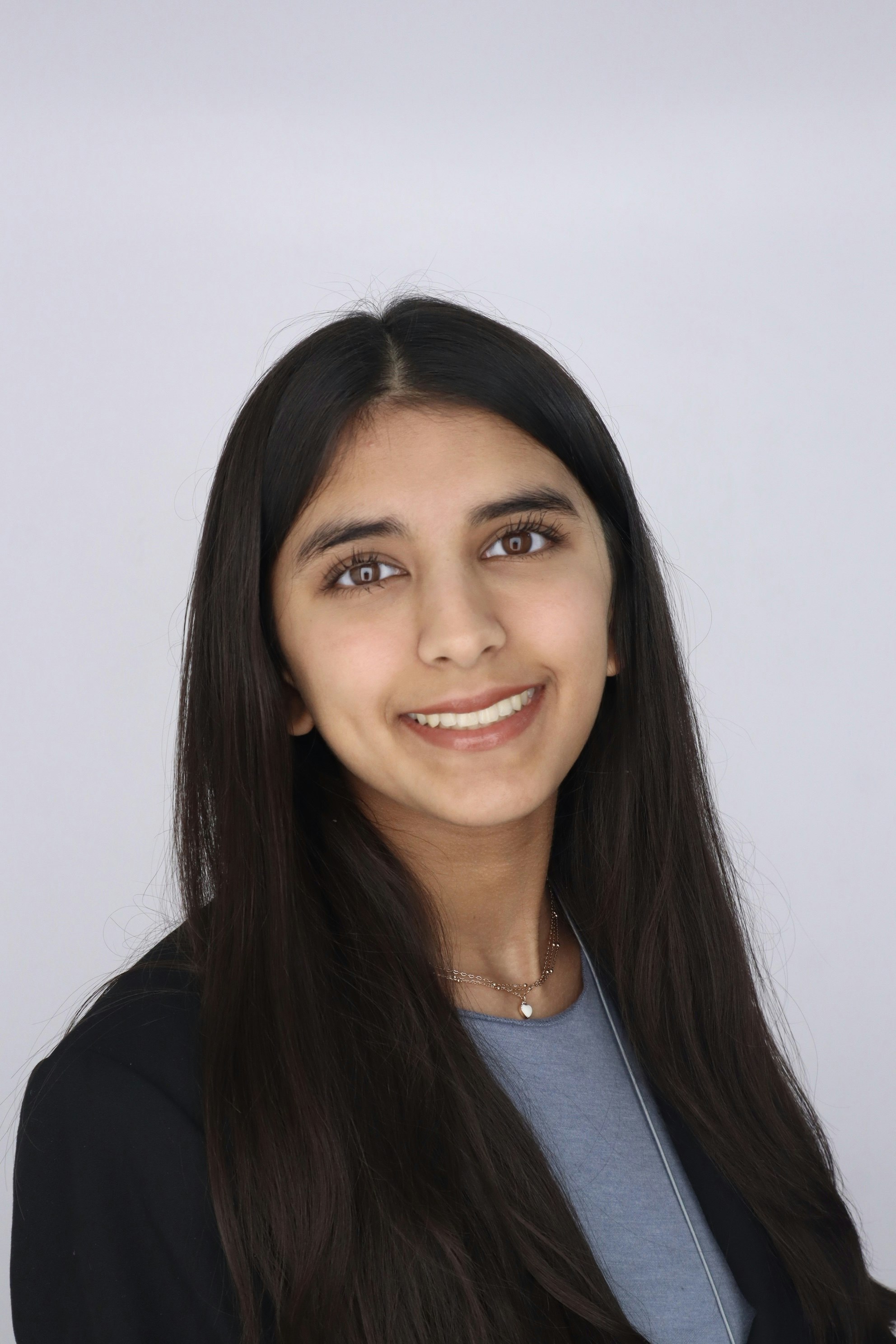

We are Somya and Nitya Jain, two high school students living in New Jersey. We are passionate about sustainability, community service, and initiatives that empower young people to take action on important issues. In our free time, we enjoy doing simple activities together like playing sports, watching TV, and listening to music. Sometimes we also play games, talk, and laugh about random things. These activities help us relax and spend enjoyable time together.
To address this issue, we created a one month sustainability challenge that invited participants to commit to practicing climate friendly habits in their daily lives. Participants began by completing an initial form where they selected the sustainable behaviors they wanted to focus on and reflected on their motivations for joining the challenge. During the month, they worked on maintaining these habits in their routines. At the end of the challenge, participants completed a final reflection form where they shared what they learned and how their habits had changed. The project was implemented primarily through online outreach, which allowed us to reach students and community members and make participation accessible.
For our Climate Leaders Fellowship project, we focused on the challenge that many people care about climate change but are unsure how to incorporate sustainable habits into their daily lives. Environmental issues can sometimes feel overwhelming because they are discussed at such a large global scale. We wanted to shift the focus toward everyday actions that individuals could realistically adopt. Our goal was to demonstrate that sustainability can be integrated into ordinary routines and that small behavioral changes practiced consistently can contribute to larger environmental progress.
Our project brought together more than fifty participants who took part in the month long challenge and committed to improving their everyday environmental habits. Participants focused on actions such as reducing waste, limiting single use plastics, conserving energy, and making more mindful consumption choices. After the challenge ended, we reviewed feedback from the final reflection form to understand its impact. More than eighty percent of respondents indicated that they planned to continue the sustainable behaviors they practiced during the challenge. This response demonstrated that the initiative helped participants develop greater awareness about how their everyday actions affect the environment.
The Climate Leaders Fellowship gave us the opportunity to work on a project that connected our interest in sustainability with meaningful community engagement. Collaborating with each other allowed us to build on each other’s ideas and create a stronger initiative together. One of the most impactful moments for us was seeing participants share how the challenge helped them become more aware of their habits and motivated them to continue making sustainable choices. That feedback made us feel proud of the project and showed us that even small initiatives can inspire people to think differently about their role in addressing climate change.
For anyone interested in starting a similar project, we would recommend focusing on actions that people can realistically maintain in their daily routines. When sustainability feels practical and accessible, more people are willing to participate and stay engaged. It is also important to communicate clearly about the purpose of the project and encourage participants to reflect on their experiences. Working with a partner or team can also make the process easier and more creative because you can share ideas and support each other. Most importantly, remember that impactful projects do not have to be complicated and often begin with small but meaningful actions.
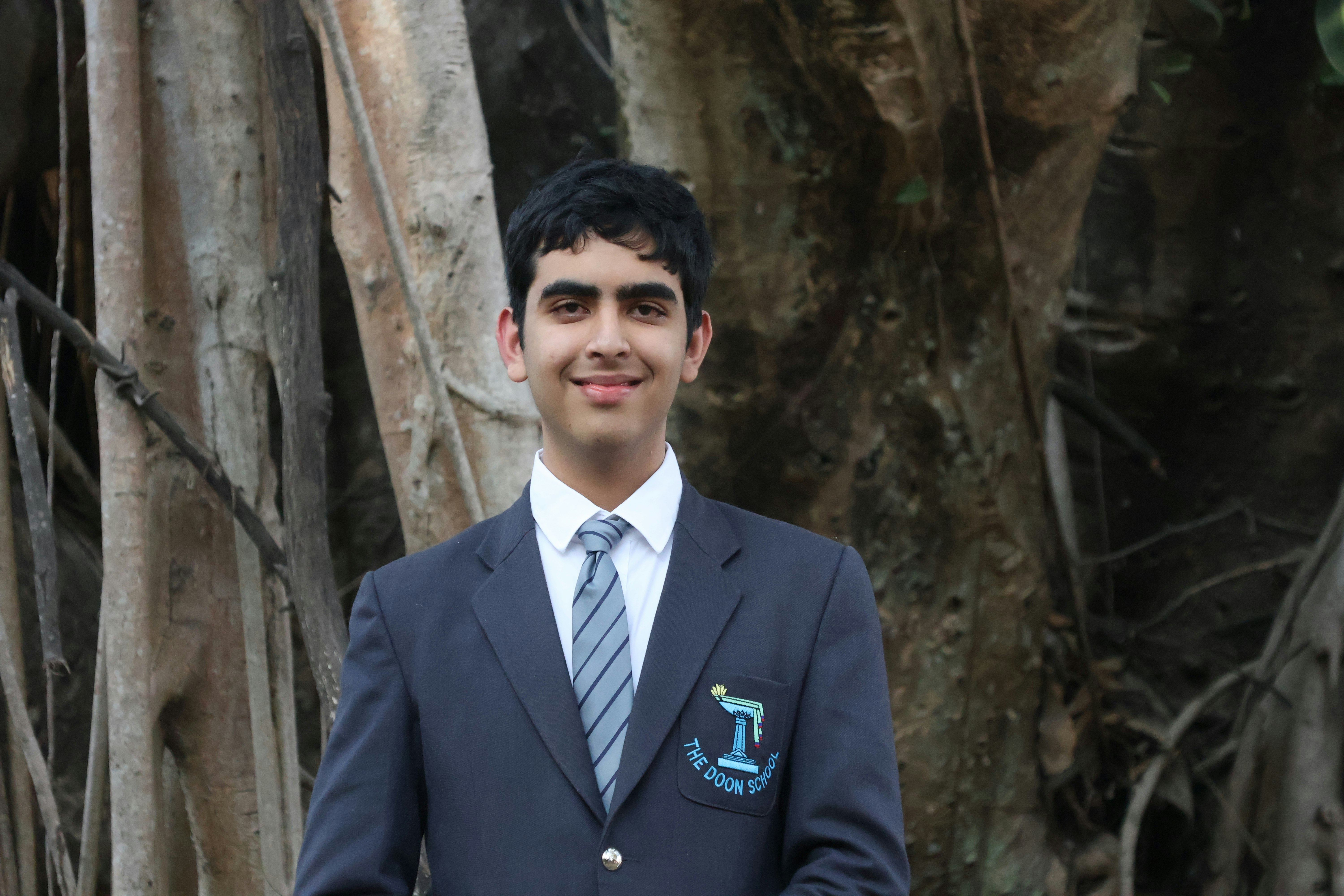
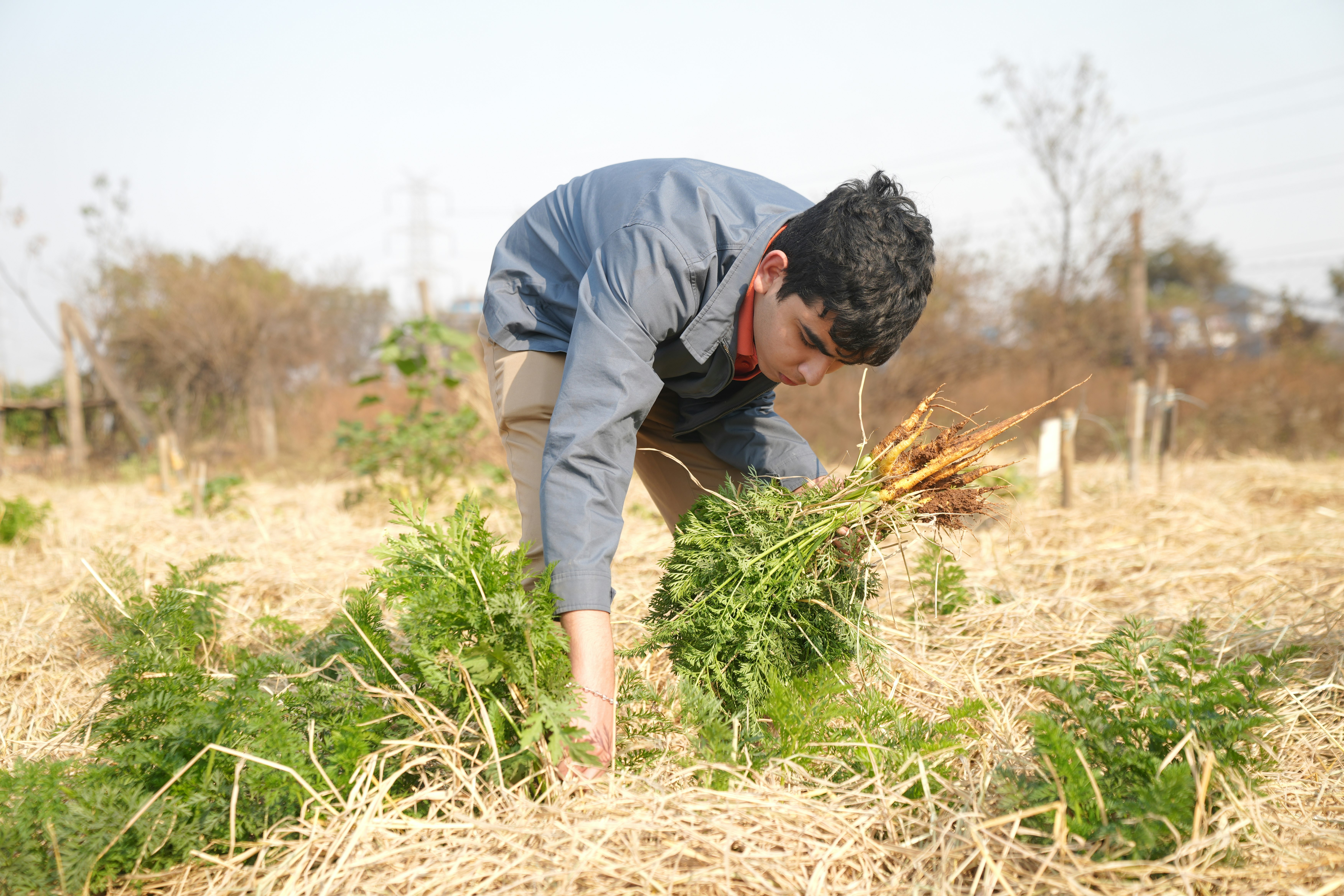
I’m Yuvaan Jalan, a 16-year-old student currently studying at The Doon School in Dehradun, although my hometown is Kolkata. I’m deeply interested in climate action, sustainable agriculture, and how local food systems can be strengthened to support both farmers and ecosystems. Through my Climate Leaders Fellowship journey, I scaled GrowLocal, my very own social initiative that focuses on supporting farmers who cultivate native varieties of fruits and crops, particularly those that are often overlooked in mainstream supply chains. My goal has been to help these farmers access wider markets while also encouraging the preservation of biodiversity and traditional agricultural practices.
GroundLocal Field Research & Visits: To begin understanding the problem firsthand, I conducted field visits in West Bengal where I met farmers cultivating native banana varieties and other local produce. Through on-site engagement, I observed cultivation methods, harvesting practices, and the logistical challenges farmers faced when trying to access broader markets. These visits helped me understand barriers such as transportation costs, inconsistent demand, and limited corporate sourcing networks. The insights gathered during these interactions became the foundation of GrowLocal’s future outreach strategy. SowLocal Farmer Survey: In June 2025, I designed and distributed the SowLocal Questionnaire, a survey focused on understanding farmers’ cultivation techniques, land use, crop diversity, economic challenges, and existing sales channels. The survey was translated into Bengali to ensure accessibility and distributed through community networks supporting farming families in West Bengal. Over 500 responses were collected, offering a detailed look into the ecological, economic, and cultural realities of farmers working with native crops. The data helped shape GrowLocal’s understanding of both supply challenges and opportunities for intervention. ShowLocal Farmer Interview Series: To amplify farmer voices and create more relatable and free-access content, I launched the ShowLocal YouTube Series, where I interviewed farmers about native banana cultivation, soil and weather requirements, harvesting techniques, and challenges in distribution. I am currently in the editing process for the videos, before uploading them online. Seed Conservation & Farming Initiatives: As the project evolved, GrowLocal began contributing toward the conservation of over 300 species of heirloom seeds, helping preserve heirloom varieties at risk of disappearing from mainstream agriculture. In addition, small-scale cultivation initiatives resulted in approximately 600 kilograms of harvest, demonstrating the potential of native crop farming when supported through structured planning.
Across many parts of India, farmers growing native crop varieties face many significant but often ignored challenges. While imported or hybrid crops dominate the more large-scale retail markets, it is the local and indigenous varieties that continue to struggle in gaining visibility despite being much better suited to regional ecosystems. This not only affects farmers, but also contributes to the general and wider loss of biodiversity and traditional seed varieties. Through early research and conversations with farmers, I realised that many were producing high-quality native fruits, particularly different varieties of bananas, but lacked access to structured supply chains and wider consumer markets. Transportation gaps, limited market awareness, and buyer preferences for uniform imported produce made it difficult for these farmers to scale their work. This issue mattered to me personally because I grew up seeing how local food traditions are deeply connected to our Indian culture and ecology. I wanted to explore how young people like myself could actually address this gap, the one between local agricultural communities and modern supply systems in a way that respected sustainability and the autonomy and expertise of farmers.
Impact GrowLocal has supported farmers by: Documenting real farming practices and challenges through surveys and field visits
Amplifying farmer voices through videos and personal narrations
Conserving 300+ native seed varieties through early-stage seed bank efforts
Supporting cultivation efforts that produced 800 kilograms of native harvest
Additionally, GrowLocal has built a volunteer network form as well, which is present on my project website and something I’d like to circulate once in my last year of high school, helping expand outreach efforts and awareness among students and community members.
Working on GrowLocal has changed how I think about climate action. It is through this that I’ve realised how sustainability isn’t only about reducing more harm to our planet and environment but it’s also about strengthening the systems that already work, especially local and traditional agricultural practices, to do so! What I’m most proud of is building real relationships with farmers and learning directly from their lived experiences. The project pushed me to step outside my comfort zone, engage with different communities, advocate for more people to join and take an interest, apply to forums like this in an effort to have my work be recognized and shared with others; and understand the complexities of food systems beyond just theory. Being part of something as wonderful as the Climate Leaders Fellowship helped me see that climate work can take many forms, from education to people engagement. It also showed me that meaningful change isn’t always large. It often begins with small, local actions.

My name is Aria, and I am a high school student from Irvine, California who is passionate about environmental science and using technology to solve sustainability challenges. I am especially interested in how communities can reduce waste and build more sustainable systems through education, data, and collaboration. Outside of academics, I participate in activities like basketball and choir.
For my project, I designed and created an informational website focused on environmental sustainability and responsible electronic waste management. The goal of the website was to make complex environmental issues easier to understand and encourage people to take action in their communities. I researched reliable environmental data and resources about e-waste and sustainability, then organized the information into clear sections on my website. I also included practical steps people can take, such as recycling electronics and extending device lifespans. I implemented my project online by creating and publishing the website using Google Sites. The digital platform allowed the project to reach a wider audience beyond my immediate community. My target audience included students, community members, and individuals who regularly use technology but may not be aware of the environmental impact of electronic waste. A way I was able to engage them included educational content and actionable steps they could take to reduce e-waste.
One environmental issue I wanted to address is electronic waste, or e-waste. Many people replace devices like phones, laptops, and tablets frequently, but a large percentage of those devices are not recycled properly. When electronics are thrown away incorrectly, they can release toxic materials such as lead and mercury into the environment. In my community, many residents are not aware of where or how to recycle electronics responsibly. I created my website to raise awareness about this issue and provide accessible information about responsible e-waste recycling and environmental sustainability. This issue matters to me because technology is such a huge part of everyday life, yet the environmental consequences of electronic waste are often overlooked. I believe small community actions can make a meaningful difference. By educating people about responsible disposal and reuse of electronics, communities can reduce pollutions.
The project primarily focused on education and awareness. Through the website, I helped share information, resources, and opportunities for community members to participate in sustainable actions such as recycling or donating electronics. Feedback from peers and community members suggested that the website helped make the issue easier to understand and motivated them to consider recycling their devices. So far, I’ve been able to reduce electricity consumption by about 15.9 kilowatt-hours annually and approximately 6.2 kilograms of carbon dioxide emissions per year. Working with mentors helped me improve both the research and communication aspects of my project. Their feedback encouraged me to think more critically about environmental issues and how to present solutions that communities could realistically implement.
Working in a cohort alongside students from different backgrounds and countries was incredibly inspiring. Seeing the projects other fellows were developing motivated me to think more creatively about how local actions can contribute to larger environmental solutions. Participating in the fellowship made me feel more confident in my ability to take initiative and create change in my community. I am most proud of taking an idea and turning it into something tangible that can educate others. Creating the website allowed me to combine research, technology, and environmental advocacy into a project that could have a real impact.
4 .Be open to improving your project over time.


My name is Emily Kantardzic and I’m a high school student from Toronto who cares a lot about my community and the people in it. I’ve always been a people person and someone who enjoys connecting with others and bringing people together around meaningful ideas. I believe that even small actions can lead to real change, especially when young people work together. Creating projects and encouraging others to get involved in causes they care about is something I’m really passionate about!
My project focuses on raising awareness about youth homelessness in Toronto and how extreme weather, especially cold winters, affects young people without stable housing. According to Toronto’s 2024 Street Needs Assessment, about 15,418 people were experiencing homelessness, including roughly 1,500 youth aged 16, 24 on any given night. Youth make up about 10% of the city’s shelter population. Warm Hearts was created to help people better understand this issue while also encouraging simple actions that can help support young people in our city.
I’m interested in community service, youth leadership, climate action, and social impact. I enjoy creating projects that bring people together, raising awareness about important issues, and using social media as a platform for positive change. I also love meeting new people, learning from others, and finding creative ways to make an impact in my community.
Through the Warm Hearts campaign, I collected gently used winter clothing, winter accessories like hats, gloves, and scarves, as well as some monetary donations from students and community members. The project helped raise awareness within my school community and encouraged many people to get involved and support the cause. One of the most meaningful outcomes was seeing conversations start among students about how small actions can make a positive impact. I partnered with Covenant House Toronto, which supports youth experiencing homelessness, and knowing that the donations would go directly to helping young people in Toronto made the project even more meaningful.
Being part of the Climate Leaders Fellowship was really inspiring because I was surrounded by other young people who are passionate about creating positive change in their communities. Hearing about the projects and ideas from other fellows motivated me to keep developing my own project and think bigger about what’s possible. The experience helped me feel more confident in my ability to take action and showed me that young people can make a real difference. I’m most proud that Warm Hearts started as a simple idea and grew into something that brought people together around a shared goal.
My biggest advice for someone who wants to start a project like this is to begin with something you genuinely care about. You don’t need to have everything figured out before starting, sometimes the most important step is simply taking the first step. Start small, involve your community or school, and don’t be afraid to ask for help or collaborate with organizations that already support the issue. Sharing your message through social media can also help spread awareness and inspire others to get involved!


Hey! I’m Renzo, a 17-year old student at Haut-Lac International school in Switzerland who really wants to see the world turn greener in a way that is both profitable and gets to the roots of the climate change issues we face today. I love learning about sustainability, building solutions to fit problems, and putting smiles on people’s faces.
At its core, the project was really about getting the youth involved in turning simple actions into measurable impact. I wrote a ton of cold emails, got as many students involved in fundraising and raising awareness on the problem as possible from around the world, and set up a system that converts donations of roughly 1.5 USD to planting one tree.
Over the summer, I created all the tools necessary in order to support students in their awareness and fundraising goals too. I wanted to show that fighting climate change could be as easy as working with your friends to bake a cake, and as fun as throwing a halloween ball fundraiser.
When I was 15, I went hunting for problems. Not just any problems, but real-world issues regarding climate change in my own community, and one problem in particular stuck out to me. In a country of over 3 million coconut farmers, roughly 60% of smallholder coconut farmers in the Philippines live under the national poverty line of $2.15 USD, meaning a vast majority of farmers don’t make enough money to support themselves, and much less their own families.
Diving deeper into the problem, I found that the root of this problem was climate change. A 2025 study concluded that 94% of surveyed coconut farmers were aware of the negative impacts of climate change on rainfall, temperature, and extreme events. This makes it impossible for them to make a decent living and pushes households either into poverty or into seeking alternative, often illegal, income sources.
Instead of feeling down, I was inspired to act. The problem especially had a personal tone for me as my father’s side of the family and their community was particularly struck by the problem. I contacted a bunch of organisations out of the blue through cold emails and ended up partnering with HOPE and the Philippine Coconut Authority in order to see how I could help best, and after various test trials and reiterations, I founded the NGO CocoHOPE.
CocoHOPE is a youth-led non-profit tackling the poverty crisis faced by smallholder coconut farmers in the Philippines. Partnering with 20+ schools and 80+ volunteers from 6 continents (including Antarctica!). The organization has already raised funds to plant around 3,000 coconut trees so far, helping farmer families grow their incomes by an average of over 60% whilst providing them financial stability. Students run their own fundraisers, and get certificates for their contribution.
To ensure that my solutions were the most effective, I enlisted the help of several mentors from the IUCN, HOPE, UN SDG Changemakers, and even student mentors from the Climate Leaders Fellowship program. They really helped me shift my perspective, and a special shoutout to Jessie Choi for her amazing tips, with CLF as a whole acting as a great environment encouraging me to push further with my goals.
For other perspectives and additional help, I got an advisory team of youth changemakers my age to support me which I also have to thank (Michael Davidsen, Laura Zogbi, Mika Weiss, Ines Navratil, Martyna Kuik, Jade Pesci, Mélia Lémoine) as they helped me refine the solution, contact other people from around the world, and even led their own initiatives related to the project.
Above all, I am the most proud of the changemakers that joined the project from around the world. For many, it was the first time they went out of their way to support the environment and they’re doing an amazing job.
We always talk about how powerful our voices are, but never our ears. I believe that the latter is more important, as you need to truly understand your problem to create a meaningful change. Mentorship is non-negotiable too; whether you get it from CLF or from elsewhere (i.e. emailing researchers, contacting experts, etc.). Don’t be afraid to embarrass yourself, be annoying, and try things for the very first time. Contact as many people as possible too, as people are almost always way kinder than you would believe. Embarrassment is an under-explored emotion, and often it’s the only thing hindering your growth.

We are Leila Barber and Katie Le, high school juniors from Pittsburgh, PA. We are visual art students who have a passion to address climate change issues within our community.
We created a clothing drive competition for high schoolers at our school, the homeroom with the most donations received a donut party. We formed an organization called Artmosphere with Linh from Cohort 1B to address climate change solutions through artistic initiatives. After reaching out to our school’s principal and activities director at CAPA, we gathered a total of 24 boxes to distribute in each homeroom and designed a flyer to pass around the school. Additionally, we also signed up for the donation under Artmopshere on the Light of Life Rescue Mission’s website, a Pittsburgh non-profit. To ensure the competition reaches everyone at school, we worked with homeroom teachers to spread the word and emphasized the donut prize as a way to boost engagement.
According to Earth.org, fast fashion ranks only second behind agriculture in water consumption, and 85% of these textiles end up in landfills each year, releasing significant microplastics and taking decades, if not centuries, to decompose. The process of making plastic fibers also requires a substantial amount of energy and exposes manufacturers to health risks. We also noticed the growing trend of fast fashion among our generation, and we wanted to bring back community effort to reduce textile waste, especially in schools, where youth have the potential to contribute to a sustainable future. Spreading awareness on sustainable clothing practices matter to us because it is an accessible solution that discourages the overconsumption of clothes, an issue most of the current generation face because we give in to our pleasures. Through the 10 day long clothing drive competition, we aimed to not only raise awareness on the issues but also boost engagement regarding sustainable clothing practices among developing teens, such as reusing clothes, to combat textile waste.
After 2 weeks, we collected 276 clothing items and contributions from 9th through 12th grade high schoolers. After the competition ended, we sorted through the clothes to organize them by type and ensure they were clean and suitable for donation. We then transported all 276 articles of clothing to the Light of Life Rescue Mission for distribution to homeless communities.
Through the cohort meetings, we found that there were many fellows interested in addressing the issues of fast fashion, and specifically worked with a girl from Cohort 1B who contributed significantly to building our small organization, Artmosphere. Participating in the Climate Leaders Fellowship is a very inclusive experience, as everybody starts out with little to no clear directions on what their project should look like, but the ideas that were exchanged on the way made us realize that we are not alone in this journey, and that we all have the potential as youth to contribute in making a difference in the world. Regarding our project, we find it rewarding that we were able to provide an engaging and valuable experience for every high schooler, collecting a total of 276 donated items in just under 2 weeks, with a fun prize for the winner.
Start out with listing your ideas on a big document rather than trying to be perfect on the first try. Ensure clear communication with your teams before proceeding with larger implementations. Create a detailed logistics plan and determine which organization is best suited to accompany your project. Don’t be afraid to reach out for help and speak up about your project, find connections with people at school who are willing to help.

Hi! I’m Audrey, a 17-year-old junior at a Houston high school. Besides being interested in environmental sustainability, I also love reading classics, listening to jazz, and watching movies!
To address these environmental and social challenges, students, faculty members, and cafeteria staff can collaborate together to safely collect and store salvageable food items (unopened and uneaten food items). After eating their lunch, students can place their unopened, uneaten cafeteria food items (e.g. milk cartons, wrapped snacks, and unopened fruit bags) into a designated Food Rescue bin or cooler. The lunch advisor for the period lightly supervises the collection area to ensure safety and compliance (e.g. no horseplay around the collection area). Trained Food Rescue students will record cooler bin temperatures (to ensure food safety), total the number of food items on a log-in sheet, and transport food from the bins to its designated cold or dry storage area. In collaboration with Second Servings Houston, the Ballard House, Katy Christian Ministries, and other community organizations, volunteers will designate pick-up times (preferably once or twice a week) where both student and/or affiliated organization volunteers can help load food onto the transportation vehicle and/or transport the food after school.
Food waste is both an international and national problem, with nearly 30-40% of food produced in the U.S. going to waste. According to the EPA, approximately 58% of methane emissions emerge from landfilled food waste, which accelerates global warming and contributes to climate change. In my hometown of Houston alone, 39% of households are food insecure, well above the national average of 14%. However, every day, our students throw away perfectly salvageable food, whether that be due to their food preferences, appetite, or other extenuating factors. As a result, our campus generates salvageable food waste (such as milk cartons, packaged fruit, and snack items) that could otherwise be rescued and redirected to people in need.
In total, we were able to collect 312.4 pounds of food waste and donate 72.3% of the salvageable food to various food pantries around the Houston area. We worked in close collaboration with the Houston-based nonprofit organization Second Servings Houston, which has a diverse and robust network of food donation and salvage partnerships. Their close mentorship allowed us to bring our salvageable food items to places all around Houston and ensured administrative compliance.
Participating in the Climate Leaders Fellowship was an unforgettable opportunity that helped me learn about organizational management, partnership, and ultimately the power that young people have in making a positive environmental impact. Although I faced a myriad of administrative hurdles along the way, CLF’s mentorship helped me expertly navigate them and ultimately make for a successful project.
Don’t be afraid to reach out to other organizations! This project was only made successful through our close collaboration with Second Servings, which I reached out through cold-emailing.


Hi, my name is Kichi, and I’m a high school student living in Vancouver, British Columbia. I’m 15 years old and interested in environmental action and community initiatives. In my free time, I enjoy travelling and playing basketball, and I’m always looking for ways to get more involved in projects that make a positive impact in my community.
To carry out Warmth Without Waste, I first focused on creating accessible drop-off locations for clothing donations. I secured two local drop-off locations to make it easy for community members to contribute items they no longer needed. At the same time, I reached out to several organizations and community spaces to find a partner who could accept and redistribute the clothing. Many places were unable to participate, but I continued contacting different groups until I connected with a local thrift shop owner. Initially, he was unsure about collaborating, but after having a conversation on textile waste, he eventually agreed to help. Through this partnership, donated clothing collected at drop-off points would be redirected to the shop, where items could be reused and proceeds used to support local community programs.
Textile waste is a growing environmental problem, especially with the rise of fast fashion. Many people buy clothes, wear them only a few times, and then throw them away even when the items are still usable. I noticed that a lot of clothing in my community could easily be reused instead of ending up in landfills. At the same time, many local organizations rely on donations to support their programs. That’s what inspired me to start Warmth Without Waste, a project focused on collecting clothing donations and redirecting them into reuse while also supporting community organizations.
So far, more than 330 items of clothing have been collected from students and community members and donated to the partnering thrift shop. Instead of being thrown away, these items are given a second life through resale and reuse. The proceeds from these sales help support community organizations, including the OWL Orphaned Wildlife Rehabilitation Society and the Greater Vancouver Food Bank. The project also encouraged people in my community to think more carefully about clothing waste and how small actions, like donating unused clothes, can make a meaningful impact.
Although I didn’t directly work with other members of my Climate Leaders Fellowship cohort, seeing the projects they were working on was really motivating. It was interesting to see how everyone approached climate action in different ways within their own communities. Participating in the fellowship pushed me to step outside my comfort zone, especially when it came to reaching out to organizations and trying to turn an idea into a real project.
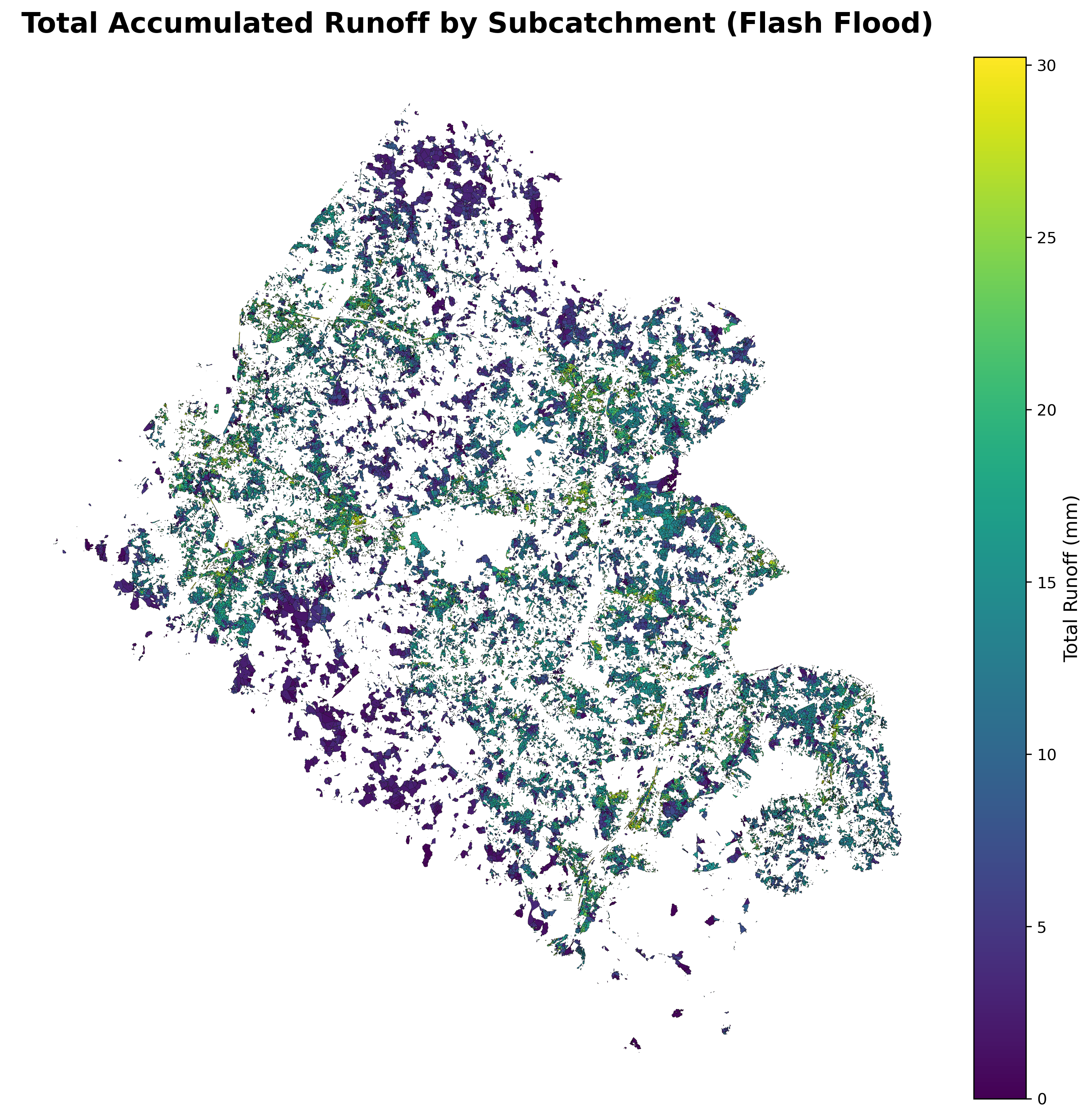
I’m a senior at Thomas Jefferson High School for Science and Technology (TJHSST). I’m 18 years old, and I love cooking, chess, and calisthenics. Next fall, I’ll be heading to the University of Chicago to major in Computational & Applied Mathematics.
There is a ton of data available for public use all over online, but much of it has never been taken advantage of to its full potential. Inspired by advice from my CLF cohort, I reached out to my county’s Conservation District and Stormwater Planning Department (SWPD). I was able to get on a call and meet with them about what resources Fairfax County had available and what their specific research interests were given my unique skill set.
After speaking with them and being directed to the relevant county datasets, I was finally able to define a coherent project plan. I would implement and analyze the simulation of a Storm Water Management Model using the County’s soils, impervious surface, and pipes data, United States Geological Survey elevation data, and the Census Bureau’s socioeconomic vulnerability metrics.
In theory, all of this could be done from a laptop in bed. But that doesn’t mean it was easy. This project demanded close to one hundred hours to implement end to end: model development, data preprocessing, validation, meetings, documentation, and long stretches of debugging included. Of those hours, I submitted 49 as official service, as those were the hours during which tangible progress was made.
One of the unfortunate consequences of rising global temperatures is more extreme weather all around. I felt this in my own community in recent years, with wild swings from snow storms to heat waves to rain storms that lasted days and days.
What’s worse is, the more urbanized your local area becomes (i.e., the more impervious surfaces that don’t let water seep into the soil and become groundwater as it rains) the more drastic the effects of flooding, as more and more of that rain becomes runoff. That’s why it’s so important to have stormwater infrastructure in our communities. But even so, how do we know where best to place it? Which regions are more vulnerable to flooding?
Since the massive 2018 flash floods, Fairfax County officials have been increasingly wary of the next such event. I wanted to help in any way I could to mitigate the effects of the next big storm, so that we might be more prepared.
I modeled over 160,000 pipes across 30 watersheds at 1-meter resolution. The resulting program can now automatically build any such model given similar data, no matter the scale (limited by computational costs). Three design storms were simulated. Results identified watersheds with consistently elevated flood risk and revealed statistically significant correlations between hydraulic flooding (insufficient pipes) and socioeconomic vulnerability.
This was important because it showed that the county will truly benefit from redirecting its resources to more vulnerable communities, because these also happen to have less protection against extreme flood events.
My analysis confirmed Cameron Run, Four Mile Run, and Belle Haven as the most “at-risk” for flooding, but it also shed light on the Horsepen Creek, Pimmit Run, and Little Hunting Creek watersheds as requiring more attention and resources.
I discussed and shared all of these results with SWPD officials, and I’m still working with them to conduct further analyses. I’m planning on publishing a preprint on ArXiV to allow anyone to access my approach, so that other similar analyses can be conducted in the future.
My CLF cohort was critically important in giving me inspiration. During a personal CLF coaching session, when I relayed my initial idea, I had a very productive discussion where I was recommended to reach out to my local community and work with, or receive assistance from, people who were already passionately focused on real change. My experience has taught me that by trying to reach out and connect, you have a much better chance at actually making an impact.
If you’re looking to take on a project like this, here’s what I’d tell you:
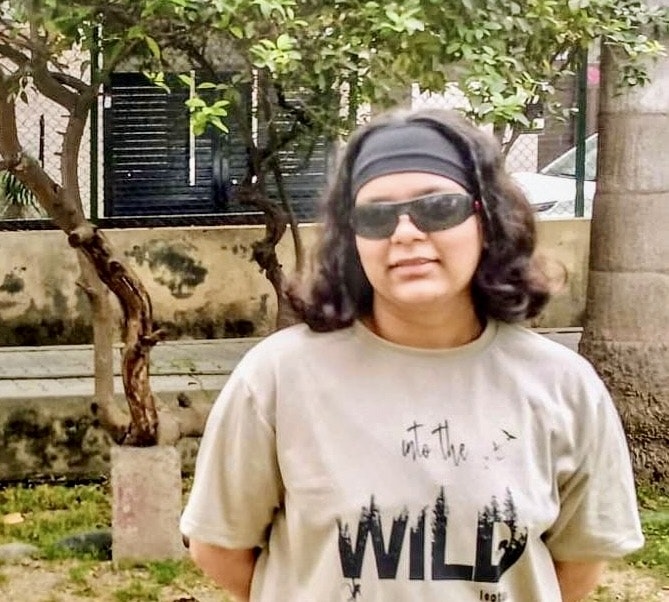
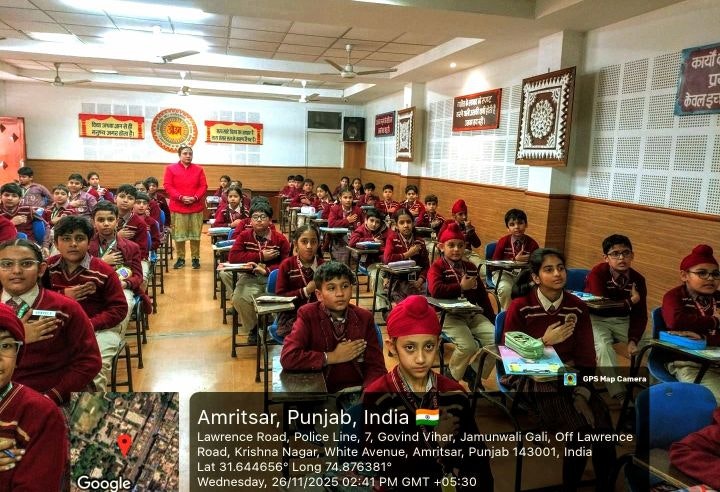
I am Ananya, a high school student from India with a strong interest in journalism and storytelling. I am curious about how local issues connect to larger global challenges, especially when it comes to climate and community impact. Through journalism, I have learned to observe closely, ask questions, and look beyond the surface. Skills that shaped the way I approached my climate project.
For my project, I worked closely with my school’s eco-teacher, who provided me with a detailed water audit report. The report included data on how water is distributed and used across the campus including washrooms, drinking stations, staff areas, and maintenance use. Studying this report helped me understand the structured system behind water usage rather than making assumptions. I analyzed how water was classified, consumed, and managed within the school. After reviewing the data, I conducted an awareness session to share my findings and discuss the importance of responsible water use. The session focused on helping students understand how water management connects to larger environmental and climate concerns.
In August & September, floods affected my state. Roads were submerged, daily life was disrupted, and water something essential for life became overpowering and destructive. Just a month later, when the Climate Leaders Fellowship began , I kept thinking about that contrast. Water has the power to devastate, yet in normal circumstances, we rarely pause to think about it. It is so present in our lives that it often goes unnoticed. This irony shaped my perspective. If water can affect us so strongly during floods, then why do we not pay equal attention to how we use and manage it every day? That question led me to create Drop by Drop: Blue Audit, a project focused on understanding how water is used within my school system and encouraging more conscious engagement with this vital resource.
The impact of the project was both educational and reflective. After studying the audit report, I organized a structured awareness session delivered through a five-speaker format. Each segment addressed a different aspect of water its institutional distribution, responsible consumption, reduce water wastage and its connection to energy use and carbon emissions. We emphasized that water does not function independently. From pumping and storage to purification and distribution, each stage requires electricity. Electricity generation often contributes to carbon emissions, making water consumption indirectly linked to climate change. This helped students understand that climate action is not limited to visible pollution but is also embedded in everyday resource use. To measure understanding andengagement, feedback was gathered after the session. Many students expressed that they had never considered the relationship between water use and energy consumption before. The discussion moved beyond simple conservation slogans and encouraged critical thinking about climate change and use water judiciously. Rather than presenting water as an overused or ignored resource, the session reframed it as a powerful and interconnected element within the climate system. The impact of the project lay in shifting perspective from passive use to informed awareness.
Participating in the Climate Leaders Fellowship significantly broadened my horizon. Throughout the process of researching, analyzing, and presenting my project, I developed a deeper understanding of how climate issues are interconnected. I strengthened my research skills by studying audit data and exploring how water systems function. Preparing the awareness session improved my editing and content-structuring abilities, especially in organizing complex information into clear, understandable segments. Planning and executing the session enhanced my confidence, communication skills, and leadership presence. Beyond technical skills, the fellowship helped me grow as an individual. It taught me that meaningful leadership begins with inquiry, preparation, and thoughtful execution. The experience encouraged me to move from simply observing issues to actively engaging with them.
If you are planning a project like this, begin by understanding the system before trying to change it. Using real data wherever possible strengthens your credibility and helps you move beyond assumptions. Water is often treated as an ordinary, everyday resource, but it plays a significant role in climate systems and energy consumption. Looking deeper into how resources are distributed and managed can completely shift your perspective. Collaboration also matters working with mentors or teachers improves both accuracy and impact. Focus on building awareness before rushing into action, and choose a project that genuinely connects with you so your motivation stays authentic. Most importantly, stay open to learning throughout the research and execution process. Participating in fellowships like the Climate Leaders Fellowship can provide structure, mentorship, and exposure beyond academics, helping you grow both in skills and in confidence.


My name is Loren, and I’m a seventeen-year-old junior from the New York City metropolitan area. I love the ocean and everything in it, which is what inspired me to do our project on microplastics in the New York City waterways. I’m advanced open water scuba certified, I swim (competitively and open-water), founded my school’s coding club, lead my school’s biology club, and serve as a member of my church’s youth leadership group and as a junior ambassador for a local marine biology organization.
Something that we discovered along the way was that there’s a lot of research about all sorts of plastic pollution in NYC, so we had to narrow it down a bit. We decided that the Hudson River was the most accessible, and that microplastics were a more niche subject that fewer people were aware of, so we decided to focus on those. We then collected samples of Hudson River water and standard tap water to examine both for microplastics under a microscope.
After collecting data, we were able to then present it. I already had an Instagram account for Next Wave, so we posted our findings there, where it quickly racked up likes, views, comments, shares, and saves. We were thrilled; each interaction meant one more person made aware of the microplastic problem in our area and of what they could do about it.
I’d already started Next Wave to some extent when I first encountered CLF, but partnering with three other CLF students (Heide, Sophia, and Arianna) from my school who are just as passionate as I am about caring for the environment was what really kickstarted the project. My idea was that Next Wave would educate the “next wave” of teens who would be researchers, conservationists, and ocean lovers. During one of our CLF meetings, someone in my small group proposed that we do a project based on plastic pollution in the NYC waterways, which was right up Next Wave’s alley. I suggested we incorporate it with Next Wave, and our project was launched.
Through Next Wave’s Instagram account, we were able to get over five thousand viewers and counting, which was much more impact that we ever dreamed of having. Five thousand views means five thousand more people aware of a problem that a lot of people never hear about. More interactions means more people likely to do something about it, whether that’s reaching out to a local government official or simply spreading the word. And the numbers speak for themselves; on more than one occasion, I’ve had people come up to me and tell me that my group informed them about an issue that they had never heard of, and that they were changing their habits (for example, using fewer plastic products or being more mindful of where plastics are disposed) to prevent the problem from growing.
I never really believed it was possible for four high schoolers to really make an impact in their community, but my incredible teammates, our mission, CLF, and Next Wave proved me wrong. My group actually had a mishap occur near the end of the Fellowship and we had to redo our whole project, so the collaboration and initiative from everyone was really inspiring. I think we as a group are most proud of how we were able to make the most of our situation, even though we had to redo the entire thing.
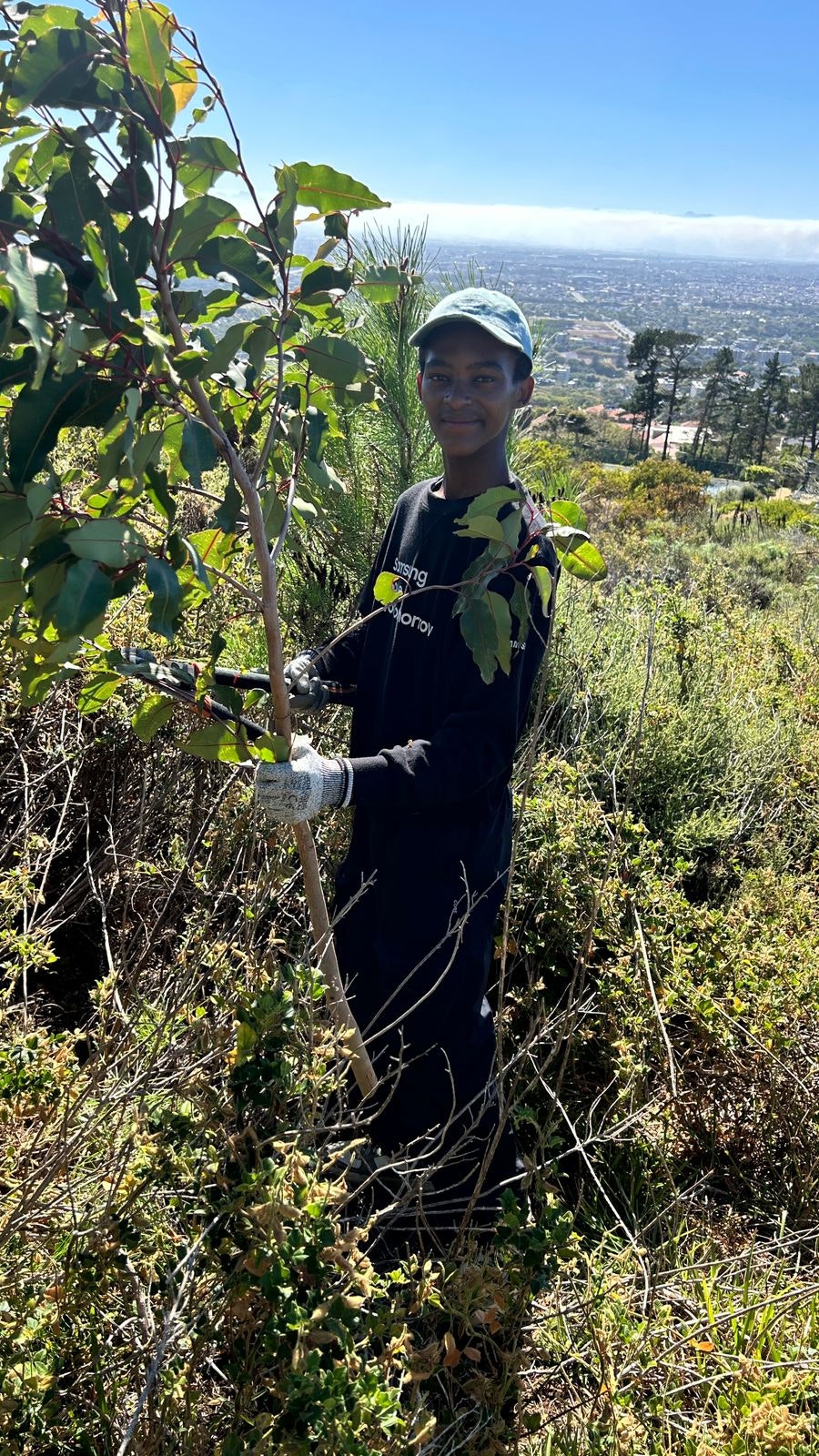


Hello my name is Imanam Maqwazima and I am a Grade 11 high school student and a teenage environmentalist from Cape Town.I love nature, climate action, and STEAM, and I like to come up with new ways to solve problems in my community that have to do with the environment.I play sports tennis and volleyball. I’ve loved being outside since I was a kid, and I still do. Being outside in the nature whether for hiking, camping, gardening, or just walking on the beach with friends and family it helps me feel grounded and reminds me why protecting the environment is so important to me. As I aspire to be an architect am looking forward designing sustainable and green buildings that connect civilization to the nature.
For my project Restore The Cape I focused on restoring fynbos ecosystems that had been damaged by wildfires in the Western Cape. After fires invasive alien plants often spread quickly and prevent native fynbos from recovering naturally, so my goal was to help these areas recover by removing invasive species and supporting the regeneration of native vegetation.
I participated in fieldwork in wildfire affected areas where I identified and manually removed invasive plants working with local environmental organizations and youth volunteers, especially fast growing pine seedlings and gums that compete with native plants after fires. By clearing these invasive plants early we created space and better conditions for native fynbos species to regrow and restore the natural ecosystem. While carrying out the restoration work I also documented the process using photos to track the recovery of the landscape to show the impact of the restoration efforts.
This project was implemented in post wildfire fynbos Rhodes Memorial Cape Town which is part of one of the most biodiverse ecosystems in the world but is increasingly threatened by invasive species and more frequent fires. My target audience included local community members and especially young people, because I wanted to raise awareness about how invasive plants affect wildfire recovery and show that youth can play an active role in protecting ecosystems. I engaged people by sharing what I was doing in the field, explaining why fynbos restoration is important for biodiversity and the environment and encouraging others to learn about and participate in protecting these unique ecosystems.
The problem I focused on in my community is the increasing number of wildfires around Cape Town, especially in areas within the Cape Floristic Region. In recent years, Cape Town has experienced many wildfires that have burned large areas of land in a short period of time. While the fynbos ecosystem naturally relies on fire to regenerate, climate change has made fires happen more frequently and sometimes more intensely, which damaged local ecosystems, wildlife habitats, and nearby communities.
This problem matters to me personally because Cape Town is my home. Growing up surrounded by nature made me appreciate how unique and important our environment is given that also cape town’s fynbos is home to our South African national flower the protea. Seeing fires destroy parts of the landscape made me realize how vulnerable our ecosystems are and how important it is for people especially young people to get involved in protecting them by minimizing the spread and damage of the fires. It motivated me to take action and start thinking about ways communities can become more aware of wildfire risks and work toward climate resilience, restoring what’s damaged and educating on what’s next to save our floral region.
For this project most of the contributions came in the form of volunteer time and community participation rather than funding. Volunteers helped with clearing invasive plants in wildfire affected fynbos areas, contributing several hours of fieldwork to remove young pine seedlings and gums. As a result of these efforts removing invasive species helped reduce competition and potential fuel loads that could worsen future fires.
I also documented the changes using before and after photos and observations of the restoration event. During the project, I worked with local conservation efforts like sugarbird, cape town scout groups, Youth steam advisors Sanparks and received guidance from individuals experienced in environmental restoration, which helped me better understand invasive plant management and safe field practices. These partnerships and mentorship helped strengthen the project by providing knowledge about restoration techniques and ensuring the work contributed positively to ecosystem recovery.
Definitely yes, I received inspiration from other members of my Climate Leaders Fellowship cohort. Seeing the different environmental projects from peers and others that were not environmental and ones they were working on motivated me to think more deeply about how local actions can contribute to solving global climate challenges and I think all of us came up with projects that address atleast a challenge where not just that individuals community faced but many of us in the cohort have communities with such problems, and this really allowed us to work hand in hand sharing information that was useful to one’s project.
Sharing ideas and learning from each other helped me stay motivated and think about new ways to improve my project. Participating in the Climate Leaders Fellowship made me feel empowered and more confident as a young person working on environmental solutions. What I am most proud of is being able to take real action in restoring fynbos ecosystems after wildfires and showing that even as a 17 year old I can contribute to protecting biodiversity and raising awareness about the importance of restoring and protecting our natural environments.
My 11 tips to give to other young people who would like to do an environmental impact project in their communities would be tips I received from my mentors during the fellowship and ones I established my self which are:
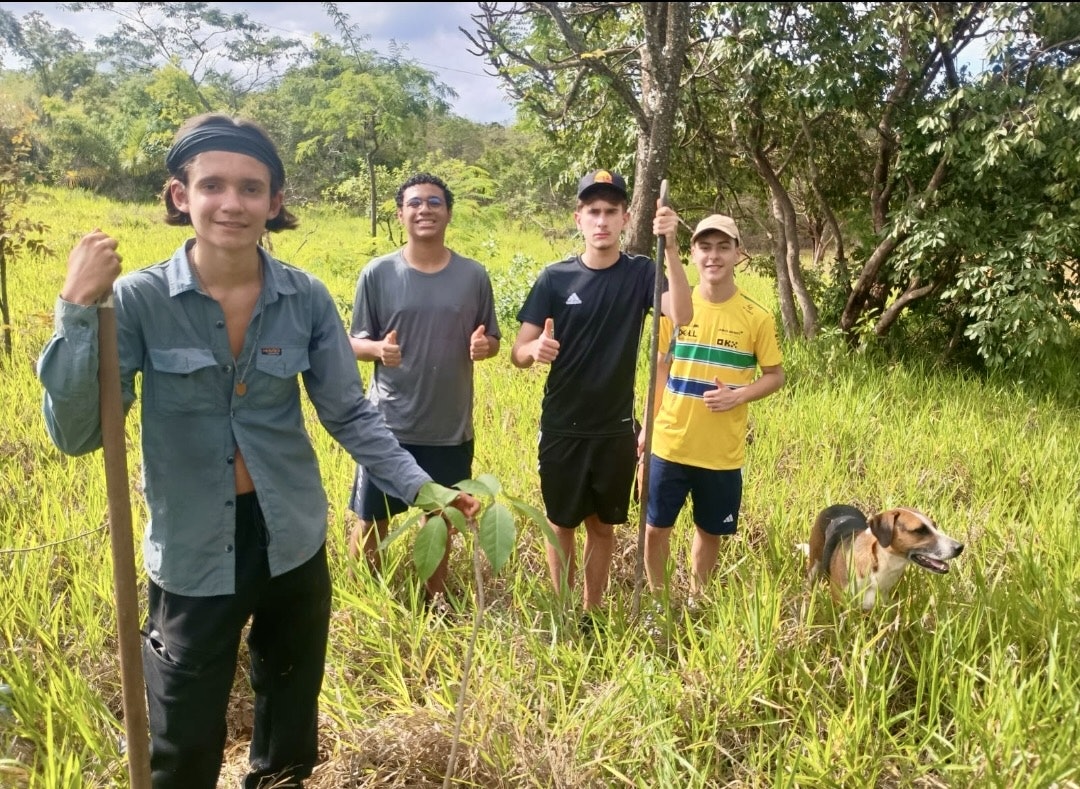


I’m Ian, a 16-year-old from the interior of Brazil. My days are split between exploring waterfalls, studying Syntropic Agriculture and Korean Natural Farming, AI consulting, industrial automation, calisthenics, chess, and languages. I’m currently learning German, my fourth. I’m particularly proud of having written a professional paper for the Virtual Youth Institute of the World Food Prize Foundation and of competing in 19 essay, business, and creative writing competitions, achieving a 26% award rate.
With a group of friends, I planted young but established trees in the St. Helena hills. Before doing so, I had to step out of my comfort zone and consult with the relevant governmental departments to understand what was actually permitted, given Brazil’s strict environmental laws. We chose a more irrigated area, and I’m currently also growing date seeds as a longer-term effort.
My interest in local sustainability was sparked by large wildfires in the St. Helena hills, an area I care deeply about for its waterfalls. Wanting to understand what was really happening, I went looking for data and found mostly regional sources, mainly through Embrapa, a Brazilian public institution for agricultural and environmental research that has a unit in my city. What I found was striking: the average temperature in Sete Lagoas rose by 1.85 °C between 1926 and 2021, and cities across the metropolitan region have seen significant shifts in precipitation, with droughts and extreme rainfall events becoming increasingly common over the last two decades. As a 16-year-old, I didn’t notice the temperature rise in early childhood, but looking back, it’s clear. In recent years I’ve lived through unprecedented heat waves between 35 °C and 40 °C, followed by days of extreme rainfall after long dry stretches. My father remembers a more predictable climate. A telling example: the stream on my grandfather’s property, and those of many acquaintances, used to flow year-round. Today, those same streams dry up for most of the year and flood their surroundings when the rains finally come. Having hard numbers from official sources to confirm was truly eye-opening.
Along the way, I was lucky to have support from two adults I reached out to: a biology professor with a genuine passion for sustainability initiatives, and an acquaintance who loves the St. Helena hills even more than I do. He fundraises dog food for the stray dogs there and plants trees whenever he can. The hardest part was trying to partner with local organizations. Living in the Brazilian countryside, options are limited: I found and contacted 5 suitable organizations, every one I could identify in my city, but only one ever replied, and even that one went silent after the first exchange. It was frustrating, but it also taught me to keep moving with what I had.
The CLF experience itself was invaluable. My coaching session with the facilitator gave me the direction I needed to finish my project, and connecting with the other fellows in the Zoom sessions reminded me that young people across the world are tackling the same kinds of challenges. Participating in the CLF genuinely made me believe that, even as a teenager, I can make a real difference in my community.
My tip to future fellows: it will feel hard to start from scratch, and the obstacles will seem enormous, but they rarely are as big as they look from a distance. You’ll only see that once you actually take the first step. So just go for it.


I’m Caline Matar, a 16-year-old from Lebanon. The founder of youth4earth_global.I’m passionate about climate action, youth leadership, and creative projects. I draw, play sports, enjoy watching films, and love learning new skills and exploring different cultures. I also enjoy connecting with people worldwide to raise awareness and inspire change for the planet.
To address the lack of awareness around climate change and sustainability, I collaborated with young people from different countries to create an Instagram page dedicated to climate action. We researched key topics, designed posts and campaigns, and shared educational resources to engage a global audience. I focused on content creation, audience interaction, and encouraging practical steps for sustainability, while our posts sparked discussions and inspired peers to take action. The project was implemented entirely online, allowing us to reach young people worldwide, and our main target audience students and youth were engaged through interactive, visually appealing, and informative content that made climate awareness accessible and actionable.
My project focused on the lack of awareness and action around climate change and sustainability, especially among young people. Together with collaborators from different countries, we aimed to educate and inspire our peers by creating an Instagram page (https://www.instagram.com/youth4earth_global?igsh=MXcydzUycm1wemFmaQ== , youth4earth.global@gmail.com) and sharing campaigns, posts, and resources about climate issues. The project addressed the need for accessible, engaging, and actionable environmental education, showing that young people from around the world can work together to make a meaningful impact on the planet.
The project focused on raising climate awareness and inspiring action. My collaborators and I dedicated our time to research, create content, and manage an Instagram page, while our audience contributed by engaging with posts, sharing them, and adopting sustainable practices in daily life. Through our global efforts, we reached a wide audience, sparking conversations and inspiring young people to make small but meaningful changes, such as reducing waste and conserving energy. Guidance from mentors within the Climate Leaders Fellowship helped ensure our content was accurate, engaging, and impactful, and their support allowed our international collaboration to succeed in connecting and motivating youth worldwide.
Participating in the Climate Leaders Fellowship was an inspiring and empowering experience. Collaborating with young people from around the world allowed me to learn from their ideas, perspectives, and experiences, which strengthened my project and motivated me to do more. I felt proud to see our campaigns reach a global audience and inspire real conversations and actions about climate change. What I am most proud of is how we turned awareness into tangible engagement, showing that even young people can make a meaningful impact when they work together.
For anyone looking to start a project like mine, I would suggest: choose a cause you are passionate about, research the issue thoroughly, collaborate with others, use creative platforms like social media, stay consistent, make content engaging and accessible, involve your audience actively, focus on solutions, celebrate small successes, learn from mentors and peers, and believe that every action counts. These steps can help turn an idea into a meaningful project that inspires change.


Sawasdee Krub! I’m Tataz (Taz) Mekanuwongsa from Nonthaburi, just outside of Bangkok, Thailand. I’m someone who loves exploring life in all kinds of ways. Whether it’s traveling to new places, trying out different hobbies, listening to new music, or tasting food from different cultures, one second I’ll be singing with my band, the next i’ll be on the flight to finish exploring the diversity of the world.
Gogreen Recycling works with a system that I created simply with free tools (a messaging app and Google Forms) where participants would fill out a simple Google Form once a month to indicate whether they were ready for a pick up of their sorted recyclable materials, or they would like to defer the pickup for next month. It is that simple. The pick up process is also very efficient, where I made a deal with a third-party recycling facility for them to come in for the pick up with a slight fee for transportation and their tools to weigh the materials. The residents get compensated for their recyclable materials with only a small fee, which is divided amongst everyone in the program. Though this is the main part of GoGreen Recycling, I didn’t stop there with other additions into the project, where we would consistently fundraise for natural disasters caused by climate change, such as the recent flood that happened in the South of Thailand, and we do activities to prepare the younger generation to be well-equipped with the skills to make the world more sustainable. So, it can be seen that Gogreen Recycling encompasses everyone in different age groups, where we try our best to best impact on the community and beyond.
Back home, not just in Nonthaburi but in Thailand in general, perfectly recyclable materials are being thrown away in the same bins as compost, and well, anything one might want to throw away, even in nation-wide waste management collections. That’s why I created Gogreen Recycling, a recycling initiative done in my neighborhood to solve this problem, not only for people to start sorting their recyclable materials, but to in the end, bring these materials to actually be recycled, not left in our endless landfills creating even more pollution, or an easier solution seen is simply burning the “waste.” With this in mind, I knew I couldn’t just quietly ignore this problem, and that was when it hit me that I needed to do something.
With GoGreen Recycling, I am very proud to announce that my neighborhood has recycled 2 TONS of recyclable materials, period. That is an impressive amount that would offset lots and lots of CO2 emissions As of right now, we are looking to expand to a nearby neighborhood next to us and hope we could create an even larger impact in helping with carbon emission levels. At the same time, Gogreen Recycling could be a blueprint of something other students, such as you who are reading my article, can also do! Not only that but now those who come after us would be able to know much more about solving these issues to prepare us for a better world in the future.
I never thought I could have gone this far in a project that initially was probably “would fail.” More than just the statistics and impressive numbers I felt like I really got to know much more of my neighbors who live right next to eachother, 17 years of my life spent here and it was really the first time I was able to know this many stories of everyone. This same goes for life and how talking to people in my cohort who came from everywhere around the world. So I really encourage you on the meetings to speak your heart out about your project. All in all, though, I am really grateful to attend the climate leadership fellowship and be able to learn more about others who have a similar passion to me and are willing to sacrifice their time to change the world. It is really this motivation that made me push forward, now understanding that us younger generations, can never be underestimated, where we are infinite.
My name is Oliver Mjos, and I’m 15 years old from Manhattan Beach California. I am deeply passionate about medicine and hope to work in the medical field later in my life. I also love caring for the environment in many ways even if its a small impact. In my free time I also love to play basketball, water polo, and go to the beach to surf.
For my project I wanted to go around to homes and collect peoples old clothes and used batteries. With the clothes I would take them to goodwills and donation centers and with the batteries I would take them to best buy where they would recycle them properly. I created flyers that would have my phone number and email listed with a small description of what I was doing. I also had a qr code on my flyers to a page that had a more in depth description of my idea.
Before fully committing to my idea I had to create a schedule of times I was available to pick peoples items up and I had to work around school hours and other extra curricular activities I was involved in. I also had to work with my parents on specific times when they could drive me to take these items too donation centers or recycling centers.
My target audience was older people and people who tend to be very busy. In my neighborhood their tends to be more of a older population, so I started off by placing many flyers in my area because I know it’s harder for older people to recycle batteries and donate old clothes. I also started moving towards downtown area where more families tend to live who may just have a lot on their hands and don’t have the time to take care of these issues, so I started placing flyers in that area. All of my work took place in where I live which is Manhattan Beach.
Every day in my community I would notice people throwing away old clothes in trash cans in front of their homes. Many people also tend to just toss used batteries carelessly usually because people don’t have the time or are too lazy to get rid of the batteries or clothes the proper way.
Personally this issue stood out to me because it hurts me when people throw away old clothes just for it to sit in our landfills when there are people who need clothes in our society. Batteries are also the same as they release toxic chemicals such as mercury and lead into landfills damaging our environment. This was a sign for me that I needed to step up in my community and help out.
My project was entirely self-led, with zero funds or volunteer hours. I fully created the idea by myself and put it into action with the help of my parents. I managed to collect data from about 4 different houses. Three of which had me take old clothes which I took to my local donation center, and one of the house had a bag of used batteries they been collecting which they wanted to get rid of, and I took that to my local best buy.
Although I didn’t partner with any organizations or mentors, my project successfully got the attention of people in my local community and even these small changes can have an impact on the environment.
By participating in the climate leadership fellow program I felt like I was part of something big in helping the environment. This made me realize how much things people can do to help even if its only in your community. I gained confidence to take initiative and take on the leadership role in my community. I learned many new skills from the program such as leadership, time management, and being more independent. Overall, I’m very proud my project succeeded in alerting people about a small issue in my neighborhood. Knowing that I could help inspire other people to take action is one of my biggest takeaways.
My biggest tips for others is to have fun. Create an Idea that involves something you are passionate about and love spending your free time doing. If you create an idea just to create one you won’t have fun coming up with it and implementing it. Your project should help the environment and be something you want to spend time on instead of waiting till the last minute to do. This will also make your project more meaningful to you. Another tip is be creative with how your going to implement you project or where your gonna do it. The more creative your project is the more authentic it will be rather than just copying someone else’s idea or a basic one everybody has done.


My name is Hammad Ali Mujahid, and I come from Haveli Lakha, a small town in District Okara, Punjab. I belong to a first-generation college- and university-going family, who is not only breaking stereotypes but also contributing as much as they can to improve others’ lives. I am 16 years old, and currently a first-year college student, majoring in Mathematics and Physics. In addition to academics, I have a strong interest in sustainable business practices, social development, and welfare, as I firmly believe that progress should go hand in hand with responsibility toward people and the environment.
For my project, I organized an “Anti Smog Awareness” seminar at my college (Punjab Group of Colleges, Okara Campus) and led a small fundraising effort to support two flood affected families near Head-Sulemanki, a remote Pakistan-India border area. This area is especially important to me, as 1) my home is just 10 miles away from the border, 2) people’s main source of income and livelihood is agriculture, which was completely destroyed because of floods, and 2) people from this area have to travel more than 20 miles everyday to access education, school, and work. With limited resources, I combined awareness raising about air pollution and climate change among my class-fellows in college to support vulnerable vulnerable households. To address the problem, I:
I implemented the project at my college campus for the seminar and fundraising, and in Head-Sulemanki (through a trusted relative) for the direct support to families. My main target audience was college students, because I believe awareness goes a long way than mere-financial help. Secondly, college student are the future decision makers and have the potential to spread awareness in their homes and communities. I engaged them through in person announcements, a formal seminar, and by giving them a simple, clear action: donate, plant a tree, wear masks, and spread this message. I also indirectly engaged with 2 flood affected families by providing them with essential groceries.
In Punjab, Pakistan, the 2022 floods which affected and displaced millions of family, and as well the very recent 2025 floods (June, October), coupled with extreme winter smog every year have become serious threats to people’s health, safety, and livelihoods, especially for low- and middle-income families. My discussion with my fellow classmates, and as well people from my society tells me that they are not fully aware of how dangerous polluted air and climate related disasters are, or how to protect themselves. Infact, I have observed that most of the people just don’t care enough. This lack of awareness and preparedness coupled with systemic inequality always motivated me to address this problem. Part of the reason why I am aware of such issues is because of my siblings are now studying advanced degrees in political science and international relations, and my modest background, which helped me in understanding how environmental crises hit ordinary families the hardest. To sum it up, hearing about families who lost their homes and even their children and seeing students around me breathing harmful air every day made me feel a responsibility to act, even as a 16 year old student.
My brother told me such actions don’t have immediate impacts, and neither they can be measured in abstract. However, the seminar I arranged gathered 43 students and 2 teachers. They discussion lasted one hour, followed by an interactive question-answer session. We were also able to collectively arranged 75 US dollars, which is a big amount for student. This 75 dollars were used to provide one month grocery packs to two families. In addition, my college supported the event by distributing masks among attending students, and they all promised to continue this mission further by planting, spreading awareness, and by donating. The families I helped provided very strong emotional feedback as someone was able to help them in those difficult times. They had lost their crops and livestock, and were happy with this. During the college seminar seminar, the ENT specialist shared a powerful case of a worker who suffered long term chest problems from continuous exposure to sulphur dioxide in a factory, showing how pollution slowly destroys health if ignored. Students told me they had not realized how serious smog and air pollution were, and they appreciated receiving clear guidance and masks. I worked mainly with my college, Punjab Group of Colleges, as my partner organization, and with my teachers and principal who supported the logistics and outreach. My relative also acted as an informal partner by identifying the most vulnerable families and delivering the groceries. These partnerships made the project possible: the college provided the platform, trust, and access to students, the doctor provided expert knowledge, and my relative ensured that our limited resources reached the right families in an efficient and respectful way.
I did not work directly with other Fellows on the ground in my city, but I received ideas, motivation, and moral support from other members of the Climate Leaders Fellowship cohort through the sessions and online community. Seeing others’ projects gave me confidence that my small actions could also matter. Participating in the Climate Leaders Fellowship made me feel more confident, responsible, and hopeful. It pushed me out of my comfort zone to speak in front of a crowd, organize an event, and coordinate with adults like doctors and college administrators. I am most proud that, as a first year student from a small town, I was able to bring together dozens of students, raise funds, and directly support two families who are struggling to rebuild their lives after the floods.
Tips for Others If someone else wants to do a similar project, my top tips would be:

My name is Dua Nadeem, and I am from California! I’m a fifteen-year-old freshman at Mountain House High School. I enjoy the arts, sports, and learning more about the world!
The issue I aim to address in this cohort, amongst many others, is raising awareness about the true impact of our every action. I want to show the people in my city the power that they each hold in making a true difference. This time, I aimed to show them further how they can truly turn one man’s trash into the world’s treasure, from compost scraps to rich fertilizer. We find ourselves consistently not only sorting our trash in the wrong bin, but contributing toward destroying our environment where it could possibly benefit both the environment and ourselves instead.
In 2019, the U.S. Environmental Protection Agency found that 24% of landfills were filled with compostable resources, which means that 62.5 million tons of waste in our landfills could have been repurposed, but wasn’t, releasing an estimated 119.8 million metric tons of carbon dioxide alone into our atmosphere. Going into more detail, when we just throw away our food scraps and compostable materials into the trash or even the recycle bin, our compost combines and decomposes just like in a compost pile (more later). However, what happens is that they decompose in such a way with other materials that they become toxic, releasing methane and other substances that contribute toward the issue of climate change rather than against it.
Whereas, we could create the opposite effect on our impact by considering learning more about how the compost can be turned into something precious for our environment; compost, when decomposed, can be converted into fertilizer, which allows for more plants to thrive and therefore more carbon dioxide to be absorbed, not released. Other detrimental substances are also prevented from ever being released in the first place. This contributes against global warming, a branch of climate change which causes a plethora of its own issues. Plus, at the same time, with the cost of fertilizer steadily rising in California, as well as the cost of climate change and consumerism on our food resources, taking the time to donate this fertilizer to farmers who may need it would be equally helpful to our own selves! What is missing here is an understanding of the reality behind our normal practices, and also an understanding of the simplicity in going from harming to saving! Simply putting compost in the designated compost bin, donating to those involved in the composting process, or starting a compost pile yourself is a perfect way to start.
This problem matters to me because I have grown very attached to my city and all its life. My city was only recently established from its state as a town two years ago, and it has a lot of potential when it comes to living and being eco-friendly. There are still so many natural, healthy aspects of it, when it comes to the many trees, the stray cats, and baby turkeys. We can still see many stars in our sky (well, not a lot, but still a good amount), and the streets are still clear of litter. I want my city to continue to be so nature-blending and caring, not only based on what’s in clear sight, but also through our smaller actions on the side. One of these smaller, yet so very considerate actions would be taking the time to turn trash into fertilizer! A reminder that this small effort would not only benefit the environment and our world, but our local farmers as well!
For my project, as mentioned above, I decided to try out the process of converting compost into fertilizer. I aimed to show my community the effort that could be taken to benefit the environment, farmers, and indirectly themselves.
I implemented my project, specifically, in a compost bin in my garage. This is most definitely not the best place to have a compost pile, which requires living microorganisms to break down the organic material. However, I accommodated based on the raccoon problem in my city, as well as the heavy wind that could have blown the compost everywhere if taken outside. Here are the basic steps I took toward creating a compost pile and caring for it, and my plans for giving it away to farms!
-Do I have a medium-large place and the resources to take care of my compost pile, for as short as a month to as long as a year? -Learn more about composting!
For example… What is compost? It is nutrient-rich organic material that can be decomposed to be used as a plant fertilizer! This
What would my compost pile need? You are going to be treating your compost pile similarly to a plant.
One of the most important thing any living being needs is balance! You need a good ratio of what’s called “green” compost (more moisturized) to “brown” compost (more dry) Green compost would include food scraps and coffee grounds, for example, while brown compost would include things such as leaves and cardboard. At the same time, you want to be checking in on the compost pile between every 4 days to every two weeks, based on your environmental conditions. You don’t want your compost pile to be too dry or too wet, nor do you want to suffocate the microorganisms carrying out the composting process.
-Asking people in the community for compost through social media posts and posters hung up in popular spots. I also went to places, such as Starbucks, in person, to collect materials such as coffee grounds.
-Setting up the exact area for the composting process to happen. Ensuring all materials are there, and breaking up the compost into smaller pieces!
-Checking up on it based on the environmental conditions, and providing each part of the compost pile with air and water. How often and where this needs to happen should be accommodated based on your specific conditions!
Note that your compost pile really just needs to
And by being moisturized, this does not always mean it needs to feel wet! Sometimes, the pile can appear dry but still be moisturized. What really matters is the ratio of green compost to brown compost.
-Research your concerns to ensure the composting process is progressing as it should. For example… a healthy, decomposing compost pile should start heating up significantly, even over 100 degrees Fahrenheit, in the center at some point amongst the process! For a smaller compost pile like mine, this may take a bit longer because heat is able to escape more easily.
Learn more about key factors to watch out for like this, and also red flags. -Your pile should not look like a landfill! It should appear healthy and well, not slimy or smelly.
-When the compost has finished its decomposition process, it should be a dark brownish-blackish color, and it should feel soft and crumbly with an earthy scent.
-This fertilizer can be used in your own garden or given away (whether it be to a friend, an organization, or a farm!) -Reach out by calling and emailing if you are planning to give it away! -In my case, I would research local farms and ensure that I am speaking to the farmers themselves so that they are ready to receive the fertilizer.
More information about my exact project can be found here! This was prepared with some other students in my city. https://docs.google.com/document/d/1mP7TX7I_0ZLYa7gu6WdwQuBy3I2HZTEAdAOrPEVW00E/edit?usp=sharing
My target audience was the people in my city, anyone who has compost materials that can be put to good use. Those people were about everyone, since we all consume some kind of organic food to survive, or at least use paper and cardboard sometimes. Collecting compost from their houses, stores, and schools helped add on to my compost pile, as a larger size to a point actually speeds up the composting process.
As mentioned earlier, I collected composting materials in our city. More specifically, used coffee grounds from Starbucks, fallen leaves from our driveway, fruit and vegetable scraps, paper scraps from our high school, cardboard scraps, and other materials.
An organization I looked to for reference was Everything Starts Small, and I was guided by CLF’s co-director, Audrey, when it came to building and preparing a compost pile. I also received significant support from my high school club, the Global Health Initiative, in planning the process and increasing awareness. As seen in the link above, we prepared a 15-page paper covering the different parts of our process, from the urgency to preparing to the actual part of converting compost into fertilizer.
Audrey, who also happens to be the founder of Everything Starts Small, helped me a lot when it came to getting started on my project. She shared how I could approach other people and places (such as Starbucks) in order to collect compost pile materials, as well as the basic process of preparing the fresh compost in the compost pile for the decomposing process. I learned how I should break down the clumps in the used coffee grounds until it’s a brown powder, which would look similar to fertilizer itself.
One thing to note is that Everything Starts Small is an organization specific for the conversion of coffee grounds to fertilizer. I aimed to expand this process by doing the whole of the effort from compost to fertilizer, delivering the finished product to farmers for ready use!
Other members in the CLF were amazing in giving me inspiration and ideas about how I could increase the influence of my project! They had very unique and interesting ideas that they found could apply the best to their communities, and they motivated me to dig deeper into learning more about how I could best establish my CLF project specifically to my city. I learned about my city’s strengths and weaknesses when it comes to taking action, and that allowed me to be more successful in getting things done.
Being in the CLF itself was very comforting, because I got to see other students going through similar struggles and breakthroughs as me. Of course, we had our own unique and wonderful projects, but the fear, joy, worry, and relief that we felt in each part was the same, as well as our determination toward the same goal of helping our world.
Compared to my projects in previous cohorts, there was a comfort that came with mechanically carrying out the compost process. I could truly and physically see the change happening right before me, along with the progress I was making from turning math homework into fertilizer. Based on how it looks and smells (when it’s healthy, it should actually smell foresty!), I could cater to what the compost pile may need to work out best.
Currently, the composting process is still going on, but I am beginning to see the compost materials, such as the paper, losing their shape and strength. I’ve also noticed the various changes in its smells, from an acidic one (which was because it was too moist) to nothing at all to something much more fresher.
Overall, I find it fascinating how there are so many ways to carry out a CLF project, even around the topic of waste management alone. I hope that other people can find change just as interesting as I do, and are motivated to try to both understand and act against climate change. I hope that this project shows you that making change can be done in many different ways, and encourages you to learn, experiment, and have fun.
Get to know your city/community/town/the group that you are impacting! It is helpful to get to know those that you are going to be affecting, because you’re trying to influence them in some kind of way. This makes it so much less intimidating for both sides, and your project can become something even more special to both yourself and others.
Just do it! Planning and preparing are very important, but make sure that it doesn’t hold you back from the actual part of taking action. Even if the steps are small, ensure that you push yourself outside of your comfort zone, starting by just sending that email, just talking to that organization, or, in my case, just going to Starbucks to get four bags of coffee grounds.
Don’t get discouraged by failure! There were many mistakes I made with my compost pile, along with my communication. My dad actually threw my leaves in our actual compost bin twice because I forgot to tell him I was making a compost pile. I also made some errors when it came to consistently providing my pile with the right amount of water and air. These errors can be managed, so it is important to stay calm and address the issue head-on!


My name is Nusaiba Neesa, a 18 year old high school senior living in New York City with a strong interest in environmental sustainability, climate justice, and youth leadership. As a Senior Climate Leaders Fellow, I led EcoHarvest, a school based sustainability initiative designed to reduce food waste while creating meaningful climate education opportunities for students.
EcoHarvest transforms cafeteria food scraps into nutrient rich compost which is then used to grow herbs and plants in a revived, student managed school garden. The project connects climate education to everyday school operations and allows students to actively participate in waste reduction and sustainable food systems.
Throughout the project, I organized school wide climate awareness campaigns, planned and coordinated a School Eco Day event, and collaborated with student clubs and local organizations to expand composting efforts across the shared school building. I also supported small fundraisers through plant sales. The funds raised were used not only to maintain the garden and composting systems but also to purchase dry food pantry items, allowing us to organize a small food drive to support community members in need.
The initiative was implemented directly within the school campus using cafeteria collection systems, shared green spaces, and student organization meetings. Students, teachers, and staff from multiple schools within the building were engaged through peer education, interactive activities, leadership opportunities, and collaborative events.
EcoHarvest was created in response to ongoing food waste within my school cafeteria and the limited availability of hands on environmental learning opportunities in public schools. Although the school building included an outdoor area and garden space, it had remained unused for a long period of time. The building is shared by multiple schools and serves a large population of students, teachers, and staff, making coordinated sustainability efforts both complex and necessary.
This issue mattered deeply to me because I saw both a challenge and an opportunity. There was an underused space that could be transformed into a learning environment, and there was a diverse school community that could benefit from practical climate solutions. I wanted to revive this space and ensure that sustainability efforts also addressed real community needs.
EcoHarvest helped transform an unused garden area into a functional educational space while increasing awareness of food waste reduction and sustainable practices across the school community. Students gained hands on experience with composting and gardening and developed a stronger understanding of how environmental action can also support food security and community wellbeing.
The project fostered collaboration across schools within the building and encouraged a shared sense of responsibility for sustainability and mutual support. By combining environmental action with a food drive, EcoHarvest demonstrated how climate focused initiatives can also address immediate human needs.
Participating in the Climate Leaders Fellowship strengthened my leadership, environmental advocacy, and community engagement skills. Working alongside other fellows inspired me to think creatively, navigate complex systems, and approach challenges with persistence and purpose.
I am most proud that EcoHarvest revived an underused space, reduced waste, and extended its impact beyond the school by supporting people in need through a student led food drive.
Students interested in launching similar initiatives should begin by identifying underutilized resources, building strong partnerships, and designing projects that address both environmental and community needs. Integrating sustainability with service creates deeper and more lasting impact.


Hi! My name is Liara Nelson, I am 15 years old and I am from Rockland County, New York! Some of my interests are art and running! But a big passion of mine is helping my community, big or small, I love to help make other people’s lives easier. I am also a small business owner of stick&stones, stick&stones sells stickers that promote good spirit in the community, then we give the profits charity to raise money for disadvantaged families in the community!
For my project, I used my existing business to help complete my project. I designed completely new stickers that promoted community spirit and raised awareness for climate issues. To promote my business and the specific fundraiser I was doing for this fellowship I hosted two fundraisers and an event and created many fliers to put up around my school. I would sell stickers in my school’s hallway with volunteering clubs that had connections to the charity I was donating the profits to. I even hosted a create your own sticker event. These fundraisers and events helped my peers and younger kids get more involved with combating climate change and helping our community.
My project addressed the problem of lack of resources for some families in my town. Some families lack the resources to buy basic necessities like food, clothing, and school materials. My project helps address that problem and help combat that problem in my community!
During the competition of the cycle we raised around $162.76 for charity. We did around two big fundraisers and an event, with many sales made in between. However, as my business continues, we have now continued to raise $76 more since the end of the cycle in December and have had two more fundraising events. My stickers in person are sold at around $2 each in person and $3 each online, all of our stickers are water resistant and dishwasher safe. We donate all of our profits to the Clarkstown Family Resource Center.
I loved the Climate Leaders Fellowship! I found that talking with other fellows and the student facilitators was so helpful in helping me solve any problems that I was having with things like marketing and project ideas! I loved the flexibility the fellowship gave to create a personal project. This fellowship made me more confident in my communication and problem solving skills, which will continue to help me throughout the rest of my life!
A tip is to make connections! Don’t be afraid to reach out to people and tell people about your project! These people may give you specific advice and help for your project. They also may be helpful to you in the future with future projects or research!


Hi! I’m Linh, a freshman at Delta Global School (Hanoi, Vietnam). Some of my interests include media, baking, and environmental initiatives. In my free time, I love to craft things with air dry clay, bake something (especially cookies), or play badminton with my friends. If we share any interests or hobbies, feel free to drop me a message at @starillise on Instagram, I’d love to have a chat.
Artmosphere aims to raise funds for Keep Vietnam Clean, an environmental non-profit in Vietnam through artistic initiatives such as an art shop selling original artworks from CLF fellows and (hopefully) craft workshops in Hanoi, as well as seasonal activities including an online thrift shop called “Lost & Found”. On top of that, we also share educational posts on our social media page on climate related issues, such as rising global temperature, overconsumption of clothing, the gentrification of thrifting, etc, to spread awareness upon them and inspire more people to act against climate change. In the near future, we hope to host more offline events such as exhibitions, meetups, walking tours, etc to engage with our targeted audience outside of social media and strengthen the project’s impact on our community.
I live in Hanoi, which is one of (if not the most) polluted cities in the world. There has been multiple ins one of (if not the most) polluted cities in the world. There has been multiple instances where the AQI reaches hazardous levels, reaching as high as 283 in December 2025 as a combined result of temperature inversions that trap pollutants, agricultural burning, construction dust, and heavy traffic. Despite so, efforts to mitigate the situation remain limited, and pollution-inducing activities such as trash burning, widespread use of personal transport, and industrial activities persist despite alarming pollution levels. Artmosphere combines two areas that I’m deeply interested in: art and environmental action to not only fund environmental non-profits but also spread awareness and urge others to act. I wanted to take a more unique approach towards climate initiatives and deliver a larger message that you don’t have to stop climate change completely or have a large organization in order to make change, you just have to take action and contribute to the cause. Small actions build up, you just have to find the courage to start.
In the first month of our project, we raised 2 million VND for Keep Vietnam Clean and reached a wide audience (especially DGS students, teachers and staff) from our in-school art sale. Our educational posts and social media accounts have received ongoing support, showing that others also feel driven to our mission and values. We aim to continue this project even after the CLF cycle and hope to achieve more milestones to share with the community.
The Climate Leaders Fellowship changed me a lot as a person and gave me a completely new perspective on climate action. When I was younger, I was deeply invested in environmental issues but that topic of concern slowly drifted out of my mind as I grew older because I believed that I was too insignificant to make a change. But, joining the program reminded me that change doesn’t have to be huge, and I didn’t have to stop climate change immediately and altogether in order to be part of a meaningful act. What truly matters is that you take action and inspire others around you to do the same, because a global-scale problem like climate change cannot be resolved by one person alone, but will all our efforts combined. I’m really glad that there are many other ambitious and passion fellows across the globe who are eager to take action against climate change and join forces to make the world a better place for all, and I’m wholeheartedly grateful for the opportunity to meet and work with all of them.
Hey! I’m Aurora and I turn 16 this year, so I’m soon going to upper secondary school. I’m from Finland, the country of a thousand lakes as they say! I’m interested in a lot of different things including music, climate change, politics, maths, sports and a whole lot of other things, but those are my main interests.
After a while of thinking I joined a few other fellows and started working with them to make a greater impact. After having calls and doing endless texting with the group, we decided to start posting about the effects of climate change in our countries, so that other people could gain knowledge about climate change easily. Basically we chose subjects, such as loss of biodiversity, and did research on how it has affected our country. While working on the posts, I also held a presentation to my classmates about the harm food production is causing to the environment.
When I first started planning my project I had a lot of ideas. I had noticed a lot of problems in my own community as well as just in Finland in general. I noticed that a lot of people don’t really pay that much attention to climate change, because the changes it has caused to Finland don’t always show up in people’s everyday lives. I wanted to work on this theme because we can’t make progress on something if people don’t even pay attention to the main cause.
With this project we reached hundreds of people through Instagram, educating them about climate change. Sadly we couldn’t get any organization to work with us, but we still kept going. I collected 19 volunteer hours through this project.
Through this project and the whole Fellowship in general, I feel like I unlocked a new part of myself. Even though the main focus was on the project, I got better at thinking bigger and speaking English with others. While working on the project, I sometimes stressed myself about “doing too little”. However somewhere along the project I realized that small impact is still impact. Even if me and the fellows I worked with didn’t make some grand invention, we still made an impact. The thing I’m most proud of, including the project, is also the motivation and courage I managed to gain. After participating in the Fellowship I knew that I wanted to do more in the future. I sadly couldn’t join the Fellowship this spring, but with the help of the knowledge I gained, I’m working on a new project independently.
My top tips for people who want to make an impact too:


My name is Christina Peng, and I am a high school sophomore from Taiwan. Beyond my academic life, I am someone who deeply cares about the future of our planet. My journey into climate activism began with a fascination for our oceans and a growing concern about how climate change threatens these vital ecosystems.
When I’m not working on environmental projects, I enjoy finding creative ways to connect with people globally. I am particularly interested in global issues, ranging from environmental crises to international affairs, as I believe understanding the world is the first step to changing it. I believe that youth have a unique power to drive change, and my goal is to bridge the gap between “wanting to help” and “knowing how to start.” I am a co-founder of ACT4EARTH, a platform dedicated to helping teenagers worldwide take their first intentional steps toward a sustainable future.
To address the “action gap,” my members and I are building ACT4EARTH as a multi-functional digital hub. Our execution focuses on three innovative pillars:
The “Petition Hub”: We are developing a centralized platform that gathers environmental petitions from around the world, covering issues like coral destruction and deforestation. This allows users to scan through multiple causes and sign them all in one place.
Relatable Storytelling: We’ve shifted away from “strict” environmental lectures. Instead, we are filming “Day in the Life” vlogs from our different countries. By showing our normal daily lives while casually discussing local environmental issues, we make climate action feel natural and reachable for other teenagers.
On-the-Ground Engagement: We don’t just stay behind screens. We conduct interview-style reels, visit schools for short presentations, and document live activities like ocean cleanups to keep our community inspired through regular, organized posting.
We have already begun posting active content on our social media to spark awareness. Currently, we are in a major recruitment and outreach phase, looking for any teenager who is interested in helping the world to join our mission. Whether you are talented at drawing, writing, speaking, or social media management, we genuinely hope you will join us because the world needs your unique skills right now. We are also actively reaching out to more organizations to build partnerships that can support and amplify our collective impact.
The specific problem I am addressing is the “action gap” among youth. I found out that there are so many teenagers around the world who care deeply about climate change and global issues, but they often feel overwhelmed or don’t know where to begin. There is a common misconception that real change is only for “experts” or “leaders,” which leaves many young people feeling like their voices don’t matter.
This problem matters to me personally because I’ve been in that exact same position. When I first started researching the impact of climate change, I felt a deep conviction to help, but I also felt paralyzed by the scale of the issue. I realized that if I felt this way, thousands of other teens probably did too. I wanted to create a space where passion could be transformed into tangible action, showing that no step is too small when we rise together.
The impact of ACT4EARTH this season has been incredible. What started as a passionate idea between three students from three countries (Taiwan, USA, and Italy) has rapidly scaled into a global movement. 🇰🇷🇺🇸🇹🇼🇳🇿🇫🇷🇫🇮🇨🇦🇧🇩🇮🇹🇹🇯🇮🇳
Global Expansion: We successfully recruited new members this season, expanding our team to include students from over 10 different countries.
Resource Consolidation: We have created a “one-stop shop” for youth to stay informed on topics like coral reef restoration and environmental news. Instead of a student having to search 10 different websites to find information or ways to help, they can come to ACT4EARTH. We do the hard work of gathering the most important news and petitions so our peers can take action without feeling overwhelmed by too much information.
Volunteer Mobilization: Through our platform, we provide meaningful volunteer opportunities and official certificates, helping students turn their skills in writing, art, or social media into recognized contributions for the planet.
Participating in the Climate Leaders Fellowship has been a transformative experience. It taught me that I don’t have to wait for “expert” status to lead; I just need the courage to take the first step. I am most proud of our global team culture. Seeing students from over 10 different countries, each with different time zones and backgrounds, collaborating on things like the “Petition Hub” is incredibly inspiring. I’ve realized that my voice as a high school sophomore in Taiwan can truly resonate across borders when paired with a dedicated team.
Participating in the Spring CLF season has motivated me to go further. I hope to grow as a leader within this community, perhaps even hosting future sessions, and I look forward to staying deeply connected with Stanford and Rustic Pathways as I continue my journey in climate leadership.
Don’t Wait for Perfection: You don’t need a degree to start. If you care about an issue, that’s your “green light” to act.
Make it Relatable: People engage more with “Day in the Life” vlogs than with strict lectures. Show the human side of environmentalism.
Consistency is Key: Posting regularly makes your project look active and organized. Even small, frequent updates are better than one big post every few months.
Use Your Unique Skills: Whether you are good at drawing, writing, or speaking, there is a place for your talent in the climate movement.
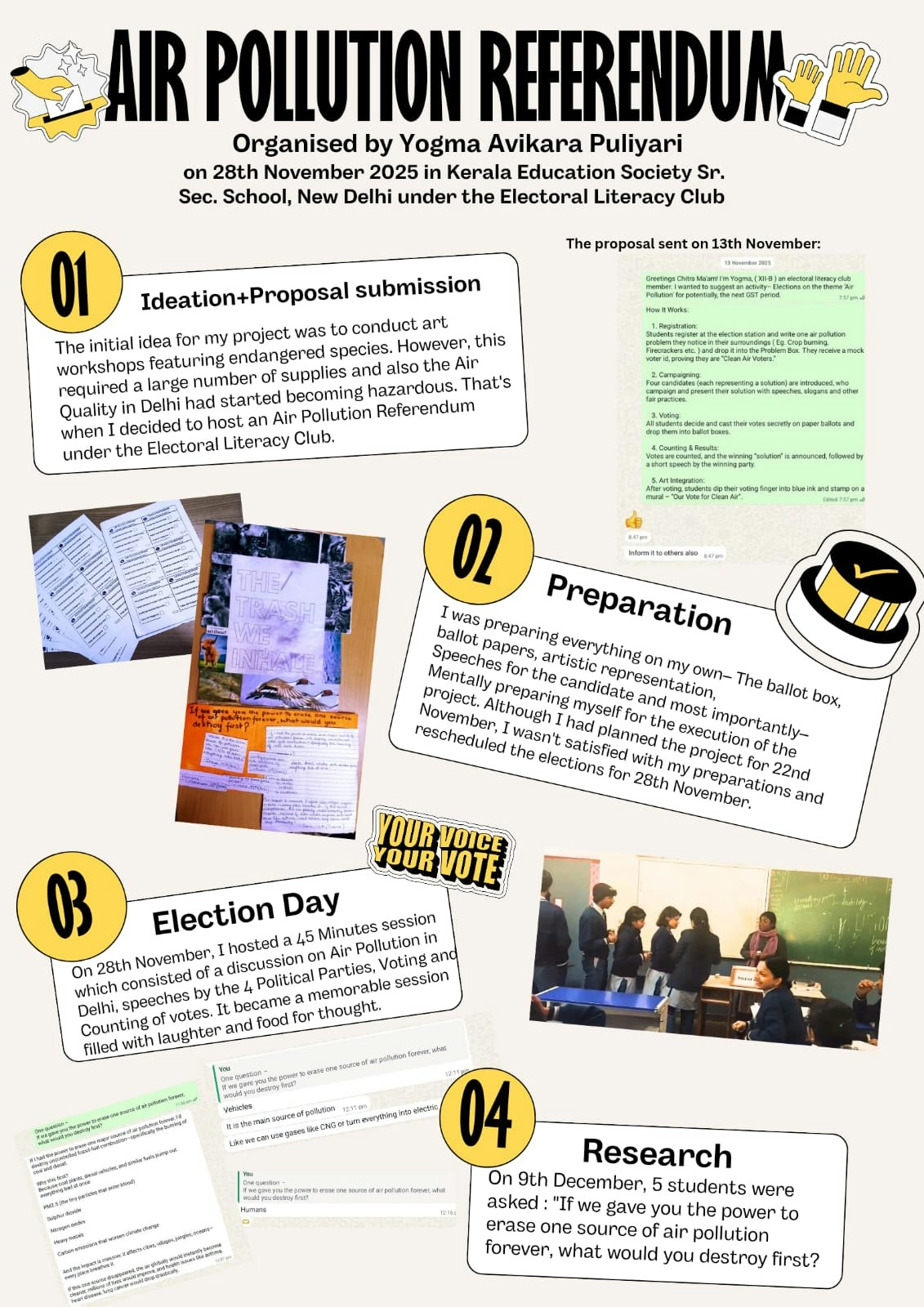
Hey! I’m Yogma, a 17 year old Climate Leader’s Fellow from the Fall 2025 cycle, from India.
In 2025, I took up the goal of raising environmental awareness, shortly after my participation in a WWF ( World wildlife Fund ) Summer camp, centered on reducing plastic pollution. The most memorable part of the camp, was the Indian Star Tortoise – I had built out of scrap lying around my house. A tiny achievement which made me go from visiting wildlife museums to creating projects focused on climate. In the future, I wish to expand my goal from raising environmental awareness to bringing a change, by performing research and building large-scale projects, using my knowledge in STEM!
Other than that, I’m an Art and culture admirer with the experience of professionally promoting various cultures all around the world!
I conducted a 45 minute session with 16-18 year olds/new voters, with the first 20 minutes, dedicated to an interactive discussion on Air Pollution and the rest, for the Elections. This was held at my school, under the Electoral Literacy Club. They provided me with the authority to conduct the session, and its members as Mock-Party Candidates, for which the students voted according to the Speeches and presentation of each party’s solution towards fighting Air Pollution.
In my project, I fused the problem of Air Pollution with Policy-making and Elections. From the past few years, There has been a need for Enforcing GRAP ( Graded Response Action Plan for Pollution in Delhi ). The pollution levels in 2025 were particularly concerning with each day’s AQI greater than ~250.
I remember, In 2024, my biology lecturer said that humans are born with pink lungs but for people living in cities like New Delhi, it darkens in a few years of life. That struck me.
The students were positive that they learned more about climate change and effective voting. Afterwards, I conducted a post-session Q&A with 5 students from different backgrounds, asking a single question: “If you had the power to erase one thing, to reduce the effects of climate change. What would it be?”
The idea of this whole project was sudden. It changed from my previous vision of doing an art workshop to a mock referendum. Later, while researching – I got inspired from The Stanford University’s idea of Deliberative polling.
The Climate Leader’s Fellowship is very well-structured and each meeting, gives your project more clarity. Another thing is that the other fellows are always blasting with energy and ideas, so you will surely feel motivated to build your own project! It might seem like a big deal to brainstorm, assemble and execute a project under 3 months. Which, it is. But, The fellowship provides all the guidance you would require to start. I’m proud that I achieved my goal of raising environmental awareness in 2025 through the fellowship!
Oh, how I wish I had started a bit earlier with such projects and global interaction. Because, it not only develops your mind but helps you discover yourself. But, Please know that it is never too late to start!
My ultimate tip would be to never stop at one idea, keep brainstorming. Maybe, your next one is more feasible? More effective? And let’s be grateful for everything the earth has provided us, everyday.
Hi! My name is Riya Suraneni, and I live in San Diego, California. I am 14 years old and love to participate in leadership and community service activities. I also sing, act, and dance, and I am really interested in law and public policy.
For my CLF project I ran I drive for the local San Diego humane society. One of their efforts is their Project Wildlife. This effort is specifically designed to help rehabilitate animals that have been injured, especially in natural disasters. I designed multiple flyers and posted them around the neighborhood and city, as well as in multiple places online. I put donation boxes at multiple local businesses so people had convenient places to donate. My target audience was people who had pets, because they deeply care about animals, and they are the ones that will have the majority of things to donate for animals.
For my project I knew I wanted to do something in relation to animals, because I am really passionate about wildlife protection and animal welfare. I did some research on what was impacting wildlife in the community the most. I found out that a lot of wildlife is getting injured in natural disasters. This led me to focus on that specific issue for my project.
Through my drive I raised over $600 worth of donations for the San Diego Humane Society. These include food, towels, medicinal product, enclosures, and toys for the animals undergoing their rehabilitation. Working with them really helped me increase the scale of my impact. I educated many of my friends as well as people in our community about San Diego Human Societies efforts and how climate change is impacting the animals right in our own backyard. I am so glad that I had the chance to do something to help the wildlife in my community!
I am so grateful that I got the opportunity to interact with so many kids my age from all over the world. It really increased my perspective on how climate change impacts all of us in different ways, but that we all can bring our own fresh ideas to the table, and make a difference in our communities. The fellowship was a really great experience and I definitely think that I benefited from everything that I learned.


Hi my name is Sahasra Talasila and I am a high school sophomore student in the United States. When I’m not in school, I’m usually exploring trails, baking, or learning about new things I seem interested in. After a challenging 25-mile backpacking trip where I realized how quickly a lack of preparation can lead to a health crisis.
I developed a Emergency Resilience Kits specifically designed for fire and earthquake preparedness within the unhoused community. I researched and assembled survival-focused kits containing masks for wildfire smoke protection, emergency fire blankets for small fires, whistles for earthquake signaling, light sticks for security and safety purposes, and compact first-aid supplies. I focused on direct distribution and partnership with a local shelter to ensure the kits reached individuals living in encampments who are often bypassed by traditional municipal emergency alerts or supply drops. I was able to achieve this through hard work and effort that led me to my high point, the bake sale.
In the the area I live in, we live with the constant threat of two major systemic disasters: wildfires and earthquakes. While many residents have emergency go bags and secure their homes, our unhoused neighbors are in a state of constant exposure. In the event of a major earthquake or a fast-moving fire, those living in encampments often lack the basic survival tools and information systems necessary to stay safe and navigate the immediate aftermath of a disaster.
I personally believe that basic health safety shouldn’t be a luxury dependent on having a roof over your head. Seeing how vulnerable people are when a crisis hits and knowing that thousands have no safety net for these disasters, it felt like a failure in society that needed a targeted, immediate response, whether it be spreading awareness or direct action.
I collected over $400 in donations and assembled 48 kits, dedicating over 40 hours to research, fundraising, distribution, and everything in between. The primary result was providing immediate survival gear to around 200 individuals. I worked with Shelter Inc. and the possibility to work with the Food Bank of Contra Costa and Solano. These organizations were essential because they provided the infrastructure and trust needed to reach the target audience effectively.
Participating in this fellowship made me realize that leadership isn’t always about being the loudest person in the room, it’s about being the most useful. I got lots of help from mentors as well as other fellows who gave me advice when I was at my lowest as well as friends. I could not have completed this project without any of them. I’m most proud of the fact that these kits provided a practical, physical solution to a massive environmental and regional problem. It taught me that while we work on long-term climate goals, we can’t ignore the immediate survival needs of our neighbors. During the bake sale, I also felt really useful and proud, and so did the people who came by in fact! They were telling us how they wanted their kids to be like us as well as how proud they are of us. These are some of the memories in life that money cannot buy, the purest of them all.
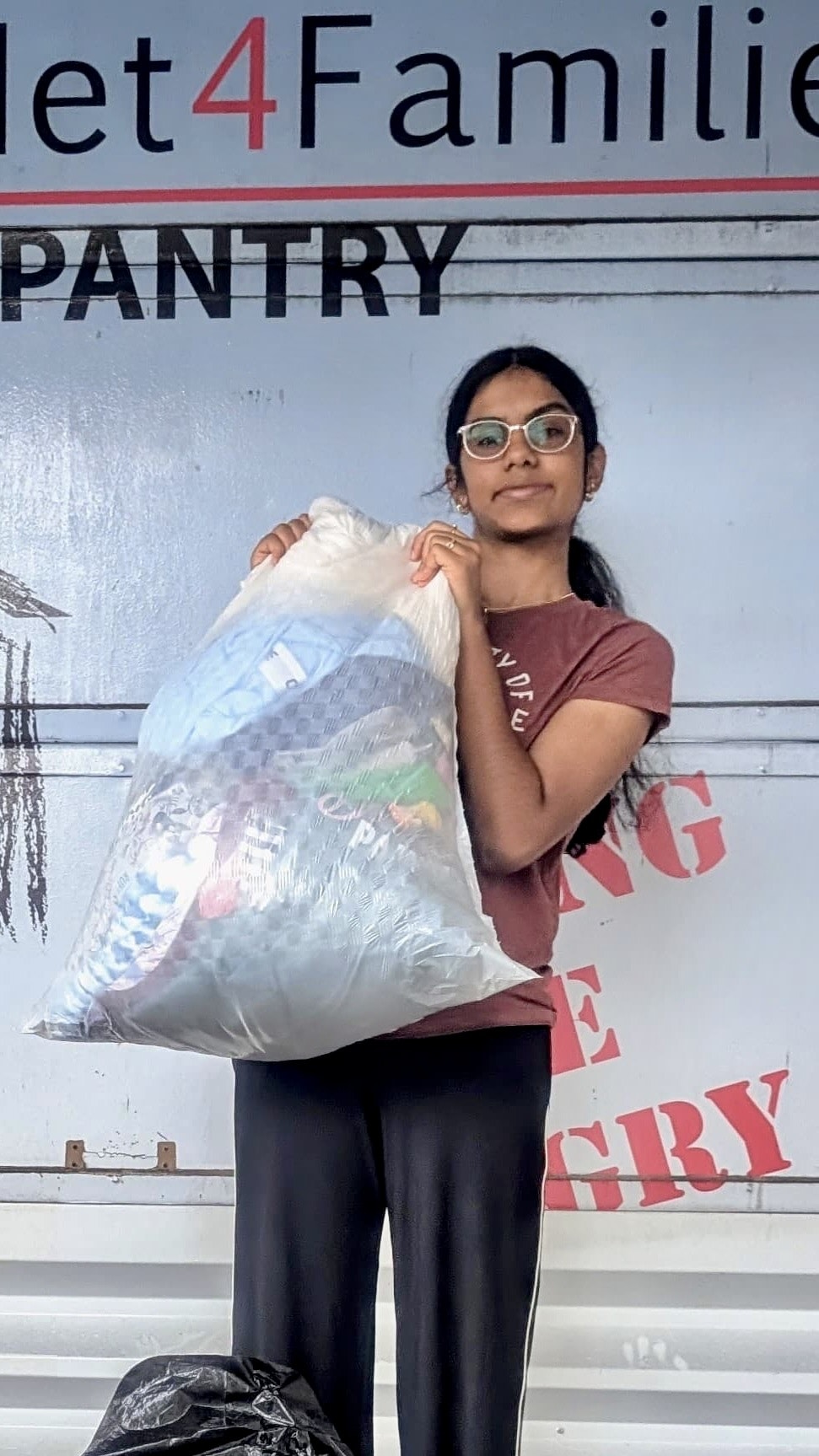
Hey! My name is Shreenidhi, I live in South Florida around the Miami/Fort Lauderdale area and I’m about to be a junior in high school. I am super crafty and have loved to help my community and environment ever since I was little.
I first emailed the distribution center to check in to see if it would be alright to drop off some clothes as a “New Year Clothes Drive”. Since I had volunteered with them in the past, I was able to get approval fairly quickly. Since I wanted to make sure I had enough clothes, I asked many of my friends, classmates, neighbors, and family friends for any sort of clothes they may have. After collecting a fairly decent amount of clothes I went to the facility to drop off all the bags.
The problem I addressed was the fact that many people simply throw away clothes that can end up in landfills and eventually the environment around us. I found this out when I thought back to the many times I’ve seen t-shirts and jackets on the road. I saw this in my local community as well when I saw a shoe thrown in the middle of the road that was of decent quality. When I started to pay attention to that, it reminded me of the time I volunteered at a food bank that also handed out clothes.
The purpose of my project was to collect gently used clothes to donate to a local food distribution center. I started off by going around and collecting clothes from my friends and around my neighborhood. I would then check through them to make sure they were decent. Once I finished with that, I put them in bags and boxes to bring to the distribution center.
While I may not know the immediate effects since the clothes have to be cleaned and checked through prior to being distributed, from the time I had volunteered at this facility as well as other organizations I am sure that it will help anyone who receives these clothes as well as the environment by preventing the immediate disposal of all the clothes I collected.
Participating in the CLF fellowship was like a community and hearing so many ideas deeply inspired me. Especially since I was able to connect with everyone there with the variety of activities and discussions that were hosted every meeting.
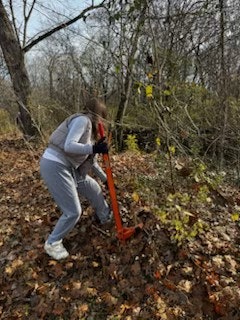
My name is Kyreni Vidalakis, and I am a freshmen in high school, living in Nashville, Tennessee. I was born in San Francisco, California, where redwood forests and trash removal projects on the beach sparked my interest and concern for the environment. Some of my other interests include singing, poetry, and embroidery.
For the execution of my project, I decided to gather other students and chaperones who were also dedicated to this cause. I also partnered with Percy Warner Park, which has a large number of invasive plants as well as tools to remove them. Our group got together, spending hours pulling invasive plants from the park, and we collectively removed hundreds of pounds of invasive plants.
My project focused on removing invasive plants from my local parks. I felt that this problem was important for me to solve because invasive plants not only consume the resources that other native plants depend on for survival but also destroy their habitats and ecosystems, contributing to the reduction of bio diversity. Because plants such as these lack natural predators in the wild, I wanted to try and conserve my local park’s health by removing them with a group of other people.
My project was able to inspire others even after our volunteer hours to come back to Percy Warner Park and continue to remove invasive plants. I made posters for my project to help raise awareness of the issue extending out of Nashville, where I carried out my project. I also became an ambassador for Climate Leaders Fellowship to recruit and inform others on how they can make their own impact with their own projects.
While I didn’t receive any direct inspiration for my project from others in my cohort, they all definitely helped give me advice on areas of the project plan or research that I was unsure about. I also received inspiration from another girl from my school who chose to do a project on conserving bee health, which helped direct my attention to preserving the natural environment regarding a particular species.
My name is Cynthia Xu, and I am a freshman at the Overlake School. I became interested in environmental science after watching endless streams of animal documentaries on National Geographic as a child. After witnessing how amazing our planet could be, I made it my goal to protect it! I am passionate about creating a lasting impact in my community, whether it is at my school, with my family at home, or in Washington state. My goal is to combine my love for the environment with my skills and talents to help others and make a difference.
My first step was defining the scope of my project, identifying potential collaborators, and determining my target audience. After defining my next steps, I sought advisors to help me continue this project. I initially researched companies that might support my project, but none were targeted towards teenagers or aligned with my goals. I then shifted my focus to the teachers and clubs at my school, The Overlake School, and found The Idea Lab, a place where people use code and materials to build and solve a range of issues. After contacting Idea Lab, the head of my school, the maintenance staff, and my environmental science teacher, I found the right mix of mentors to help me execute my project. To begin my project, I created an executive summary to brainstorm the ideas, steps, and solutions for my project. I then collected watertesting kits and worked with staff to collect rainwater runoff and coordinate testing and data collection. At the same time, I spread the word of my project to the students and staff at school, speaking to them during an assembly about my project and the issue of stormwater pollution. After spreading the word in this assembly, I collected 173 signatures supporting my project.
I initially struggled to narrow my focus for this fellowship until a local environmental issue hit home: my sister had to cancel her plans because our neighborhood lake was closed due to pollution. This sparked my investigation into stormwater runoff, which remains one of the largest sources of pollution in Washington’s Puget Sound. As rain sweeps over roofs and streets, it carries heavy metals, microplastics, and oils directly into our aquatic ecosystems. To combat this, I began developing a storm drain filtration system designed to capture pollutants before they reach local waterways.
Since my project is still ongoing, I do not have a summarized image of my impact, but this project has been successful in raising awareness and educating students in my community to learn about this issue. While I was collecting signatures for approval, many students shared that they hadn’t known about this issue and wanted to find a way to contribute. Seeing my classmates become aware and get involved with this issue is already an important step towards change.
Participating in the Climate Leaders Fellowship took me out of my comfort zone. At the beginning of my project, I believed that as a freshman, I had little ability to make an impact on my community. Soon, with the help of mentors in my school, I realized that even though I’m young, I can still make an impact. All you need is a drive to make a change, and it will happen. At each meeting, hearing about the other fellows’ projects inspired me to continue and improve my own. I hope that this project can eventually expand beyond my school and inspire other communities to take action against stormwater pollution.
Your age does not determine your ability to make an impact. Never be afraid to ask for help Remember to have a clear timeline for your project Every issue matters, even if it affects only a small number of people.
Want to learn more about how the Climate Leaders Fellowship works, upcoming cohorts, or how your students or school can get involved? Request more information, and our team will reach out to answer your questions.