Portugal · Summer 2027
Teen travel programs to Portugal
On Rustic Pathways teen travel programs to Portugal, students fly into Lisbon, take a surf lesson and join a beach cleanup at Costa da Caparica, then take an included flight to Barcelona. The program ends in Spain, Portugal’s land neighbor,1 with farm service, flamenco and a day on the Costa Brava.
- 12 days
- Ages 14–18
- $5,395 Program Tuition
- 6 summer 2027 departures


$5,395 Program Tuition12 days · Ages 14–18 · 6 departures
See dates and prices- Operating in Portugal
- Since 2025
- Local language
- Portuguese and Spanish
- Travel time from New York
- 6 hr 55 min nonstop
- Getting there
- Optional chaperoned group flight from Newark to Lisbon, home from Barcelona
The Portugal teen travel program for summer 2027
Portugal & Spain: Culture & Coast is Rustic Pathways’ only Portugal teen travel program for summer 2027. Students spend Days 2–6 near Setúbal for a surf lesson, a beach cleanup at Costa da Caparica, a Portuguese cooking class and a boat day on the Arrábida coast, then take the included flight to Barcelona for Days 7–12 of farm service, flamenco, the Sagrada Família and a coastal hike at Tossa de Mar.
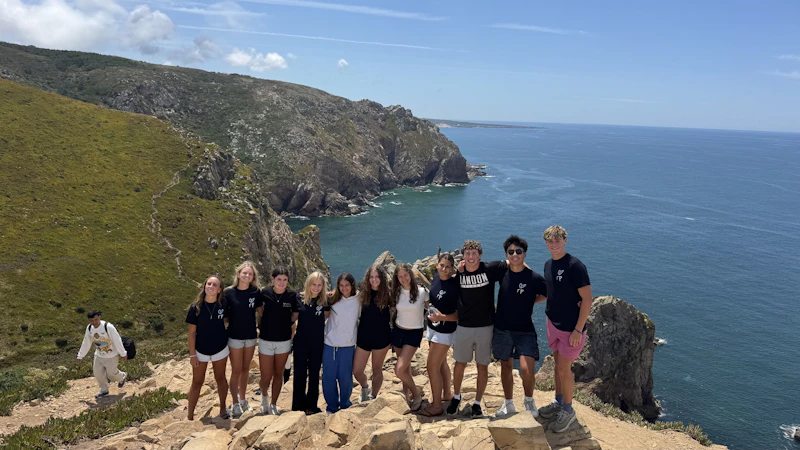

Program highlights


Costa da Caparica
A surf lesson, then a beach cleanup on the same stretch of coast.


Lisbon and Setúbal
Lisbon’s photo spots, a Setúbal cooking class and an Arrábida coast boat day.


La Roca del Vallès and Barcelona
Farm service and flamenco, then the Gothic Quarter and the Sagrada Família.


Costa Brava
A coastal hike at Tossa de Mar, a beach day and the closing ceremony.
Portugal vs. Costa Rica, Greece and Italy
Portugal offers surfing, city days and culture on a 12-day route from Lisbon to Barcelona. Costa Rica offers turtles, surf and service; Greece focuses on sea turtle conservation and culture; and Italy features Mediterranean marine biology and culture.
Portugal vs.
| This pagePortugal$5,395 | Costa Rica$2,495–$5,745 | Greece$3,495–$5,395 | Italy$3,395–$5,395 | |
|---|---|---|---|---|
| Choose this if… | Your teen wants surf, cities and culture across two countries in 12 days. | Your teen wants a choice: service, turtles, surf, Spanish, camp leadership or a middle school week. | Your teen wants turtle fieldwork, or Italian and Greek food and history. | Your teen wants marine biology, or Italian and Greek food and history. |
| Length | 12 days, 10 nights | 8 or 15 days | 9 or 12 days | 12 days |
| Program Tuition | $5,395 | $2,495–$5,745 | $3,495–$5,395 | $3,395–$5,395 |
| Local language | Portuguese and Spanish | Spanish | Greek, plus Italian on Italy & Greece | Italian, plus Greek on Italy & Greece |
| Time difference in July2 | 5 hours ahead of U.S. Eastern | 2 hours behind U.S. Eastern | 7 hours ahead of U.S. Eastern | 6 hours ahead of U.S. Eastern |
| Travel time from New York3 | 6 hr 55 min nonstop | 5 hr 17 min nonstop | 9 hr 10 min nonstop | 7 hr 55 min nonstop |
| Travel time from Los Angeles | 13 hr 20 min, 1 stop | 6 hr 7 min nonstop | 14 hr 20 min, 1 stop | 13 hr 50 min, 1 stop |
| Travel time from Miami | 8 hr 25 min nonstop | 2 hr 50 min nonstop | 13 hr, 1 stop | 9 hr 40 min nonstop |
| Travel time from London | 2 hr 45 min nonstop | 14 hr 5 min, 1 stop | 3 hr 35 min nonstop | 1 hr 55 min nonstop |
| Travel time from Hong Kong | 17 hr 40 min, 1 stop | 22 hr 45 min, 1 stop | 15 hr 5 min, 1 stop | 18 hr 40 min, 1 stop |
| Getting there | Passport. Optional chaperoned group flight from Newark to Lisbon, home from Barcelona; the Lisbon to Barcelona flight is included. | Passport. Optional chaperoned group flights from Los Angeles, plus Newark or Miami by date. | Passport. Optional chaperoned group flight from Newark, to Athens or Italy by program. | Passport. Optional chaperoned group flight from Newark on both programs. |
| Land vs. water | Surf and a beach cleanup in Portugal, Costa Brava in Spain. | Volcano and rainforest, a turtle beach, a surf coast or a homestay town, by program. | Kefalonia turtle beaches, or Venice to the Peloponnese, by program. | Marine biology on the Ligurian coast at Imperia, or Venice to the Peloponnese, by program. |
| Service | 12 service hours: farm work and two days with Anellides in Spain, plus a beach cleanup in Portugal | Schools, trails, turtles or beaches, 12 to 26 hours on the 8-day programs | Turtle fieldwork, 20 hours; none on Italy & Greece | Marine biology study, or cultural classes on Italy & Greece |
| 2027 departures | 6: Jun 24, Jul 1, Jul 8, Jul 15, Jul 22, Jul 29 | 21 across six programs | 11 across two programs | 8 across two programs |
| See Portugal dates and prices | View Costa Rica programs→ | View Greece programs→ | View Italy programs→ |
Prices are in U.S. dollars. Program Tuition is not the total cost. Flights to and from the program, the enrollment fee, medical insurance (required), travel insurance (optional) and personal expenses are separate.


Is Portugal right for your teen?
Portugal is right for your teen if they want a surf lesson, Lisbon and Barcelona, and Portuguese and Spanish culture in one 12-day program that starts in Portugal and ends in Spain.
Portugal fits if…
- Your teen wants some service along the way: 12 hours, including farm work near Barcelona and two days with Anellides on the Catalan coast.
- Your teen is a first-time surfer: the surf lesson at Costa da Caparica needs no experience.
- Your teen wants a pastel de nata tasting and a Portuguese cooking class, then Barcelona’s Gothic Quarter, the Sagrada Família and a flamenco workshop.
- Your teen is comfortable in the water, since every student who goes in the water completes a water-competency test first.
Look elsewhere if…
- Your teen wants food, history and culture from northern Italy to Athens: Italy & Greece in Greece and Italy, also 12 days.
- Your teen wants surfing and service in 8 days at lower tuition: Surf and Service in Costa Rica, at $3,495.
- Your teen wants 12 days in one country at lower tuition, doing marine biology fieldwork on the Italian coast: Mediterranean Marine Biology in Italy, at $3,395.
- Your teen would rather practice Spanish for the whole program, with a shorter flight from the U.S.: Costa Rica.
What Portugal Program Tuition includes
Portugal Program Tuition is $5,395 for 12 days and 10 nights, including accommodations, scheduled meals, ground transportation, airport transfers within designated windows, and planned activities.
Included
- Accommodation for every program night
- Breakfast, lunch, and dinner, from the first meal after airport pickup through the last meal before airport drop-off
- Airport transfers within the published arrival and departure windows
- Ground transportation during the program
- The Lisbon to Barcelona flight
- All scheduled activities, excursions and entrance fees listed in the program itinerary
- Gratuities and donations, so students never need to bring money to give away
- Program Leaders housed on site and available overnight
- 24/7 emergency support line for families
Not included
- Flights to and from the program, including the optional chaperoned group flight
- A one-time $100 enrollment fee, which rises closer to departure
- Medical insurance with coverage in Portugal and Spain (required)
- Travel insurance (optional, and strongly recommended)
- Personal expenses, such as spending money, laundry and phone data
Summer 2027 teen travel departure dates by destination
Portugal & Spain: Culture & Coast offers six summer 2027 departures from June 24 to July 29, shown alongside Costa Rica, Greece and Italy in the calendar below.
Calendar tip: Each row represents a week starting Monday. Select a date to view that departure.
Costa Rica dates carry a program initial: P for Pura Vida Service, T for Turtle Conservation Project, S for Surf and Service, L for Spanish Language Immersion, C for Summer Camp Leadership, M for Pura Vida Service (Middle School).
Greece dates carry a program initial: T for Island Turtle Conservation, I for Italy & Greece: Culture, Food & Exploration.
Italy dates carry a program initial: M for Mediterranean Marine Biology, I for Italy & Greece: Culture, Food & Exploration.
Is teen travel to Portugal safe?
Yes, teen travel to Portugal is safe on a supervised Rustic Pathways program. The U.S. State Department rates Portugal Level 1, the lowest of its four advisory levels,4 and Spain, where the program spends Days 7 to 12 before students fly home from Barcelona, Level 2 for terrorism and unrest.5
Rustic Pathways has run programs in Portugal since 2025, with Program Leaders housed on site and available overnight and a 24/7 emergency support line.


Why book Portugal with Rustic Pathways
Booking with Rustic Pathways brings a chaperoned flight option, the MyRustic portal and an advisor you can call.


In Portugal since 2025
Rustic Pathways has run programs in Portugal since 2025. The group is based near Setúbal for Days 2 to 6, then flies to Barcelona and spends Days 7 to 12 in Spain, with farm service in La Roca del Vallès, a flamenco workshop and a day on the Costa Brava. Rustic Pathways has operated student travel since 1983.


Chaperoned group flight
U.S. students can join an optional chaperoned group flight from Newark to Lisbon, flying home from Barcelona. International students fly independently to Lisbon, where Rustic Pathways coordinates pickup, and leave from Barcelona. Program Tuition includes the Lisbon to Barcelona flight on Day 7, when a Rustic Pathways staff member flies with the group. The chaperoned group flight is not included in Program Tuition.


MyRustic portal
MyRustic (myrustictrip.com) is Rustic Pathways’ free, web-based parent and student portal. It holds enrollment forms, billing, the full itinerary, travel logistics and a moderated daily photo feed.


A travel advisor to call
Scott Ingram, Director of Admissions, and Emily Green, Admissions Counselor, answer Portugal questions before you enroll. Call +1 440-975-9691 or schedule a call.
Portugal teen travel FAQ
How is Portugal different from other countries for teen travel?
Students surf the Atlantic, explore Lisbon and Barcelona and travel into Spain on Rustic Pathways’ 12-day Portugal & Spain: Culture & Coast program.
Does the Portugal program spend the whole time in Portugal?
No, the Portugal program spends Days 2–6 in Portugal and Days 7–12 in Spain. Students travel from Lisbon to Barcelona on Day 7; the staff-accompanied flight is included in Program Tuition.
Does my teen need to speak Portuguese or Spanish?
No, your teen does not need to speak Portuguese or Spanish on the Portugal program. Program Leaders accompany students, and local instructors lead surf lessons.
What do students need to travel to Portugal?
Students need a passport and medical insurance valid in Portugal and Spain. U.S. citizens do not need visas for these short visits; other nationalities may. U.S. students can join optional chaperoned flights from Newark to Lisbon, returning from Barcelona. International students fly independently, and international airfare costs extra.
Every student also needs a notarized travel consent letter from their parents or guardians.



Footnotes
- According to the U.S. State Department, Portugal has maritime borders with the Atlantic Ocean and shares a land border with Spain. ↩
- Time differences are for July, from the IANA time zone database. Times include daylight saving time where it applies. ↩
- Fastest one-way flight, including layovers, on the days students fly in 2027 (Google Flights, October 2026). Not the chaperoned group flight. ↩
- Advisory levels as of October 2026. Check travel.state.gov for the current level before travel. ↩
- Spain advisory level as of October 2026: the U.S. State Department travel advisory for Spain. ↩
Portugal has six summer 2027 departures: June 24, July 1, July 8, July 15, July 22 and July 29.
See Portugal dates and prices