
Teaching development and service effectively starts with connecting curriculum outcomes to real-world learning experiences. This guide shows IB, CAS, and international school educators how to integrate service learning, experiential education, and global perspectives into their curriculum using proven strategies from the field.
Complete Curriculum Alignment Planning Guide →
Why Teaching Development and Service Matters
Parents in international schools invest significantly in school trips, and educators are responsible for ensuring these experiences deliver clear educational value. When development and service learning are intentionally planned and tied to curriculum outcomes, trips become powerful tools for building 21st-century competencies such as critical thinking, collaboration, communication, creativity, and global citizenship.
As Thoughtful Learning notes, students today must solve problems creatively, communicate across media, adapt to rapid change, and produce work that meaningfully contributes to an information-rich world. These competencies cannot be developed through classroom instruction alone; they require authentic, real-world experiences.
Educational travel is a key step in the learning process.
Linking Classroom Learning to Real-World Experiences
The IB Blog highlights the growing importance of experiential learning and student self-discovery. Whether teaching within IB, AP, MYP, or other curriculum frameworks, development and service learning reinforce academic objectives by helping students apply concepts in a global context.
Because these skills are interdisciplinary, experiential learning becomes a natural extension of the classroom. The Marine and Environmental Field Studies in Fiji program demonstrates how science, sustainability, leadership, communication, and service integrate organically without forcing curriculum links.

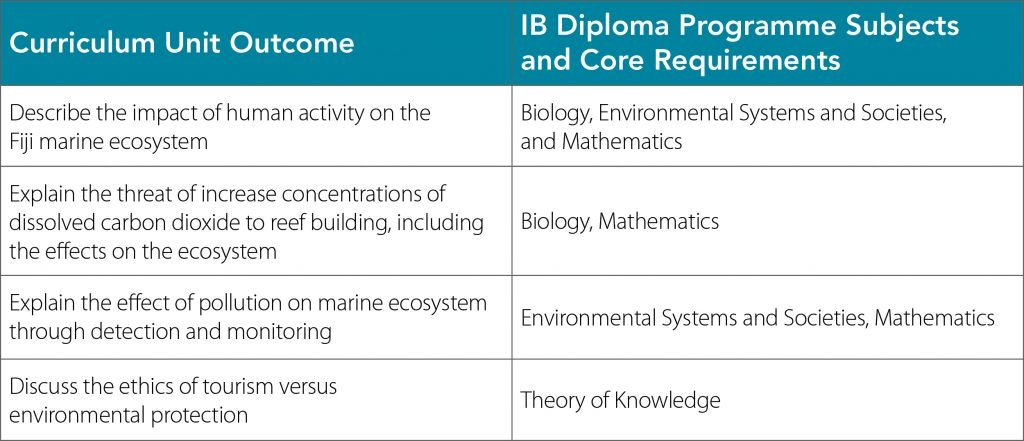
When aligned to clear unit outcomes, experiential travel provides measurable educational impact. Below is an example of curriculum outcomes identified with a Rustic Program Coordinator for the Marine and Environmental Field Studies Program.
How to Teach Development and Service Effectively
Teaching development and service requires intentional planning that bridges curriculum outcomes with hands-on experiences. Below are practical strategies used by international schools that integrate experiential learning into formal assessment frameworks:
1. Start with Curriculum Outcomes
Identify which IB, MYP, AP, or school-specific learning outcomes naturally align with development topics, global issues, sustainability, or community partnerships.
2. Build Experiences That Reinforce These Outcomes
Students learn best when theory connects to lived experience. Choose programs where fieldwork, cultural immersion, or service provides meaningful application of classroom concepts.
3. Integrate a Structured Reflection Cycle
Use the Experiential Learning Cycle (experience → reflection → conceptualization → application) to help students translate travel experiences into academic growth.
4. Introduce a Service Component Early
Service learning strengthens global awareness, leadership skills, and empathy. Students gain a deeper sense of purpose when their actions support SDG-aligned community needs.
5. Communicate Educational ROI to Parents
Clearly explain how the trip supports curriculum goals, builds essential skills, and strengthens academic performance. This builds trust and demonstrates the value of experiential learning.
See Curriculum-Aligned Week Without Walls Programs →
Teach Your Students to Talk About Development and Service
Share these guidelines with your students before they describe their service experience to others.
Use the Right Words
Make sure you’re describing communities accurately and honestly and conveying the shared values of community members. Take the time to get answers and do your research to correctly represent our partners and their stories.
refugee vs. immigrant
Is this community forcibly fleeing political oppression or persecution, or are they living in this place to provide a better life for their family?
migrant worker vs. seasonal worker vs. low-wage worker
Is this family moving regularly to follow crops, are they stationary and only employed seasonally when jobs are available or are they only able to find jobs that don’t provide livable wages?
nationality vs. ethnicity
What nationality would this person describe herself as if you asked her (regardless of legal status), and what is her self-described ethnic background?
worker camp vs. settlement vs. batey vs. refugee camp
What is the purpose of this settlement? Is it temporary? Is it permanent?
without a nation vs undocumented
Does this person have legal status in any nation, or have they entered the country from another without proper documentation?
Rustic Pathways Children’s Home + The Sacred Valley Project vs. orphanages
The Children’s Home and Sacred Valley Project are dormitories and boarding houses that allow students closer access to good education; they are not orphanages.
cultural beliefs vs. personal beliefs
Does this person I spoke with act or behave this way because they belong to a certain group, or because of their own personal beliefs?
Describe Service and People in Ways Others Can Relate
Use empowering words to describe the people you meet to others.
We all want to be proud of where we live and the communities we have created. Though someone’s house may look very different than yours, remember that it is their home and they have worked hard to make it their own, so use words that reflect this. If a person you met is working a low-wage or undesirable job, remember that he or she is doing it for their family. If someone is sick or in a bad place, imagine how someone would describe you if they met you under these circumstances.
Ask yourself: Would I describe someone this way if they were standing here with me?
Explain your service project in the context of the ongoing projects and vision.
If you have contributed (or will contribute) to development work, describe some of the ongoing projects and how yours fits into the community’s long-term plan. You are working on one piece of the puzzle; the community was there before you arrived and will be there after you leave, continuing the project and working toward their vision.
Ask yourself: By doing this work, how will this change people’s day-to-day lives? What issues does this project address? What steps of the project happened before you arrived? What is the next step in the project? What is the greater benefit?
Give examples of parallels to your audience’s lives to create empathy.
Paint a picture for the people you’re speaking with to help them understand what it would be like to live in this community. Give them examples of parallels to political, cultural, or social movements that they can relate to.
1. The family we worked with had three kids, two girls and a boy, like ours!
2. Imagine if when it rained, water leaked into your house and turned your floor into mud.
3. The migration concerns they have are very similar to what we are experiencing here.
4. The turtles we worked with were the ones that we saw at the aquarium last year.
Unanswered Questions Are OK
Everyone’s situation is different. Sometimes the solutions are more obvious (we prioritize building homes for the elderly and families with children) and other times they are complicated. Give as much information as you can and be honest when you don’t know an answer.
When you want to know more, ask us or your community partners on the ground. Sometimes the people you are talking to will have more information than you about a topic, so keep an open mind to learn more from unexpected places. Is your mom a doctor who works in public health? Is your neighbor originally from Tanzania where you did your project? Development is about learning, asking questions, and pairing problems with resources.
And remember that projects and visions change. Communities’ needs are not static, and neither are our projects! Communities change with time, growth, cultural shifts, and innovations. We always need to be ready and adaptable for these changes and continue the open communication with our global and local partners that allows us to make the greatest impact with the resources we have.
One of the most empowering and humbling things to admit is I don’t know. And isn’t why we travel to answer that question?
Integrating Service Learning for Deeper Global Understanding
Introducing a structured service element strengthens the global learning dimension of any experiential program. Service learning builds empathy, leadership, initiative, and cultural understanding—skills not always reflected in traditional academic assessments yet essential to students’ long-term growth.
With clear unit outcomes and intentional planning, parents gain confidence in the trip’s educational ROI, and students benefit from meaningful global engagement. This integration supports IB CAS strands, Service as Action, and global education frameworks.
To explore curriculum-aligned experiential travel opportunities, visit the Rustic Pathways Group Travel page.