School Trips to South AfricaCape Town, Kruger & the Cradle of Humankind

In 2026, Rustic Pathways school trips to South Africa run 9 to 11 days at $3,995 to $5,905 per student, excluding international airfare.
Itineraries combine history, culture, and wildlife: apartheid sites and townships in Johannesburg and Cape Town, Table Mountain and the Cape Peninsula, and game reserves where rangers teach students conservation.
No commitment, and no sales call unless you ask for one.
4.9on Trustpilot and Google

South Africa School Travel Itineraries
The three South Africa school travel itineraries are Discovering Cape Town, History and Safari Adventure, and Ranger Conservation and Safari. Discovering Cape Town starts at $3,995 for 9 days, History and Safari Adventure starts at $5,905 for 11 days, and Ranger Conservation and Safari starts at $3,995 for 10 days.
Compare the three itineraries side by side
| Itinerary | Discovering Cape Town | History and Safari Adventure | Ranger Conservation and Safari |
|---|---|---|---|
| Length | 9 days | 11 days | 10 days |
| Starting price | From $3,995 | From $5,905 | From $3,995 |
| Learning focus | Geography · Service Learning | History · Environmental Science | Environmental Science · Conservation |
| Route | Cape Town · Boulders Beach · Cape of Good Hope · Table Mountain · Elgin Valley | Johannesburg · Soweto · Kruger National Park · Cape Town · Boulders Beach | Johannesburg · Cradle of Humankind · Karongwe Game Reserve |
| Overnight bases | Cape Town (6) · At home (1) | Johannesburg (2) · Kruger National Park (2) · Cape Town (4) · At home (1) | Cradle of Humankind (2) · Karongwe Game Reserve (5) · At home (1) |
| Physical profile | 4 low · 3 moderate · 2 high | 6 low · 4 moderate · 1 high | 5 low · 1 moderate · 4 high |
| On-program flights | None inside South Africa. The group flies into and out of Cape Town International Airport. | One internal flight, Johannesburg to Cape Town, included in the price. The group flies into Johannesburg and out of Cape Town. | None inside South Africa. The group flies into and out of O.R. Tambo International Airport (JNB). |
| Best for | Best for schools that want to explore Cape Town in depth, with a service day, mountain walk, and beach day in one program. | Best for schools that want to combine South Africa's apartheid history and wildlife, with a longer itinerary that includes Johannesburg, Cape Town, and a safari. | Best for schools that want hands-on conservation experience, with students spending several days in one game reserve learning about wildlife and conservation. |
- Cape Town · One hotel for every night; the city walk, the service day, and Table Mountain
- Boulders Beach · The African penguin colony, and the snorkelling in the kelp forest and at Hout Bay
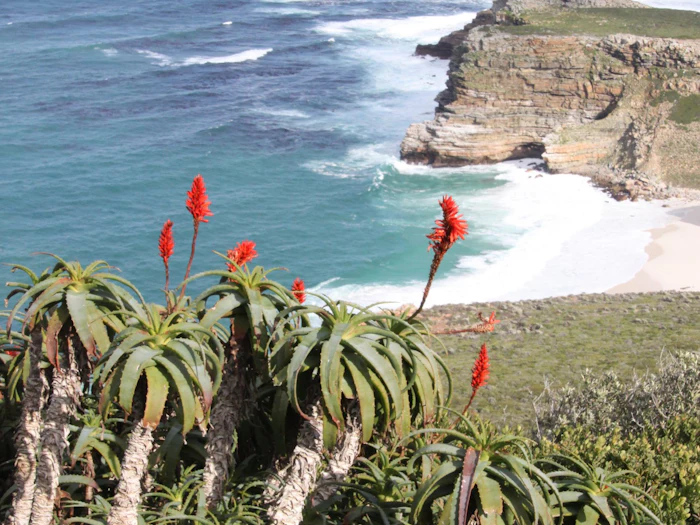
- Cape of Good Hope · The furthest south-western point in Africa
- Elgin Valley · The zipline over fynbos on the last full day
- Johannesburg and Soweto · The Hector Pieterson Memorial, Nelson Mandela's former home, and the Apartheid Museum
- Kruger National Park · A full-day game drive and an early bush walk on foot
- Cape Town · Reached by internal flight; Table Mountain, the District Six Museum, Langa, and the peninsula day to the Boulders Beach penguin colony
- Johannesburg · Arrival and departure only; the group does not stay in the city
- Cradle of Humankind · Two nights, and the Gladysvale and Malapa fossil dig sites
- Karongwe Game Reserve · Four days of junior ranger training in one reserve
 Cape Town · Table Mountain · Boulders Beach · Cape of Good Hope
9 days · From $3,995
Cape Town · Table Mountain · Boulders Beach · Cape of Good Hope
9 days · From $3,995
Discovering Cape Town
Students explore Cape Town and the Cape Peninsula through city walks, a township service project, a beach day, and a guided Table Mountain hike. The nine-day itinerary uses Cape Town as its base and ends with a zipline experience in the Elgin Valley.
Choose this program- Cape Town6 nights
- Overnight flight1 night
- At home1 night
Your nine-day itinerary
-
Day 1
Depart for South Africa
The program starts at the school's own airport rather than in Cape Town, so the group is together from the first hour and lands as a group.
MorningMeet the group at a pre-selected point in the home airport and check bags together.AfternoonThrough security as a group, then board.EveningIn flight.- Route
- The school's home airport to Cape Town.
- Travel
- One international flight, flown as a group.
- Overnight
- In flight.
- Meals
- Airline meals. Program meals begin on arrival.
- Physical demand
- Low effort, apart from the length of the flight.
- Customization
- Rustic Pathways will book the flights as an add-on service, or the school books them.
-
Day 2
Welcome to Cape Town
The first evening is deliberately social rather than educational. Dinner, drumming, and live music come before any of the history does.
MorningLand at Cape Town International Airport and meet the Program Leaders.AfternoonTo the accommodation, settle in, then group orientation.EveningA Welcome to Africa dinner, then a drumming lesson with live music and entertainment.- Route
- Cape Town International Airport to the hotel.
- Travel
- Program transport from the airport; no further movement today.
- Overnight
- The same program-approved hotel in Cape Town for every night on the ground, shared gender-separated rooms, one student one bed.
- Meals
- Dinner is the group's first meal on the ground; earlier meals depend on the arrival flight.
- Physical demand
- Low effort. The day is arrival and orientation.
- Customization
- A late landing moves the orientation to the following morning; the proposal sets the arrival time.
-
Day 3
Explore Cape Town
A walking day that puts the city's food, history, and geography in one line. The Company's Garden was planted to resupply ships rounding the Cape, which is the whole reason the city is where it is.
MorningA walking tour of the city, with an introduction to its culture, history, geography, and food.AfternoonThe Company's Garden, South Africa's oldest garden, and a tasting of locally grown rooibos tea, rusks, and milk tart.EveningBack into the city after lunch.- Route
- Central Cape Town and the Company's Garden.
- Travel
- On foot for the whole day.
- Overnight
- The same program-approved hotel in Cape Town for every night on the ground, shared gender-separated rooms, one student one bed.
- Meals
- Breakfast, lunch, and dinner included.
- Physical demand
- Moderate. A full day of city walking.
- Learning outcome
- The garden makes the founding argument: the city exists because ships rounding the Cape needed feeding.
-
Day 4
Penguins, kelp, and the Cape
The peninsula day, and the coldest water most students will have swum in. Boulders Beach, the kelp forest, and the Cape of Good Hope in one drive south.
MorningThe drive down the coastline.AfternoonThe African penguin colony at Boulders Beach, then snorkelling in the Great African Kelp Forest or with the seals at Hout Bay.EveningThe Cape of Good Hope, the furthest south-western point in Africa, and the coastal drive back.- Route
- Cape Town south to Boulders Beach, Hout Bay, and the Cape of Good Hope, then back.
- Travel
- Program van, with the swimming and snorkelling from the shore and from a boat.
- Overnight
- The same program-approved hotel in Cape Town for every night on the ground, shared gender-separated rooms, one student one bed.
- Meals
- Breakfast, lunch, and dinner included.
- Physical demand
- Moderate. The Atlantic here is cold year-round; wetsuits and a briefing come with the snorkelling and it is supervised throughout.
- Customization
- The snorkel is optional and the penguin colony and the Cape run either way.
-
Day 5
Service at a school garden
A full day at a township school garden with the Amy Foundation, which is also the day the week's argument about food security gets made in front of the students rather than to them.
MorningLearn about local needs from the Amy Foundation.AfternoonService work in one of the school gardens in a local township, and why school feeding programs matter to South Africa's food security for children.EveningSports with the children from the school, and time spent with them.- Route
- Cape Town out to a township school garden and back.
- Travel
- Program transport, with a fixed pick-up point and a local partner throughout.
- Overnight
- The same program-approved hotel in Cape Town for every night on the ground, shared gender-separated rooms, one student one bed.
- Meals
- Breakfast, lunch, and dinner included.
- Physical demand
- High effort. This is outdoor garden work, and it is the physical day of the week.
- Learning outcome
- Students meet a school feeding program as a food-security measure rather than as charity, which is the framing the Amy Foundation itself uses.
-
Day 6
Table Mountain
Up on foot with a qualified mountain guide and down by cable car. The Cape Floral Region on the way up is the reason the walk is worth doing rather than riding both ways.
MorningThe hike up Table Mountain with a qualified mountain guide, through the Cape Floral Region.AfternoonA picnic lunch at the top, then the cable car down.EveningAn option to visit the V&A Waterfront.- Route
- Table Mountain, on foot up and by cable car down, then the V&A Waterfront.
- Travel
- Program transport to the trail head, then on foot.
- Overnight
- The same program-approved hotel in Cape Town for every night on the ground, shared gender-separated rooms, one student one bed.
- Meals
- Breakfast, lunch, and dinner included.
- Physical demand
- High effort and the hardest day of the week: a sustained ascent with a guide, exposed, and the weather at the top is not the weather at the bottom.
- Customization
- A student who cannot make the ascent takes the cable car up and joins the group at the summit; the proposal records it.
-
Day 7
Zipline over the Elgin Valley, and closing
The last full day goes out of the city to the mountains and then comes back for the closing. Rustic Ties is the structured reflection every Rustic Pathways program ends on.
MorningThe journey out to the Elgin Valley, in the mountains outside Cape Town.AfternoonZiplining over fynbos shrubland, with the mountainscapes below.EveningBack to Cape Town for the program wrap-up and the Rustic Ties ceremony.- Route
- Cape Town to the Elgin Valley and back for the closing.
- Travel
- Program transport out and back.
- Overnight
- The same program-approved hotel in Cape Town for every night on the ground, shared gender-separated rooms, one student one bed.
- Meals
- Breakfast, lunch, and dinner included.
- Physical demand
- Moderate. The zipline is harnessed and instructed and the walking between platforms is short.
- Learning outcome
- At the end of each program students reflect on their experiences and the issues they engaged with. Rustic Ties is the activity that carries those moments back to their own communities.
-
Day 8
Farewell, or the start of the safari
The day the group either goes home or turns onto the optional safari extension. The morning is loose either way, shaped by the departure time.
MorningLast-minute shopping or a quick beach visit, depending on the departure time.AfternoonThe transfer to the airport for a departing group.EveningFor a group continuing, the transfer toward the safari lodge instead.- Route
- Cape Town to the airport, or onward for a group taking the extension.
- Travel
- Program transport.
- Overnight
- In flight for a departing group.
- Meals
- Breakfast at the hotel. Meals after that depend on which way the day goes.
- Physical demand
- Low effort.
- Customization
- The four-day, three-night safari extension is OPTIONAL and carries an extra per-person fee. It runs from Cape Town to a Garden Route game lodge and is not part of the nine days or the $3,995. The proposal prices it separately if the school wants it.
-
Day 9
Return home
Home, or the second day of the extension.
MorningThe flight home.AfternoonArrival.EveningFor a group on the extension, four days of wildlife instead.- Route
- Cape Town to the school's home airport.
- Travel
- The return flight.
- Overnight
- At home.
- Meals
- Airline meals.
- Physical demand
- Low effort.
- Customization
- A group on the safari extension is not traveling today; see day 8.
 Johannesburg · Soweto · Kruger National Park · Cape Town
11 days · From $5,905
Johannesburg · Soweto · Kruger National Park · Cape Town
11 days · From $5,905
History and Safari Adventure
The eleven-day itinerary connects South Africa's apartheid history with its wildlife and landscapes. Students visit historical sites in Johannesburg and Soweto, explore Kruger National Park on safari, and fly to Cape Town for Table Mountain, District Six, Langa, and the Cape Peninsula.
Choose this program- Johannesburg2 nights
- Kruger National Park2 nights
- Cape Town4 nights
- At home1 night
Your eleven-day itinerary
-
Day 1
Depart from home
The group travels together from the check-in counter, which is where the program starts.
MorningMeet at the check-in counter of the home airport.AfternoonCheck in and board as a group.EveningIn flight.- Route
- The school's home airport to Johannesburg.
- Travel
- One international flight, flown as a group.
- Overnight
- In flight.
- Meals
- Airline meals. Program meals begin on arrival.
- Physical demand
- Low effort, apart from the length of the flight.
- Customization
- Rustic Pathways will book the flights as an add-on service, or the school books them.
-
Day 2
Arrive in Johannesburg
A deliberately quiet first day after a long flight. The history starts tomorrow.
MorningArrive into Johannesburg Airport (JNB) and meet the Program Leaders.AfternoonTo the accommodation and settle in.EveningGroup orientation on the week ahead and on expectations, then dinner.- Route
- Johannesburg Airport to the accommodation.
- Travel
- Program transport from the airport; no further movement today.
- Overnight
- Program-approved accommodation in Johannesburg, shared gender-separated rooms, one student one bed.
- Meals
- Dinner is the group's first meal on the ground; earlier meals depend on the arrival flight.
- Physical demand
- Low effort, and the day is built for recovering from the flight.
- Customization
- A late landing moves the orientation to the following morning.
-
Day 3
Johannesburg and Soweto
The heaviest day of the program and it comes early, deliberately, so the rest of the trip has somewhere to put it. The Hector Pieterson Memorial honours the students who protested in the 1976 Soweto Uprising, which makes the subject the same age as the group standing in front of it.
MorningThe Hector Pieterson Memorial.AfternoonNelson Mandela's former home, then a local school where the group meets students.EveningThe Apartheid Museum.- Route
- The Hector Pieterson Memorial, Nelson Mandela's former home, a local school, and the Apartheid Museum.
- Travel
- Program transport between the sites, each walked.
- Overnight
- Program-approved accommodation in Johannesburg.
- Meals
- Breakfast, lunch, and dinner included.
- Physical demand
- Moderate walking; the demand today is emotional rather than physical.
- Learning outcome
- This is the day the school prepares students for before departure. The memorial and the museum are direct, and the school visit puts a present-day classroom beside them the same afternoon.
-
Day 4
East to Kruger
The long drive east, broken by two stops: a toboggan run and a descent through the forest canopy into a gorge.
MorningA toboggan ride at Long Tom Misty Mount.AfternoonDown into the forest floor at Graskop Gorge.EveningOn to Kruger National Park and the reserve accommodation.- Route
- Johannesburg east to Long Tom Misty Mount, Graskop Gorge, and Kruger National Park.
- Travel
- Program coach for the whole day.
- Overnight
- Program-approved accommodation at Kruger National Park.
- Meals
- Breakfast, lunch, and dinner included.
- Physical demand
- Moderate. Mostly seated, with the gorge descent on foot and by lift.
- Customization
- The arrival time at the reserve is set by the park's own schedule rather than by the group, so this day's timings come from the proposal and are not movable on the day.
-
Day 5
Safari in Kruger
A full day in an open safari vehicle. Kruger is one of the largest game reserves in Africa and a full day is the minimum that makes the Big Five a realistic prospect rather than a promise.
MorningOut in an off-road safari vehicle at first light.AfternoonA full-day game drive through the park.EveningBack to the accommodation.- Route
- A full-day game drive through Kruger National Park.
- Travel
- Off-road safari vehicle, with a guide, for the whole day.
- Overnight
- Program-approved accommodation at Kruger National Park, the second of two nights.
- Meals
- Breakfast, lunch, and dinner included.
- Physical demand
- Moderate. Seated, but long, open, hot, and dusty, and the day starts early.
- Learning outcome
- Students look for elephant, lion, leopard, buffalo, and rhino, and for everything else the park holds; what is seen is not guaranteed and the guide says so.
-
Day 6
Bush walk, then fly to Cape Town
The pivot of the program. An early bush walk on foot, then the internal flight that makes the second half possible: the group wakes in the Lowveld and is on the Atlantic coast by the afternoon.
MorningAn early morning bush walk to see wildlife on foot.AfternoonThe flight to Cape Town.EveningThe Company's Garden and Greenmarket Square, then free time at the V&A Waterfront.- Route
- Kruger to the airport, then Cape Town, the Company's Garden, and Greenmarket Square.
- Travel
- An internal flight from Johannesburg to Cape Town, included in the program price.
- Overnight
- Program-approved accommodation in Cape Town, for the rest of the program.
- Meals
- Breakfast, lunch, and dinner included.
- Physical demand
- Moderate. The bush walk is on foot and early; the rest of the day is travel.
- Learning outcome
- Cape Town was a colonial resupply port and is now a cultural hub, which is the frame the next three days read it through.
-
Day 7
Table Mountain and District Six
Up the mountain for the shape of the city, then down to the District Six Museum for what was done to it. The two in one day is the point.
MorningTable Mountain: the hike to the summit, or the cable car, depending on the weather.AfternoonThe District Six Museum and what apartheid did to the communities there.EveningThe Company's Garden, Greenmarket Square, and the notable sites of the center.- Route
- Table Mountain, then the District Six Museum and central Cape Town.
- Travel
- Program transport to the mountain, then on foot in the city.
- Overnight
- Program-approved accommodation in Cape Town.
- Meals
- Breakfast, lunch, and dinner included.
- Physical demand
- High effort if the group hikes; the cable car is the alternative and the weather decides which.
- Customization
- The ascent is weather-permitting and the decision is made on the day. A student who cannot hike takes the cable car either way.
-
Day 8
Langa
The city's oldest township, and a lunch at a restaurant that is part of the community rather than a stop on a route.
MorningOut to Langa, Cape Town's oldest township.AfternoonAn authentic South African lunch at Lelapa Restaurant, a long-standing local business.EveningFree time.- Route
- Cape Town to Langa and back.
- Travel
- Program transport, with a local partner throughout.
- Overnight
- Program-approved accommodation in Cape Town.
- Meals
- Breakfast, lunch, and dinner included.
- Physical demand
- Low effort, and the afternoon is deliberately unstructured after it.
- Customization
- Free time is set by the school's own policy and written into the approved itinerary before departure.
-
Day 9
The coast and the penguins
The peninsula in one guided run, from the city beaches down to the penguin colony. The one day of the eleven that is purely about the coastline.
MorningA guided tour of Sea Point, Clifton, and Camps Bay.AfternoonCape Point Nature Reserve, then Simon's Town and Muizenberg.EveningThe African penguin colony at Boulders Beach.- Route
- Sea Point, Clifton, Camps Bay, Cape Point Nature Reserve, Simon's Town, Muizenberg, and Boulders Beach.
- Travel
- Program transport along the peninsula, with each stop walked.
- Overnight
- Program-approved accommodation in Cape Town.
- Meals
- Breakfast, lunch, and dinner included.
- Physical demand
- Low effort, with short walks at each stop and a full day in the open.
- Customization
- The order runs on the weather; the reserve and the colony are the fixed points.
-
Day 10
Farewell to South Africa
A last morning at the waterfront, then the airport.
MorningThe V&A Waterfront, for last-minute souvenirs.AfternoonThe transfer to the airport.EveningDeparture, with the closing reflection before it.- Route
- Cape Town and the V&A Waterfront, then the airport.
- Travel
- Program transport to the airport, then the flight home.
- Overnight
- In flight.
- Meals
- Breakfast is included. Meals after that are on the flight.
- Physical demand
- Low effort.
- Customization
- A late flight adds a morning in the city; the proposal sets it.
-
Day 11
Arrive home
The flight from Cape Town crosses a night, so the group lands home the following day.
MorningIn flight.AfternoonArrival at the home airport.EveningHome.- Route
- Cape Town to the school's home airport.
- Travel
- The return flight.
- Overnight
- At home.
- Meals
- Airline meals.
- Physical demand
- Low effort.
- Customization
- The routing decides whether this day is a full one; the proposal sets the flights.
 Johannesburg · Cradle of Humankind · Karongwe Game Reserve
10 days · From $3,995
Johannesburg · Cradle of Humankind · Karongwe Game Reserve
10 days · From $3,995
Ranger Conservation and Safari
Conservation shapes this ten-day itinerary from the Cradle of Humankind to Karongwe Game Reserve. Students visit fossil dig sites before spending four days at Karongwe learning about wildlife and conservation through game drives, bush walks, and ranger-led activities.
Choose this program- Cradle of Humankind2 nights
- Karongwe Game Reserve5 nights
- At home1 night
Your ten-day itinerary
-
Day 1
A full day in the air from your home airport
Getting to South Africa takes the whole day. The group checks bags together at its home airport and is in the air by the evening.
MorningMeet the group at a pre-selected point in the home airport and check bags together.AfternoonThrough security as a group, then board.EveningIn flight.- Route
- The school's home airport to Johannesburg.
- Travel
- One international flight, flown as a group.
- Overnight
- In flight.
- Meals
- Airline meals. Program meals begin on arrival.
- Physical demand
- Low effort, apart from the length of the flight.
- Customization
- Rustic Pathways will book the flights as an add-on service, or the school books them.
-
Day 2
Arrive, and out to the Cradle
The group does not stay in Johannesburg. The first night is already at a game reserve an hour outside it, which sets the tone for the whole ten days.
MorningArrive at O.R. Tambo International Airport (JNB) and meet the Program Leaders.AfternoonOut to the game reserve accommodation at the Cradle of Humankind and settle in.EveningOrientation and an introduction to the local context, then dinner.- Route
- O.R. Tambo International Airport out to the Cradle of Humankind.
- Travel
- Program transport from the airport.
- Overnight
- Program-approved game reserve accommodation at the Cradle of Humankind, shared gender-separated rooms, one student one bed.
- Meals
- Dinner is the group's first meal on the ground; earlier meals depend on the arrival flight.
- Physical demand
- Low effort. The day is arrival and orientation.
- Customization
- A late landing moves the orientation to the following morning.
-
Day 3
The Cradle of Humankind
Two active fossil dig sites, in an open vehicle, on the ground that gave the area its name. Gladysvale and Malapa are working excavations rather than displays.
MorningAboard an open-air vehicle for the trek out to the dig sites.AfternoonGladysvale and Malapa: the ancient origins of the human race, and the geology that made this area a famed repository of hominin fossils.EveningWildlife on the way back, from rock-eating termites to antelope, and the views from the reserve.- Route
- The Gladysvale and Malapa fossil dig sites in the Cradle of Humankind.
- Travel
- Open-air vehicle, with the sites walked.
- Overnight
- Program-approved game reserve accommodation at the Cradle of Humankind, the second of two nights.
- Meals
- Breakfast, lunch, and dinner included.
- Physical demand
- Moderate. The sites are reached on foot over uneven ground and the vehicle is open.
- Learning outcome
- Students see excavation in progress and the geological reason it is happening here, which is the science half of the argument the ranger training makes the practical half of.
-
Day 4
South to Karongwe
The one long drive of the program, five hours down into the Lowveld, and the group arrives in time for a game drive rather than only for dinner.
MorningBreakfast, then pack up for the drive south.AfternoonThe scenic five-hour drive to the Karongwe Game Reserve in the Lowveld, and settling in.EveningA sunset game drive in open safari vehicles, then dinner around the campfire.- Route
- The Cradle of Humankind south to the Karongwe Game Reserve.
- Travel
- Program coach for the transfer, then open safari vehicles on the reserve.
- Overnight
- Glamping tents at the Karongwe Game Reserve, for the rest of the program.
- Meals
- Breakfast, lunch, and dinner included.
- Physical demand
- Low effort. Seated for the drive, then seated for the game drive.
- Customization
- The sunset drive depends on the arrival time; a delayed transfer moves it to the following morning.
-
Days 5-8
Junior ranger training
Four days in one place, which is the whole design of this program. Students train alongside reserve staff rather than being driven past the animals, and four days is what it takes for the tracking and the lectures to build on each other.
MorningEarly starts, every day, because that is when the animals move.AfternoonGame drives, bush walks, and wildlife lectures, on African wildlife, the local ecosystem, and why conservation here works the way it does.EveningDiscussions at the lodge, and the skills a ranger has to master.- Route
- Four days inside the Karongwe Game Reserve.
- Travel
- Open safari vehicles and bush walks on foot; no road transfers in these four days.
- Overnight
- Glamping tents at the Karongwe Game Reserve.
- Meals
- Breakfast, lunch, and dinner included.
- Physical demand
- High effort, and sustained: early starts every morning, bush walks on foot in the heat, and long periods in an open vehicle.
- Learning outcome
- The junior ranger program is the spine of the trip. Students learn the skills rangers master, and the four days are one course rather than four separate excursions.
- Customization
- What each day covers is set with the reserve and appears in the proposal.
-
Day 9
Back to Johannesburg, and departure
An early start and the long drive back north, straight to the airport.
MorningUp early and out of the reserve.AfternoonThe drive back to Johannesburg.EveningThe Program Leaders take the group to the airport for departure, after the closing reflection.- Route
- The Karongwe Game Reserve back to Johannesburg and the airport.
- Travel
- Program coach, then the flight home.
- Overnight
- In flight.
- Meals
- Breakfast at the lodge. Meals after that are on the road and on the flight.
- Physical demand
- Low effort, but it is an early start after four demanding days.
- Customization
- Rustic Pathways will book the flights as an add-on service, or the school books them.
-
Day 10
Overnight from Johannesburg to your home airport
An overnight flight from Johannesburg, and the program ends where it started, at the school's home airport.
MorningIn flight.AfternoonArrival at the home airport.EveningHome.- Route
- Johannesburg to the school's home airport.
- Travel
- The return flight.
- Overnight
- At home.
- Meals
- Airline meals.
- Physical demand
- Low effort.
- Customization
- International flights are not included in the program price; the proposal sets the routing.
What applies across every itinerary
- Groups and teachers
- Groups start at 10 students; smaller groups are considered individually. 1 teacher receives free Program Tuition per 8 paying students.
- Rooming
- Students share gender-separated rooms with individual beds; teachers have private rooms.
- Price
- Prices exclude flights, travel and medical insurance, and personal spending.
- Flights and documents
- Schools book international flights or ask Rustic Pathways to arrange them. Families handle passports and any required entry authorizations with Rustic Pathways guidance.
- Supervision
- Program Leaders run scheduled activities, stay on site, and are available overnight. The approved itinerary specifies any free time, and Program Leaders are present during it.
- Effort
- Moderate to high. The Table Mountain ascent, the township garden service day, and the ranger training bush walks are the demanding parts; the game drives are seated but long, early, and open.
- Flexibility
- Any day can be rebuilt around what your school wants to teach. The proposal is where that happens, before anything is booked.
How much does a school trip to South Africa cost?
A school trip to South Africa costs $3,995 to $5,905 per student for program tuition, or roughly $400 to $537 per day. Tuition covers lodging, meals, airport transfers, in-country transport, scheduled activities, guides, and entrance fees. Airfare is not included.
Schools receive 1 complimentary tuition place for every 8 paying students. Every program is quoted for your group rather than sold at a published departure date.
$3,995 to $5,905
per student across the sample itineraries, excluding international airfare.
9 to 11 days
program length across the three sample itineraries.
Group quote
every school receives its own, built on dates, group size, and route.
| Included | What it covers |
|---|---|
| Travel | Lodging for every night on the program, meals and drinking water, airport transfers, in-country transport, guides, park and reserve fees, and the internal flight where an itinerary carries one. |
| Activities | The booked activities on each itinerary: the museum and memorial visits, the game drives and bush walks, the ranger training days, and the service work where a week carries it. |
| Staff and support | At least two trained Program Leaders, including both a male and a female leader, pre-departure planning, and school documentation. |
| Community donations | Required by a service project, paid by Rustic Pathways, and never collected from students. |
| Chaperones | One complimentary Program Tuition place per eight paying students. Chaperone airfare, travel insurance and medical insurance are separate. |
Not included: International airfare, travel insurance, medical insurance, personal spending money, and the optional four-day safari extension on the Cape Town itinerary, which carries its own per-person fee.
| Effect | Factor |
|---|---|
| raises | Peak and holiday weeks cost more than shoulder dates. |
| raises | A short trip does not shrink the fixed costs. They spread across fewer days, so each day costs more. |
| raises | Beyond the one free teacher place, added chaperone seats are costed across the whole group. |
| raises | Lodging tier moves the price directly, and a game reserve stay is a wider range than a city hotel. |
| raises | An itinerary that crosses the country carries an internal flight, which a single-city itinerary does not. |
| lowers | 10 students is the starting size, with no upper limit; the more who join, the lower the per-student price. |
Payment and cancellation
Installment plans are available. Schools pay as a group, or families pay monthly under the terms and conditions.
What documents do students need to enter South Africa?
Minors need more paperwork to enter South Africa than most destinations, and it is checked at boarding rather than on arrival.
A student traveling without a parent needs:
- A valid passport
- An unabridged birth certificate or equivalent parentage document
- A parental consent affidavit
- Copies of both parents' or guardians' identity documents
- Both parents' or guardians' contact details
- A letter from the host in South Africa
Rustic Pathways works through the list with your school well before departure, because a document that does not match gets a student stopped at the airport, not at the border.

What do students learn on a South Africa school trip?
Students on a South Africa school trip learn geography, history, and environmental science through direct experiences with the places they study. Programs connect classroom learning to natural landforms, apartheid museums, wildlife reserves, and fossil sites.
Geography
Students explore how geography shaped Cape Town through Table Mountain, the Cape Peninsula, the Cape Floral Region, and communities created by forced removals.
How have geography and politics shaped Cape Town?
Discovering Cape Town
History
Students study apartheid through the Hector Pieterson Memorial and Apartheid Museum in Johannesburg, then District Six and Langa in Cape Town.
How does where history is told change how we understand it?
History and Safari Adventure
Environmental Science
Students train as junior rangers at Karongwe through game drives, bush walks, and wildlife lessons, after visiting fossil sites in the Cradle of Humankind.
What does it take to protect and manage a wildlife reserve?
Ranger Conservation and Safari

What makes Rustic Pathways educational trips different?
A Rustic Pathways school trip is one private group on your school's own dates, one bed per student, and an itinerary built to your curriculum.
- 01No mixed groups. Just your school
- 02One student, one bed
- 03Your school picks the dates
- 04Monthly payment plans available
- 05No tipping; Rustic Pathways Program Tuition includes community donations
- 06Aligned to your curriculum
How safety is managed on a school trip to South Africa
Program Leaders manage local operations and safety procedures alongside school chaperones. Across 13 years of published incident data from every Rustic Pathways program worldwide, 87% of reports were GREEN, the minor tier where the group stays intact.
What the team plans for
The cities and the townships
Guided visits to Soweto, Langa, and District Six are run with local partners and fixed pick-up points, and the group moves by program transport rather than on foot between neighborhoods
Game reserves and bush walks
Open safari vehicles, guided bush walks, and reserve accommodation, each run to the reserve's own protocol with a qualified ranger present
The coast and the mountain
The Table Mountain ascent with a qualified mountain guide, snorkelling in cold Atlantic water off the Cape, and a coastline where the weather turns fast
Controls built into every trip
Written risk plan. A score above 5 requires new controls, reassessment, or cancellation.
Two-Deep Leadership. A single staff member is never alone with students, and at least two trained Program Leaders, including both a male and a female leader, support each School Group Travel trip.
Assessed activity vendors. Transport, reserve, and activity operators are reviewed before use, every one to two years, and on site when high risk.
Medical readiness. WFR coverage for remote programs and Dr. William R. Smith, who has led medical planning as Medical Director since 2015.
Is Rustic Pathways the right partner for your school trip to South Africa?
A private trip on your dates, built around your curriculum. Students travel only with their own teachers and classmates, never with another school's group.
Individual students can join fixed-departure South Africa programs instead.
A strong fit
- One private group, your dates, your teachers.
- 9 to 11 travel days.
- You want the day-by-day before you commit, not a brochure summary.
Talk with us first
- A student has significant mobility, medical, mental-health, dietary, or religious support needs.
- Fewer than 10 students, the group minimum.
- Students traveling without parents. South Africa requires each one to carry an unabridged birth certificate, a parental consent affidavit, and copies of both parents' IDs, checked at boarding.
- Your itinerary includes apartheid museums, memorials, and townships, and you want students prepared before departure, not on the day.
Probably not a fit
- You are an individual student or parent.
- You are comparing packaged tours where several schools share a fixed departure.
- You need fewer than 9 days.
Raise individual needs before booking so the route and support plan can adapt where feasible.
Questions about school trips to South Africa
How much does a school trip to South Africa cost?
School trips to South Africa cost $3,995–$5,905 per student for itineraries of 9 to 11 days, excluding international airfare.
Final pricing depends on trip length, group size, dates, lodging, and internal flights. Programs start at 10 students, with one free teacher place for every eight paying students.
What's the best time to visit South Africa?
The best time for a school trip to South Africa is typically June through August, when conditions are cool and dry.
This period falls during South African winter because its seasons are opposite those of the Northern Hemisphere. December through February is warmer for schools that prefer summer conditions.

Have a question before you ask for a proposal?
Patrick Ziemnik answers South Africa school-trip questions with the school travel team.
Send your group size, dates, trip length, and what you want students to learn. I’ll reply within 1 business day and send you options within 48 hours, and no sales call unless you ask for one.
Start with your travel window
Start your South Africa trip proposal with your travel dates, group size, and learning goals. Receive a reply within 1 business day and customized trip options within 48 hours.
Or reach a person directly: +1 440-975-9691 or groups@rusticpathways.com
Have a school expeditions or tour operator quote?
Send it over. Rustic Pathways will show you what’s possible for the same budget.
Need approval or funding first?
Certificate of insurance, risk management plans, and fundraising templates for families, on request.



Destinations related to South Africa
Browse all school trip destinations- Rustic Pathways has operated student travel since 1983. Recent industry recognition:
- 2026 GoAbroad Innovation AwardsInnovation in Adventure-Based Programming · Global Adventure Learning Model
- 2025 International Travel AwardsBest Group Tour Operator
- 2024 Skift IDEA AwardsIndustry Innovators – Tour Operators
- 4x WYSETC Best Youth Tour Operator2015, 2017, 2018, 2019
- BBB A+ RatingBetter Business Bureau profile
- NESA Affiliate OrganizationNear East South Asia Council of Overseas Schools
- 2025 World Travel AwardsUnited States’ Leading Tour Operator