Scott is the Director of Admissions at Rustic Pathways. He has worked in student travel and experiential education since 2011. Before helping families find the perfect Rustic Pathways program, he led gap year programs that took students around the world and spent more than nine years in Japan. Read More About Scott.
Chad rarely makes headlines, but that doesn’t mean it should be overlooked. In the north, the Sahara stretches for 1,200 miles (2,000 kilometers) and extends into farmland and villages. In the west, Lake Chad, once vast enough to sustain entire communities, has shrunk to a fraction of its former size. Yet, life here endures.
With over 200 ethnic groups and more than 100 languages, Chad is a place where history is carried in traditions, spoken in countless dialects and played through the notes of a 10-foot kakaki trumpet. At night, the sky is so clear you can get an incredible view of the Milky Way.
When you look into Chad a bit more closely, you’ll see that it’s full of stories that deserve to be told.
Chad is home to the vast Sahara Desert in the north and some of the clearest night skies on Earth. Meanwhile, Lake Chad, once one of the world’s largest freshwater lakes, has shrunk by over 90% since the 1960s due to climate change and desertification
With over 200 ethnic groups and more than 100 languages spoken, Chad is often called the “Babel Tower of the World”
Chad faces economic struggles, ranking among the poorest nations due to poor governance, droughts and limited infrastructure
1. The Sahara Desert covers much of Northern Chad and is the third largest desert in the world
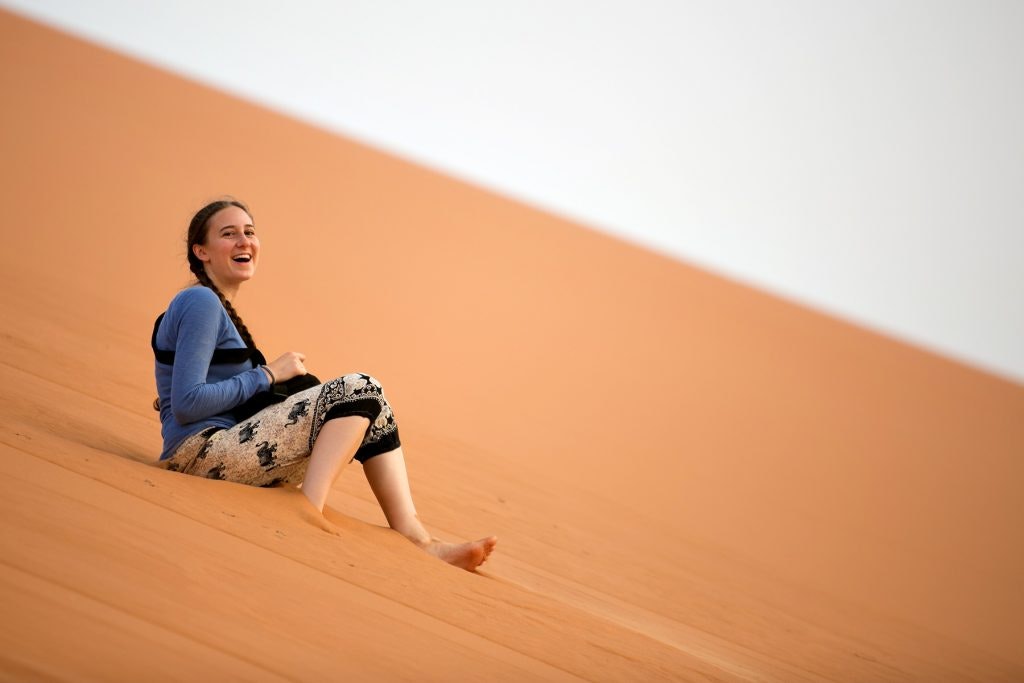
Student on a photography tour in the Sahara Desert
The Sahara Desert is the world’s largest hot desert. As the Sahara region expands, Lake Chad contracts due to climate change. Lake Chad was once the world’s largest freshwater lake, has shrunk by as much as 95% since 1963.
Chad’s desertification affects fishing, farming, and herding, leading to conflicts over resources and exacerbating the effects of poverty.
2. Chad is the largest landlocked country located in Africa
Chad is the fifth-largest country in Africa, and largest landlocked country in Africa. Chad, named after Lake Chad, has larger land area than Spain, France, and Germany combined. The country shares borders with Cameroon, Central African Republic (CAR), Niger, Nigeria, Libya, and Sudan. The economy of Chad relies heavily on agriculture.
In N’Djamena, the capital city and largest city in Chad, agriculture plays a significant role as 80% of Chadian population works in the agricultural sector. But that means the economics rely on good weather conditions, making it vulnerable during years with low rainfall. Chad’s staple foods are grains including millet, sorghum, and rice are the staple foods of Chad.
The upside of the agrarian focus is that Chad is one of the countries least affected by light pollution. The night sky conditions in Chad are pristine, and the Milky Way can be clearly seen.
The downside of this is that…
3. Chad is poor and the government is poorly run and the people of Chad suffer for it
Chad is one of the poorest countries in the world. Chad ranks 187th out of 189 countries on the Human Development Index, with 40% of the population living below the poverty line.
The country’s economy faces challenges due to its landlocked geography, frequent droughts, inadequate infrastructure, poor governance. For example, there is only one Chadian doctor per 25,000 people.
Chad often appears on the list of most corrupt countries. For instance, residents of N’Djamena are subject to tax rate of 60% of their net income.
Ten Largest Deserts in the World
Rank
Desert Name
Type of Desert
Location
Countries
1
Antarctic Desert
Polar ice and tundra
Antarctica
N/A
2
Arctic Desert
Polar ice and tundra
Eastern Europe
Alaska (United States), Canada, Finland, Greenland, Iceland, Norway, Russia, Sweden
Iraq, Jordan, Kuwait, Oman, Qatar, Saudi Arabia, United Arab Emirates, Yemen
6
Gobi Desert
Cold winter
Eastern Asia
China, Mongolia
7
Kalahari Desert
Subtropical
Southern Africa
Botswana, Namibia, South Africa
8
Patagonian Desert
Cold winter
South America
Argentina, Chile
9
Syrian Desert
Subtropical
Western Asia
Iraq, Jordan, Saudi Arabia, Syria
10
Great Basin Desert
Cold winter
Northern America
United States
4. The official languages of Chad are French and Arabic
French and Arabic are the official languages of Chad. Arabic is understandable, given the location in Africa. France colonized Chad in 1920 as part of French Equatorial Africa, leaving behind the French language and a love of bread. Chad gained independence from France in 1960. A civil war in Chad followed.
In addition, there are over 120 indigenous languages spoken in Chad, reflecting the country’s cultural identity and cultural diversity.
Chad is home to over 200 ethnic groups who speak over 100 languages, earning it the title “Babel Tower of the World.”
5. The kakaki is the traditional musical instrument in Chad and it is amazing
The kakaki is a ten-foot-long metal trumpet used by the local population in Chad during traditional ceremonies. The kakaki signifies power for sultans and kings.
The national symbols of Chad are the lion and the goat. The goat represents the northern part of the country while the lion represents southern Chad. But I think the kakaki should represent the vibes of greeting the sultan of Chad. Watch this video and tell me you’re not feeling it.
Frequently Asked Questions About Chad
What is Chad best known for?
Chad is known for its natural landscapes, including the Sahara Desert and the Ennedi Plateau, which features incredible rock formations and ancient cave art. It is also famous for its cultural diversity, with over 200 ethnic groups and more than 120 languages spoken across the country.
What is the favorite sport of people in Chad?
The most popular sport in Chad is football (soccer). It is widely played in both cities and rural areas, and many Chadians follow international football leagues. Traditional wrestling is also popular, particularly during festivals and local celebrations.
Why is Chad called Chad?
Chad is named after Lake Chad, which was once one of the largest freshwater lakes in the world. The lake’s name originates from the Kanuri word “Tsade,” meaning “a large expanse of water.” When Chad gained independence from France in 1960, it took its name from this important natural landmark.
Scott is the Director of Admissions at Rustic Pathways. He has worked in student travel and experiential education since 2011. Before helping families find the perfect Rustic Pathways program, he led gap year programs that took students around the world and spent more than nine years in Japan. Read More About Scott.